Search for:
Minimum Fish Sizes in Mediterranean Spain: Full Guide

Every angler fishing in Spanish Mediterranean waters is legally obligated to understand and comply with the minimum size regulations for all species they target. These rules — established under EU and Spanish national law and regularly updated — define the minimum size at which a fish may legally be retained. Fish below these sizes must be returned to the sea immediately and carefully. Understanding minimum fish sizes in Spain’s Mediterranean is not only a legal requirement: it is the foundation of responsible, sustainable angling that protects the fish populations that make Spain’s coastline one of Europe’s finest sea fishing destinations.
The Legal Framework: Spanish and EU Fishing Regulations

Recreational sea fishing regulations in Spain operate under a layered legal framework:

  • EU Level: EU Regulation 2019/1241 (Technical Measures Regulation) establishes baseline minimum conservation reference sizes (MCRS) for commercially and recreationally important species throughout EU waters. These are the absolute floor — member states cannot set lower minimums.
  • National Level: Real Decreto 347/2011 and subsequent amendments regulate recreational maritime fishing in Spain, setting size limits, bag limits, and gear restrictions at national level.
  • Regional Level: The Generalitat Valenciana (governing the Alicante/Torrevieja area) and Region de Murcia may impose additional restrictions more protective than the national baseline. Always check both national and regional regulations for your specific fishing location.

Enforcement is carried out by the Guardia Civil (Servicio Marítimo and SEPRONA — the nature protection service), Policia Local, and regional maritime surveillance vessels. Inspections at marina dock returns, on the water, and at shore fishing spots are increasingly common, particularly during summer months.

Official Minimum Fish Sizes: Mediterranean Spain Reference Table

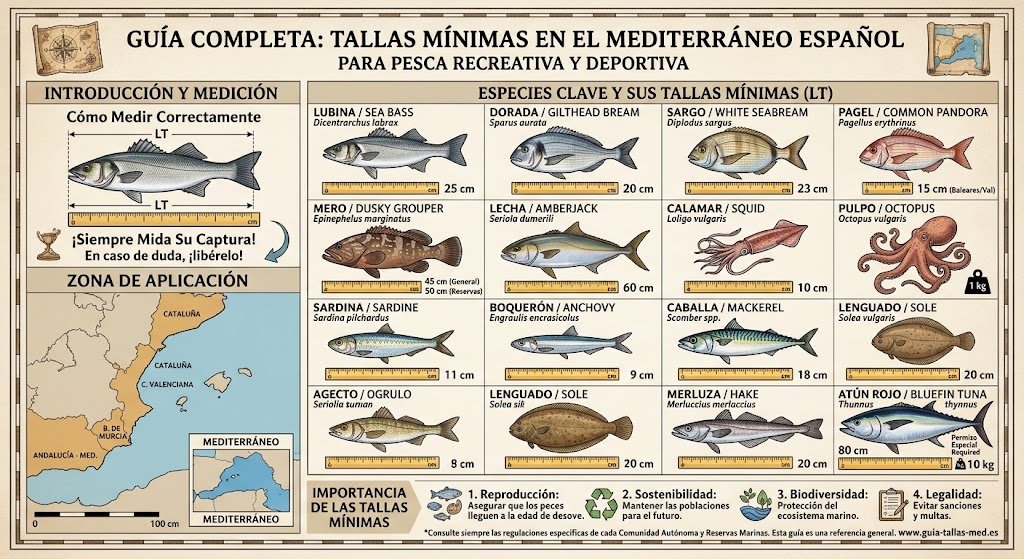
The following table presents the most current minimum sizes for species commonly targeted by recreational sea anglers on Costa Blanca and the wider Mediterranean coast of Spain. Sizes are total length (tip of snout to end of tail fin) unless otherwise specified.

SpeciesSpanish NameMinimum Size
Gilthead SeabreamDorada (Sparus aurata)20 cm
European Sea BassLubina (Dicentrarchus labrax)25 cm
Dusky GrouperMero (Epinephelus marginatus)45 cm
Common DentexDentón (Dentex dentex)25 cm
Atlantic BonitoBonito (Sarda sarda)30 cm
Little TunnyMelva (Euthynnus alletteratus)30 cm
European AnchovyBoquerón (Engraulis encrasicolus)9 cm
European PilchardSardina (Sardina pilchardus)11 cm
Common SoleLenguado (Solea solea)24 cm
Red MulletSalmonete (Mullus surmuletus)11 cm
Greater AmberjackServiola (Seriola dumerili)70 cm
European SquidCalamar (Loligo vulgaris)10 cm (mantle length)
Common CuttlefishSepia (Sepia officinalis)10 cm (mantle length)

Species Subject to Zero-Retention Rules: Bluefin Tuna

Atlantic Bluefin Tuna (Thunnus thynnus) — known in Spain as Atún Rojo — is subject to some of the most stringent restrictions in Mediterranean fishing regulations. Bluefin populations in the Mediterranean suffered catastrophic commercial over-exploitation through the 1990s and early 2000s, falling to less than 20% of their historical abundance. EU-mandated recovery plans implemented since 2010 have produced genuine population recovery, but recreational fishing access remains highly restricted.

For recreational anglers in Spain:

  • Zero retention is the default rule: Recreational anglers fishing without a specific catch-and-release authorisation (Annex III permit, issued annually in limited numbers by the Secretaría General de Pesca) may not retain or kill any Atlantic Bluefin Tuna, regardless of size.
  • Accidental capture: If a Bluefin Tuna takes your bait while you are legitimately targeting other species, you must release it immediately and carefully. Document the catch photographically if possible and report it via the Sistema de Información de Pesca Recreativa.
  • Organised recreational Bluefin tournaments require specific national and EU authorisation and are subject to strict reporting requirements including mandatory observer presence on vessels.

The Overall Bag Limit: How Much Can You Keep?

Spanish recreational sea fishing regulations impose a daily bag limit of 5 kilograms per person per day plus one additional piece (the ‘one piece’ allowance accounts for a large fish that would push the total over 5 kg if retained whole). This bag limit applies to the combined total of all species retained — it is not a per-species limit.

Specific species may have additional individual limits. Sea bass (lubina) is limited to 3 fish per day per angler on the Atlantic coast — check current regulations for Mediterranean-specific bass limits as these have changed in recent years.

Catch and Release Best Practices in Mediterranean Conditions

Warm Mediterranean water temperatures — particularly from July through September when surface temperatures exceed 25°C — significantly reduce the survival rates of released fish if they are handled improperly. Dissolved oxygen content decreases as water temperature rises, meaning fish already stressed from the fight have less oxygen available for recovery. Best practices for responsible release in warm Mediterranean summer conditions:

  • Minimise fight time: Use adequately strong tackle to land fish quickly. Prolonged exhaustion depletes lactic acid buffers and increases post-release mortality dramatically.
  • Keep the fish in the water during hook removal wherever possible. Lip-grip tools allow hook removal and a brief vertical hold without fully extracting the fish from the water.
  • Wet your hands before handling any fish to avoid removing the protective mucus layer that defends against infection.
  • Never release a fish by dropping it from height — lower it gently to the water surface, hold horizontally, and allow it to swim away under its own power.
  • Deep-water catch-and-release: Fish caught from depths exceeding 20 metres suffer from barotrauma (swim bladder expansion due to pressure change). Do not release deep-caught fish that float on the surface — use a release weight (a device that takes the fish back to depth where it can re-equilibrate) for best survival outcomes.

Inspections and Penalties

Guardia Civil SEPRONA (environmental protection officers) conduct both on-the-water checks and inspections at marina arrivals. Anglers returning to marina quays with fish on board should be prepared to present their fishing license and allow inspection of their catch for size compliance. Officers have the authority to measure all retained fish and issue on-the-spot fines for undersized specimens.

Penalties under Spanish maritime recreational fishing law:

  • Minor infraction (undersized fish, minor gear violation): €150–1,500 fine
  • Serious infraction (significant bag limit excess, prohibited gear use): €1,500–15,000 fine
  • Very serious infraction (prohibited species retention, deliberate harm to protected marine species): €15,000–150,000 fine and potential criminal prosecution

🧭 GUIDE & FAQ: Minimum Fish Sizes in Spain

Q1: Where do I measure the fish — from where to where?

Total length is measured from the tip of the snout (closed mouth, fish lying flat) to the longest point of the tail fin (with the tail fin closed in its natural position, not spread). For cephalopods (squid, cuttlefish), mantle length is measured from the posterior end of the mantle to the anterior edge, not including the tentacles. Carry a simple folding fish ruler on every fishing trip.

Q2: Are minimum sizes the same along all Spanish Mediterranean coasts?

National and EU baseline minimums apply throughout Spanish Mediterranean waters. However, regional governments (Generalitat Valenciana, Region de Murcia, Catalonia) may impose stricter local protections for certain species or in certain marine protected areas. Always check regional rules for the specific autonomous community where you are fishing. Regional fishing regulations are available from the respective regional fisheries departments and in most large Spanish fishing tackle shops (tiendas de pesca).

Q3: Can I photograph and release a species like grouper or dentex without a license?

Yes. Catch-and-release fishing in Spain is legal and does not require special authorisation (except for Bluefin Tuna, which requires Annex III permit even for touch-and-release). You do need a recreational fishing license (Clase 2 for boat fishing) regardless of whether you retain your catch or not. See our detailed guide on getting a sea fishing license in Spain for the application process.

Q4: Are there protected marine reserves near Torrevieja where fishing is restricted?

Yes. The Reserva Marina de la Isla de Tabarca (established 1986) is Spain’s oldest marine protected area and has specific zones where recreational fishing is restricted or prohibited. The internal reserve zone around the island core prohibits all fishing. The buffer and general regulation zone allows recreational fishing but with stricter size limits and gear restrictions than the open sea. Always obtain the current reserve regulations before fishing near Tabarca. Other marine reserves exist along the Alicante coast — check the Spanish Ministry of Agriculture and Fisheries website for current boundaries and restrictions.

Q5: What happens if I accidentally keep an undersized fish without realising it?

If you discover a fish in your catch that is below minimum size before inspection, return it to the sea immediately. If an inspector finds an undersized fish during a check, cooperating fully and demonstrating genuine unawareness generally influences the outcome — inspectors in Spain have discretionary authority on minor infractions. However, the legal obligation is clear: any undersized fish must be released immediately. Ignorance of the regulations is not a legal defence. Carry a fish ruler and check every fish before placing it in your cooler.

For more sea fishing guides in Spain, explore the FreeWIND Sea Fishing section. For nautical and maritime services on the Costa Blanca, visit seamen.es.
Boat Maintenance & Winterizing in Spain Guide

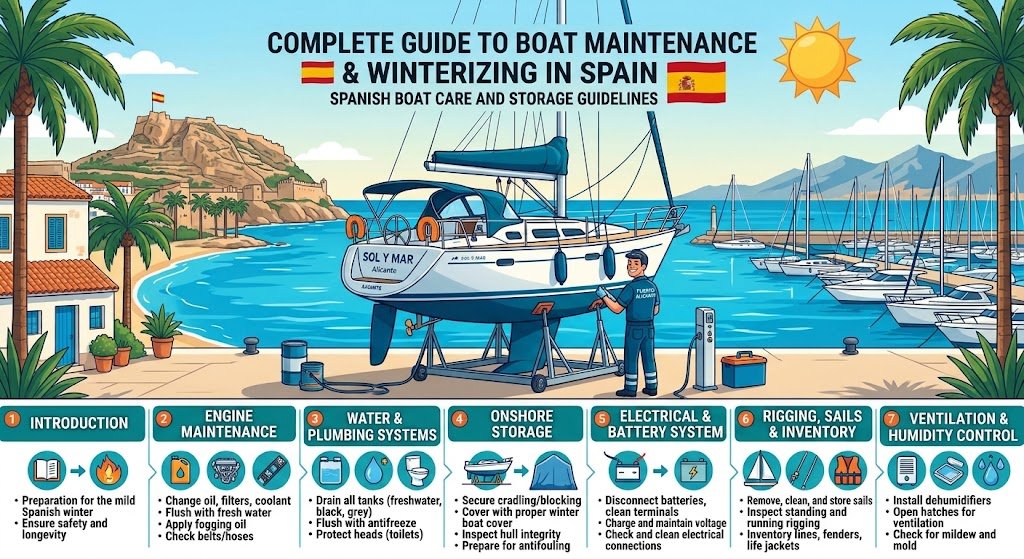
Owning or regularly using a boat in the Mediterranean presents unique maintenance challenges that differ fundamentally from freshwater or cold northern European environments. The combination of high salinity, intense UV radiation, warm water temperatures that accelerate biological growth, and extended summer operating seasons creates a demanding environment for every component from the engine to the hull antifouling. This comprehensive guide covers boat maintenance in Mediterranean Spain, from the specific corrosion threats unique to the Alicante and Murcia coastlines to practical winterising approaches, marina storage options, and the annual maintenance schedule that keeps Mediterranean boats performing safely and reliably.

Understanding Mediterranean Saltwater Corrosion

The Mediterranean Sea has an average salinity of approximately 38 parts per thousand (ppt) — significantly higher than the Atlantic (approximately 35 ppt) due to the near-enclosed basin’s high evaporation rate and limited freshwater inflow. This elevated salinity accelerates electrolytic and galvanic corrosion in all metal components below and above the waterline.

The specific corrosion mechanisms affecting Mediterranean boats include:

  • Galvanic corrosion occurs when two dissimilar metals are in electrical contact in a saltwater electrolyte. The most common example on a Mediterranean day boat: an aluminium outboard engine bracket paired with a stainless steel transom fitting. The aluminium dissolves as the ‘sacrifice’ metal in the galvanic couple.
  • Crevice corrosion attacks fittings, bolts, and hardware where saltwater can penetrate narrow gaps and become trapped — particularly common in bilge areas, under cleats, and behind instrument panels where ventilation is poor.
  • Salt spray above the waterline attacks aluminium windscreen frames, stainless steel railings, electrical connectors, and painted surfaces. Boats moored in marinas with prevailing afternoon sea breezes accumulate salt deposits rapidly on deck fittings.

Engine Flushing: The Most Important Routine Maintenance Task

For outboard and sterndrive engines — the most common powerplants on day boats and RIBs along Costa Blanca — flushing with fresh water after every use is the single most impactful maintenance action you can take. Salt crystals left in engine cooling passages, water pump impellers, and thermostat housings cause progressive restriction of cooling flow, leading to overheating damage that can write off an engine.

Outboard Engine Flushing Procedure

The standard procedure for most modern outboards (Yamaha, Mercury, Honda, Suzuki, Evinrude/BRP):

  1. Connect a garden hose to the engine’s fresh water flush port (most modern outboards have a dedicated flush connection on the engine body or lower unit) or use earmuff-style flushing cups placed over the lower unit water intakes.
  2. Turn on the fresh water supply to provide strong flow.
  3. Start the engine and run at idle for 5–8 minutes. Confirm a steady stream of water exits the engine’s water tell-tale (the thin stream of water that should pour from a small hole above the propeller when the engine runs).
  4. Shut off the engine, then the water supply.
  5. While the engine is still warm, spray an engine corrosion protector (CorrosionX, Boeshield T-9, or similar) into the carburetor air intake and over all external metal surfaces.

This procedure takes 10 minutes and should happen after every single use in salt water. Skipping even occasional post-use flushes allows salt deposits to build progressively in internal passages.

Sacrificial Anodes: Essential Galvanic Protection

Sacrificial anodes (also called ‘zincs’, though modern high-performance anodes use aluminium-indium-zinc alloys rather than pure zinc) protect the more valuable metal components of your drive system by providing a more reactive metal for galvanic corrosion to consume first. Anodes must be replaced regularly — once consumed beyond 50% of their original mass, they provide insufficient protection.

On a typical outboard motor, anodes are located on:

  • The cavitation plate (just above the propeller)
  • The trim tabs (on either side of the lower unit)
  • The mounting bracket (on bracket-mounted engines)
  • The transom plate (transom-mounted engines)

In the warm, high-salinity Mediterranean, anodes typically require replacement every 6–12 months rather than the 12–18 month cycles common in colder, lower-salinity Atlantic environments. Inspect anodes every 3 months and replace when they reach 50% consumption.

Critical tip for Mediterranean mooring: If your boat is permanently moored in a marina (afloat, not dry), shore power connections introduce stray current that dramatically accelerates anode consumption. Boats on shore power may require quarterly anode replacement. Invest in a galvanic isolator for your shore power connection to minimise this accelerated consumption.

Antifouling Paint: Schedule and Product Selection

The Mediterranean’s warm water temperatures support prolific biological growth on boat hulls: barnacles, mussels, tube worms, algae, and various encrusting organisms. Without antifouling bottom paint, a hull left in the water for one Mediterranean summer will accumulate 3–5 cm of biological fouling that dramatically increases drag, reduces speed by 20–40%, and creates habitats for electrolytic corrosion.

For Mediterranean conditions, self-polishing copolymer (SPC) antifouling paints provide the most effective long-term protection. Recommended products for the Costa Blanca environment:

  • International Micron Extra (self-polishing, biocide-rich, excellent for hot Mediterranean waters)
  • Hempel Antifouling Classic (widely available in Spanish chandleries, cost-effective)
  • Seajet 034 Shogun (hard matrix, suitable for boats that spend periods out of the water during winter)

Apply antifouling annually for boats permanently moored. For boats on dry storage over winter, the annual slipway visit provides the opportunity for proper hull inspection, antifouling application, and anode replacement. Most Spanish marinas have haul-out facilities — Club Náutico Santa Pola, Marina Salinas (Torrevieja), and Puerto de Guardamar all offer boat haul-out and dry storage services.

Winterising vs. Year-Round Operation in Spain

Unlike northern European boating environments where October signals the end of the season and full winterisation is mandatory, the Mediterranean Costa Blanca climate allows extended operating seasons. Many boaters use their vessels through November and December on settled weather days, and some small boat operators use their craft year-round.

For those who do take their boat out of active use over winter, the following procedures protect against the specific threats of the Mediterranean winter environment:

  • Fresh water flush all engine cooling circuits thoroughly.
  • Fog internal engine cylinders with storage oil (spray through spark plug holes after removing plugs).
  • Fill the fuel tank to 90% capacity to prevent condensation build-up in the tank, and add a fuel stabiliser (Star Tron, Techron Marine, STA-BIL) to prevent petrol degradation.
  • Remove and fully charge the battery, store in a cool, dry location, and connect to a smart maintenance charger to prevent sulphation.
  • Cover the boat with a well-ventilated custom cover or breathable canvas — not plastic sheeting, which traps moisture and accelerates mould growth in Mediterranean humidity.
  • Treat all upholstery with mildew protector — cockpit cushions and helm seats are particularly vulnerable to mildew in the mild, humid Mediterranean winter.

Marina Storage Options on Costa Blanca

Two primary storage approaches are available in the Alicante and Murcia region:

Wet Berth (Afloat Mooring)

Your boat remains in the water year-round at a marina pontoon. This is the most convenient option — the boat is always ready to use — but requires proactive antifouling maintenance and accelerated anode replacement due to permanent immersion. Marina berth costs on Costa Blanca range from approximately €150–600/month for a 6–8 metre day boat at facilities like Marina Salinas (Torrevieja) or Puerto de Guardamar, depending on beam, location in the marina, and services included.

Dry Stack (Marina Seca)

Dry stack storage involves keeping the boat ashore in a secure, racked storage facility. A forklift launches and retrieves the boat when needed — typically within 30 minutes of notification. Dry stack dramatically reduces antifouling costs (hulls require antifouling less frequently when not permanently immersed), eliminates anode acceleration from stray current, and reduces osmotic blistering in fibreglass hulls. Several facilities in the Alicante region offer dry stack services — the team at seamen.es can provide current recommendations for dry storage facilities in the Torrevieja and Santa Pola area.


🧭 GUIDE & FAQ: Boat Maintenance in Mediterranean Spain

Q1: How often should I service my outboard engine in Mediterranean conditions?

Follow the manufacturer’s service intervals (typically 100 hours or annually for the primary service), but in Mediterranean conditions, an annual pre-season service is essential regardless of hours used. The service should include: water pump impeller replacement (every 2 years minimum in Mediterranean heat), spark plug inspection and replacement, gearbox oil change (vital — saltwater ingress through the propeller shaft seal contaminates gearbox oil, which appears milky-white when water contamination is present), fuel filter replacement, and a full check of all anodes.

Q2: My hull has osmotic blisters. Is this serious and can it be repaired?

Osmotic blistering affects fibreglass (GRP) hulls when water permeates the outer gelcoat and reacts with materials within the laminate, creating blisters filled with acidic fluid. In warm Mediterranean water, this process is faster than in cold northern waters. Small blisters (under 5mm) are cosmetic. Larger or numerous blisters indicate genuine osmosis that requires professional treatment: haul the boat, remove antifouling, open and dry all blisters, apply multiple coats of epoxy barrier coat after full drying, and re-antifoul. Do not ignore extensive blistering — severe osmosis compromises laminate structural integrity.

Q3: How do I prevent mould on boat upholstery during the Spanish winter?

Mediterranean winters are mild but humid. Mould thrives in warm, damp, poorly ventilated spaces — exactly what a covered boat cockpit becomes. Prevention: remove all cushions and store indoors (or in breathable mesh bags) during periods of non-use. Treat remaining fabric with marine mildew inhibitor spray. Keep the boat cover well-ventilated (ridge-tent-style covers work better than flat tarps that pool moisture). Leave lockers and hatches slightly ajar to allow airflow through the interior. A moisture-absorbing product (Damp Rid, silica gel containers) inside the cabin significantly reduces humidity.

Q4: What should I do if my engine overheats on the water?

Stop immediately if the engine overheat warning alarm sounds or the tell-tale stream of cooling water stops. Running an overheated outboard even briefly can cause permanent damage (warped cylinder heads, melted pistons). Shut off the engine, let it cool for 20–30 minutes (do not cool with seawater — thermal shock risk), then check the tell-tale with engine running. Most outboard overheat issues in Mediterranean summer are caused by plastic bags, seagrass, or jellyfish (common in Mediterranean summer) blocking the water intake. Inspect and clear the intake before restarting. If the problem persists, call for assistance via 112 or Salvamento Marítimo on VHF Channel 16.

Q5: Are there qualified marine mechanics on Costa Blanca for outboard servicing?

Yes. The major marinas (Santa Pola, Torrevieja, Guardamar, Denia, Alicante) all have marine mechanic workshops or relationships with certified mobile marine technicians. Authorised service centres for the major outboard brands (Yamaha, Mercury, Suzuki, Honda) are present in the Alicante and Murcia region. For recommendations on reputable marine mechanics and boat maintenance services on Costa Blanca, the nautical services team at seamen.es maintains relationships with vetted professionals across the region and can connect you with the right expertise for your engine and hull type.

Explore more boating guides for the Mediterranean at FreeWIND Motor Boats. For professional nautical services, boat management, and maritime support on Costa Blanca, visit seamen.es.
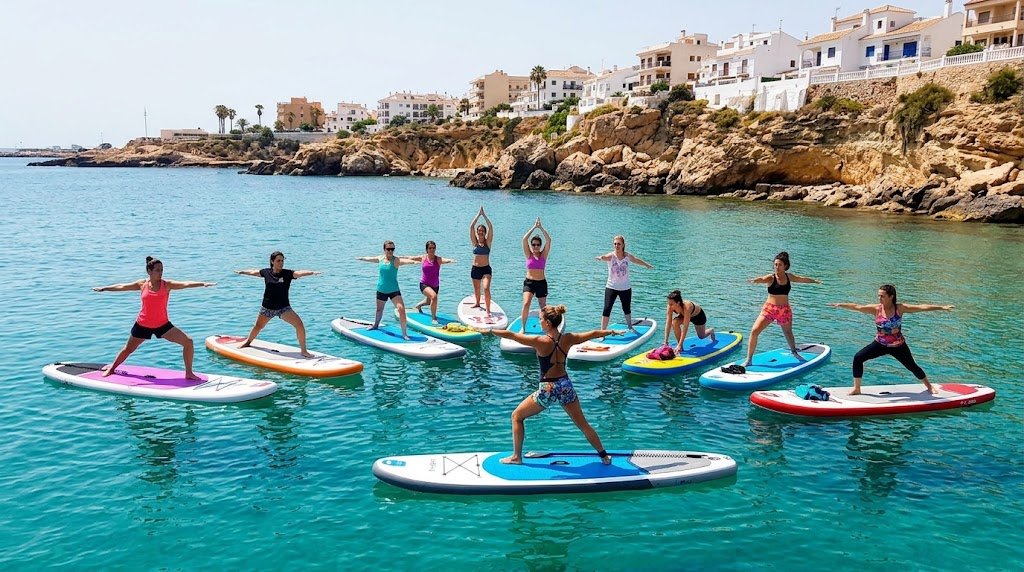
SUP Yoga & Fitness on the Mediterranean Spain

The idea of practising yoga on a paddleboard sounds like a social media trend — pretty photos for Instagram, perhaps, but not something with genuine physical or mental substance. That assumption, held widely until you try it, evaporates within approximately two minutes of attempting your first Downward Dog on an inflatable SUP floating on the Mediterranean. The subtle, constant micro-adjustments your body makes to maintain balance engage muscle systems that a gym mat never accesses. SUP yoga on the Mediterranean in Spain is one of the most complete and genuinely therapeutic fitness practices available to anyone living near the Costa Blanca coast.

Why the Mediterranean is Perfect for SUP Yoga

The Mediterranean’s characteristically calm morning conditions — particularly between June and October — create near-ideal conditions for water yoga. Unlike Atlantic or Pacific swells that create a constant pitching motion, the Mediterranean morning sea is often so flat that the primary instability comes from your own body movement, not external wave action. This means you can control the challenge level precisely: early poses can be practised in near-perfect stability, while advancing practitioners can seek out gently rolling anchorages or post-sea-breeze chop for additional balance challenge.

The warm water temperature (24–27°C in summer) eliminates the fear of falling. Unlike cold-water environments where an unexpected dip creates an immediate physical shock, Mediterranean falls from a SUP board are simply a refreshing interruption. This psychological comfort fundamentally changes your relationship with balance practice — you commit more fully to challenging poses when you know the consequence of falling is a pleasant swim, not a hypothermic shock.

Choosing the Right Board for SUP Yoga

Not all paddleboards are suitable for yoga practice. The key parameters differ from those prioritised for racing or touring:

  • Width: Minimum 32 inches (81 cm), ideally 34–36 inches. A wider board provides a dramatically more stable platform. High-performance narrow touring boards (28–30 inches) require extraordinary balance for yoga practice.
  • Length: 10′ to 11′ for yoga-focused all-around boards. Longer touring shapes are less manoeuvrable in wind and harder to maintain stationary.
  • Deck pad: Full-length EVA deck pad (covering the entire board, not just the central standing area) allows you to place hands, knees, and feet anywhere on the board surface without slipping on bare fibreglass or PVC.
  • Volume: High-volume boards (above 250 litres) provide better stability for the weight distribution shifts that yoga involves. Standard all-around touring boards are typically designed around a standing paddler’s centre of mass — yoga moves that shift weight toward the nose or tail can unbalance a low-volume performance board.
  • D-rings for anchoring: Front and rear D-rings allow attachment of an anchor line or mooring buoy cord. Being able to hold position while practising is important for focus and safety.

Anchoring Your Board for Stationary Practice

Unlike paddling sessions where movement is the goal, yoga practice requires your board to remain stationary or nearly so. Two practical solutions work well in Mediterranean coastal waters:

Folding Grapnel Anchor

A small folding grapnel anchor (1–1.5 kg) on 10–15 metres of light braided line works well in the sandy-bottom bays common on Costa Blanca. The anchor holds the board against gentle current and light wind drift. When deploying, check the depth (3–6 metres is ideal) and confirm you are anchoring on sand, not on Posidonia seagrass meadows — which are legally protected and must never be damaged by anchors. The anchor stores neatly in a small bow hatch or bungee-strapped to the board.

Ecological Mooring Buoys

Several popular coves on Costa Blanca (including sections of Cala Ferris and areas near Santa Pola) now have ecological mooring buoys (small blue or white balls) installed to prevent anchor damage to Posidonia. These buoys are accessible to all watercraft including SUP boards. Simply attach your board’s D-ring to the buoy via a short length of rope or caribiner, and you have a stable, environmentally responsible mooring point for your yoga session. Mooring priority goes to visiting boats, so if a boat needs the buoy, politely yield and relocate.

5 Foundational Poses for SUP Yoga on the Mediterranean

1. Child’s Pose (Balasana)

Begin every on-water yoga session here. Kneeling with knees wide and big toes touching, lower your chest and forehead to the deck pad, arms extended forward. This pose is extremely stable (your weight is distributed low and centrally), calming, and grounds you into the rhythm of the water’s gentle movement beneath you. Hold for 60–90 seconds, breathing deeply. The Mediterranean’s natural rocking motion massages your lower back and hips in a way that floor-based Child’s Pose cannot replicate.

2. Downward Facing Dog (Adho Mukha Svanasana)

From Child’s Pose, push up to Downward Dog with hands at the nose end of the board and feet toward the tail. The inverted-V position of the body shifts considerable weight forward — your board will respond by tipping slightly nose-down. Focus on pressing firmly through all ten fingers and toes, distributing weight evenly. Pedalling each foot alternately stretches the calves and hamstrings. This pose builds confidence with the board’s dynamic response to weight shifts. Advanced: lift one leg into Three-Legged Dog.

3. Warrior II (Virabhadrasana II)

Standing poses are the signature challenge of SUP yoga. Stand in the centre of the board, step one foot forward and one back (hip-width apart for stability), bend the front knee to 90 degrees, and extend arms wide — front arm pointing toward the nose, back arm toward the tail of the board. Gaze over your front hand. The lateral weight shift of Warrior II challenges your board’s roll stability significantly — engage your core actively and keep your gaze fixed on a point on the horizon. The expansive Mediterranean view from Warrior II at sunrise is extraordinary.

4. Cat-Cow (Chakravakasana)

One of the gentlest and most beneficial spinal mobilisation sequences, Cat-Cow on a paddleboard adds a proprioceptive challenge that makes the movement far more effective than floor practice. On all fours (tabletop position), inhale and let your belly drop toward the board (Cow), lifting your head and tailbone. Exhale and press your spine toward the sky (Cat), dropping your head and tailbone. The board’s response to your breathing and spinal movement creates a fascinating biofeedback loop that dramatically increases body awareness.

5. Savasana (Corpse Pose / Final Relaxation)

End every session lying flat on your back, arms slightly away from the body, eyes closed. On a paddleboard on the Mediterranean, this is genuinely transcendent. The gentle rocking of the water beneath you, the warmth of the morning sun, the sound of small waves lapping the board edges, and the vast blue sky above create a sensory environment that mat-based Savasana cannot approach. Remain here for 5–10 minutes. Your body temp drops rapidly when inactive — if the morning air is cool, have a towel ready to cover yourself. This is the pose that converts casual fitness paddlers into dedicated SUP yoga practitioners.

Best Sheltered Bays for SUP Yoga on Costa Blanca

Location matters enormously for yoga practice. Exposed stretches with boat traffic, afternoon chop, or strong current are unsuitable. The following sheltered bays on Costa Blanca offer ideal conditions for anchored SUP yoga sessions:

  • Cala Ferris (Torrevieja): Sheltered from prevailing NE winds by the headland, sandy bottom suitable for lightweight grapnel anchoring, and one of the most beautiful natural settings on the coast. Arrive before 08:00 AM for guaranteed flat water.
  • Inner bay, Playa Flamenca (Orihuela Costa): A calm, sheltered sandy bay with very gentle conditions suitable for beginners to SUP yoga. Boat traffic is minimal early morning.
  • Mar Menor, La Manga: The sheltered lagoon offers zero swell, warm water, and shallow depth (<3m) making it the safest location for beginners. Anchor or simply allow gentle drift in the wide, calm lagoon.

🧭 GUIDE & FAQ: SUP Yoga on the Mediterranean

Q1: Do I need yoga experience to try SUP yoga?

No yoga experience is necessary. However, some basic familiarity with pose names and cues makes instruction easier if you’re following an online video. Total beginners often find that starting with grounding poses (Child’s Pose, Cat-Cow, seated twists) builds confidence before attempting standing poses. Paddleboarding experience, similarly, is not required — you can practise yoga on a board in ankle-deep water near the shore if you’re not yet confident on open water.

Q2: What should I wear for SUP yoga on the Mediterranean?

In summer (June–September), swimwear or a rash vest and board shorts are ideal. The deck pad grips bare skin and bare feet far better than socks or yoga pants, which can slip. In spring and autumn, a 2mm shorty wetsuit keeps you warm during the inactive periods of the session (particularly in Savasana). Always apply waterproof SPF 50+ sunscreen — you are horizontal, face-up, at high elevation relative to the water surface, exposed to direct and reflected UV radiation simultaneously.

Q3: How do I get back on the board after falling in?

Approach the board from the side (never the nose or tail, as these are the most unstable re-entry points). With one hand on the centre handle and your body horizontal in the water, kick your legs to generate momentum and pull yourself up onto the board in one smooth movement, ending in a prone (face-down) position. From there, push up to hands and knees. Practice this re-entry technique in shallow water before attempting it in deep water — it requires no strength but benefits significantly from practice.

Q4: Can I follow a yoga video during a SUP session?

Yes, with a waterproof phone holder or a bluetooth speaker on your board. Several YouTube channels and apps (Yoga by Adriene, SUP Yoga with Sydney Malseed, Down Dog app) offer sessions adaptable for paddleboard use. Alternatively, record yourself practising poses to analyse alignment later — a GoPro or action camera mounted on a board nose mount provides useful self-coaching footage. Keep devices in waterproof cases — Mediterranean saltwater corrodes electronics rapidly.

Q5: Are there SUP yoga classes or instructors on Costa Blanca?

SUP yoga is growing rapidly in popularity along the Costa Blanca. Several beach yoga instructors now offer SUP yoga sessions at Torrevieja, Guardamar, and Calpe. The FreeWIND community occasionally organises group SUP yoga mornings — follow our blog and social channels for upcoming events. For broader water sports activity connections across the region, including organised sea activities and club sessions, visit seamen.es.

Explore more Costa Blanca paddleboarding content in our SUP & Surfing section. For all things nautical on Spain’s Mediterranean coast, visit our partners at seamen.es.

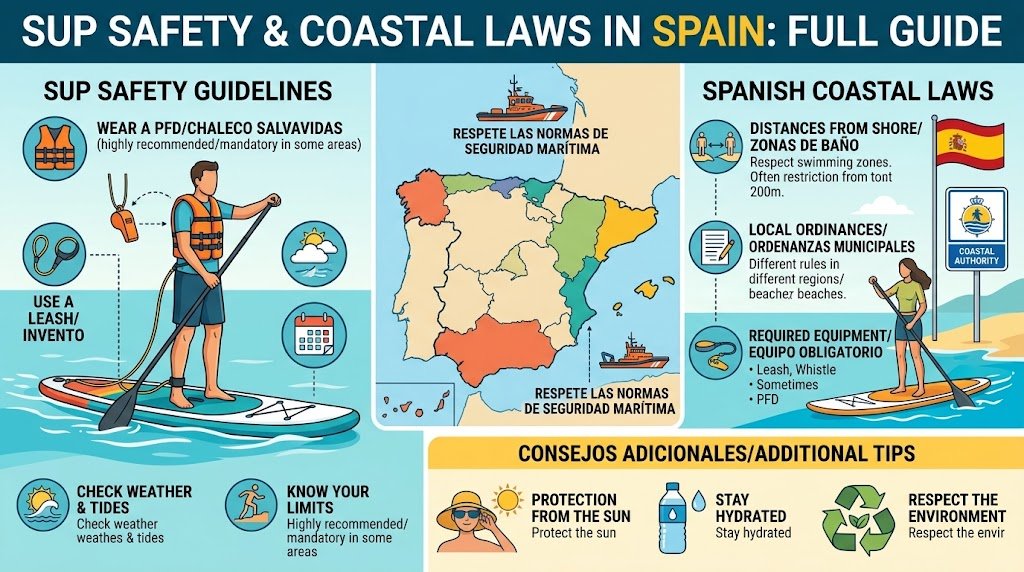
SUP Safety & Coastal Laws in Spain: Full Guide

If you paddle a Stand Up Paddleboard beyond the swimming zone on Spain’s Mediterranean coast, you are operating a watercraft subject to Spanish maritime law. Understanding the legal framework is not bureaucratic box-ticking — it determines whether you can be rescued effectively, whether your travel insurance covers you if you’re injured, and whether you face fines in the increasingly common maritime police checks that take place on busy summer days. This guide covers SUP laws in Spain comprehensively, from the legal classification of your board to the precise safety equipment required and the geographic zones where different rules apply.

The Legal Status of SUP Boards in Spain

Spanish maritime law has historically been ambiguous about paddleboards, and this ambiguity has caused considerable confusion. The legal situation as of 2024 is as follows:

Within the 200-metre coastal swimming zone: SUP boards are treated as swimming/bathing aids (artefactos flotantes de uso recreativo). No maritime regulations apply beyond basic swimming rules. Lifeguards supervise this zone and may ask you to leave if you are creating a hazard for swimmers.

Beyond the 200-metre swimming zone: SUP boards are increasingly classified under the category of embarcación de recreo (recreational vessel) — specifically within the subcategory of non-motorised craft. Under this classification, the General Regulation on Recreational Boating (Real Decreto 875/2014) applies, though its application to human-powered craft is not fully codified in all autonomous communities.

What this means practically: Maritime police (Guardia Civil Mar, Carabinieri Marítima) in Alicante and Murcia regions do conduct checks on paddleboarders beyond the swimming zone, and fines have been issued for absence of required safety equipment.

The 200-Metre Beach Zone: Rules and Consequences

Spain’s coastal safety regulations establish a 200-metre exclusion zone from bathing beaches for motorised craft. This zone is marked by yellow buoys arranged in a cordon extending from beach ends and around the swimming area. Within this zone:

  • Motorised vessels are prohibited (with narrow exceptions for emergency services and authorised operations).
  • Non-motorised craft including SUP boards, kayaks, and windsurfers may navigate, but must give way to swimmers at all times and maintain a safe distance.
  • A separate 50-metre zone from rocky shorelines (not beaches) is also defined — motorised craft must stay 50 metres clear of rocky coastal sections, but again, SUP and human-powered craft are not restricted by this.

The practical implication for paddleboarders launching from a beach: you must paddle through the swimming zone carefully, giving absolute right of way to all swimmers, before reaching open water. Do not paddle at speed through crowded bathing areas. Beach wardens and lifeguards have authority to stop and redirect paddleboarders who are creating hazards within the swimming zone.

Mandatory Safety Equipment for SUP Beyond the Swim Zone

Based on the current interpretation and enforcement patterns in the Alicante and Murcia regions (where FreeWIND community members have direct experience with maritime police checks), the following safety equipment is expected for paddleboarders operating beyond the 200-metre zone:

1. Personal Flotation Device (PFD) / Life Jacket

A certified buoyancy aid or life jacket must be carried aboard (i.e., on your board, on your person, or in a deck bag). The requirement is to have it available, not necessarily to wear it at all times, though wearing it is strongly recommended. The CE-certified minimum is 50N buoyancy for recreational use in sheltered coastal waters, though 100N life jackets providing greater protection are recommended for open water and offshore conditions. SUP-specific inflatable PFDs (worn as a belt or in a minimal vest) are widely used by experienced paddlers and satisfy the legal requirement.

2. Ankle Leash

While not specified in national legislation, the maritime police in several regions treat a leash as a fundamental safety requirement for SUP. The leash serves as your connection to your board — your largest buoyancy aid. In offshore wind, a paddler separated from their board by even 10 metres cannot swim back against the breeze before exhausting themselves. A coiled leash for sea paddling (to prevent tangling with seaweed and rocks) or a straight leash attached to your ankle or calf is essential.

Important coiled vs. straight leash guidance: Coiled leashes are recommended for SUP on the Mediterranean as they keep the cord out of the water and away from propellers, rocks, and kelp. Use the same length as your board (10′ board = 10′ leash maximum). For big surf or areas with underwater obstacles, a quick-release waist leash allows you to detach from a sinking board in an emergency.

3. Sound Signalling Device

Under maritime collision regulations (COLREGS), any vessel — including non-motorised craft — operating in restricted visibility must be capable of making sound signals. A simple sports whistle attached to your PFD satisfies this requirement. An aerosol horn (available for under €5 at chandleries) carries much further in an emergency.

4. Visual Distress Signal (Recommended)

For coastal paddling beyond 500 metres from shore, a waterproof mobile phone in a float-equipped case serves as your primary emergency communication device. The Salvamento Marítimo maritime rescue service (reachable on VHF Channel 16 or via phone 900 202 202) is active 24/7 on Spain’s coasts. A small mirror for daytime signalling is an inexpensive backup. Proper maritime flares require licences in Spain and are impractical for SUP — a waterproof high-lumen flashlight or LED signal device is the practical alternative.

Night Paddling Rules in Spain

Night paddling — or twilight/dawn paddling before full nautical daylight — is subject to additional requirements. Any vessel (including SUP) operating between sunset and sunrise must display navigation lights: a white all-round light visible for 2 nautical miles is the minimum requirement for non-motorised craft under 7 metres. Practically, a high-lumen headlamp worn on your head satisfies this requirement, making you visible to approaching motorboats while allowing you to see ahead.

Many Costa Blanca paddlers do early dawn paddles starting before full daylight. In these conditions, a chest-mounted flashing red or white LED combined with reflective strips on your board and paddle provides excellent visibility to other water users.


🧭 GUIDE & FAQ: SUP Laws in Spain

Q1: Do I need a license to use a paddleboard in Spain?

No license or skipper qualification is required to operate a non-motorised SUP board in Spanish waters. This applies to all nationalities, ages (for adults — minors under 14 should be supervised in open water), and all types of SUP boards. The legal framework requires safety equipment beyond the swimming zone, but no formal training certificate or license. See also our article on boat licenses in Spain for comparison with motorised vessel rules.

Q2: Can I be fined for paddleboarding without a life jacket in Spain?

Yes, fines have been documented for paddleboarders stopped by maritime police (Guardia Civil Servicio Marítimo) operating beyond the 200-metre zone without a personal flotation device. Fines under Spanish maritime law for failure to carry mandatory safety equipment start at €300 for minor infractions. While enforcement specifically targeting SUP paddlers is not yet systematic, inspections are becoming more common in summer on the Costa Blanca and Costa del Sol. Carrying a PFD costs under €40 and eliminates this risk entirely.

Q3: Can I paddleboard anywhere on the Spanish coast, or are some areas restricted?

Most of Spain’s coastline is freely accessible to SUP paddlers, but several specific zones have restrictions: Marine reserves like the Reserva Marina de Tabarca have strict circulation restrictions for all watercraft (including SUP) within certain zones — check the reserve regulations before entering. Military exclusion zones (marked on nautical charts) prohibit entry by all vessels. Certain port and harbour approaches have designated shipping channels that small craft including SUP should avoid.

Q4: Does my travel insurance cover SUP activities in Spain?

Most travel insurance policies covering ‘watersports’ include non-motorised SUP. However, policies vary significantly — check whether your policy specifically excludes ‘extreme watersports’ (some define this loosely) and whether coverage requires you to be operating within the swimming zone or extends to open coastal waters. If you are paddling regularly or on longer coastal routes, a specialist watersports insurance policy or nautical club membership with third-party liability coverage is recommended. Seamen.es can advise on appropriate maritime activity insurance options in Spain.

Q5: Are electric SUP motors (eSUP) subject to different laws?

Yes, significantly. An electric-assist SUP (eSUP with a motor) is classified as a moto náutica or motorised recreational vessel in Spanish law, regardless of engine power. This brings the craft within the full scope of the Spanish recreational boating regulation (Real Decreto 875/2014), requiring a skipper’s license (minimum Licencià de Navegación / Titulín) for operation beyond the 200m zone, vessel registration, and third-party insurance. Using an electric SUP motor without complying with these requirements constitutes an offense. This is a rapidly evolving area of maritime law — check current guidance with the Dirección General de la Marina Mercante before purchasing or operating an eSUP in Spain.

For more practical guidance on water activities in Spain, explore the FreeWIND SUP section. For maritime legal and licensing questions, the team at seamen.es can provide expert nautical advice.

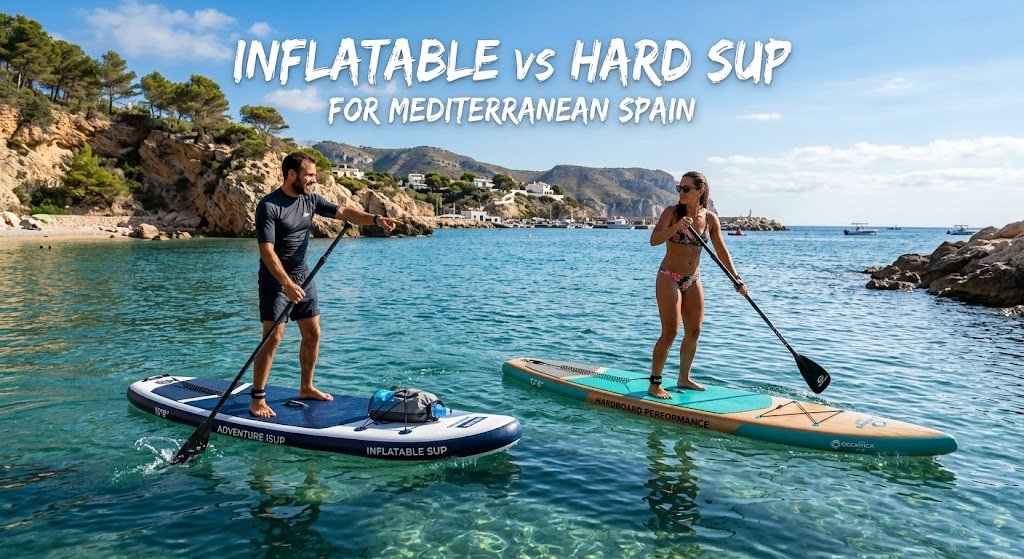
Inflatable vs Hard SUP for Mediterranean Spain

Choosing between an inflatable SUP (iSUP) and a hard paddleboard for use in the Mediterranean is one of the most important decisions any paddler makes — and the specific conditions of Spain’s rocky, sun-scorched coastline create unique requirements that differ significantly from, say, paddling on a calm lake or an Atlantic beach. This comprehensive guide covers every factor: durability against jagged limestone, PSI management under extreme Spanish summer heat, transport logistics along Costa Blanca, touring performance, and long-term maintenance.

The Case for Inflatable SUPs on Mediterranean Coasts

The Costa Blanca’s coastline is dramatically rocky. Cala Ferris, Cabo Cervera, Sierra Helada, and dozens of other prime paddling spots involve carrying your board over sharp limestone rocks, setting it into water where submerged boulders lurk close beneath the surface, and occasional contact with barnacle-encrusted harbour walls. For these conditions, modern high-quality inflatable SUPs have significant practical advantages.

Durability Against Rocky Mediterranean Shores

Quality inflatable SUPs from brands such as Red Paddle Co, Starboard, Fanatic, and Decathlon Itiwit use military-grade PVC dropstitch construction with double or triple-layer reinforced rails. When struck against a submerged rock at paddling speed, an inflatable board flexes and bounces — absorbing impact energy elastically. A hard epoxy/fibreglass board in the same scenario receives a direct blow to its rigid shell, which can chip, crack, or delaminate. On Costa Blanca’s rocky entries, this flexibility is a genuine safety advantage.

It is worth noting that cheap inflatable SUPs (under €200) use single-layer PVC that is markedly less durable. Invest in double-layer construction for Mediterranean coastal use. The additional €150–300 pays back quickly in avoided repair costs.

The Critical Issue: PSI and Spanish Summer Heat

This is perhaps the most important technical consideration unique to paddling in southern Spain. Mediterranean summers are brutal. Air temperatures in July and August regularly reach 35–40°C, and the black or dark-coloured top surface of a paddleboard — left in direct sun — can reach internal air temperatures of 50–60°C or higher.

Inflatable SUPs expand with heat according to basic gas physics (Gay-Lussac’s Law: pressure increases proportionally with temperature). A board inflated to the manufacturer’s maximum of 15 PSI at 20°C in the morning can reach 18–20 PSI if left deflated (sic: left inflated) in direct midday sun. Most quality boards have a design safety margin of 20–25 PSI before structural failure — but cheaper boards and older boards with fatigued seams are at risk of seam separation or valve failure at elevated pressures.

Critical practical tip for Spain: Never inflate your board to maximum PSI in the cool morning and then leave it in a parked car boot or on the beach in full sun. Either under-inflate by 2–3 PSI to leave a thermal expansion margin, or keep the board in shade and top up pressure at the water’s edge. Always carry a pressure gauge and check PSI before launching.

Transport and Portability

The practical logistics of getting a paddleboard to Costa Blanca’s scattered coves are dramatically different for inflatable and hard boards. An inflatable rolls into a backpack roughly the size of a large rucksack (typically 80cm x 40cm x 30cm, 8–12 kg) that fits in any car boot, overhead locker, or Spanish domestic flight cargo hold. This makes spontaneous road trips to different coastal spots — from Guardamar to Moraira to Benidorm — completely practical.

Hard boards require roof racks, van loading, or specialised transport. They cannot be brought on flights without substantial surcharges. Many Costa Blanca expats and visitors choose inflatables precisely because they can be packed into a hire car and transported to any spot along 200 km of coastline without logistics complications.

The Case for Hard SUPs in the Mediterranean

Hard boards — typically constructed from EPS foam cores wrapped in fibreglass, carbon fibre, or bamboo composites — have genuine technical advantages that no honest inflatable review can dismiss.

Performance: Speed, Glide, and Efficiency

A quality hard touring SUP (11’6″ to 14′) glides significantly more efficiently than an equivalent inflatable at equivalent paddle input. The rigid hull generates less water resistance, and each stroke propels you further. On flat Mediterranean water, an experienced paddler on a hard touring board covers the same 3 km route in 15–18 minutes that an inflatable takes 22–26 minutes to complete. Over a 6 km round trip, that efficiency saving matters enormously if you are racing a building sea breeze back to the launch.

For fitness paddlers, racers, or those covering long coastal distances, the hard board is the performance choice. The Benidorm Island circuit (8 km), the Santa Pola lighthouse traverse (6 km), and the open-water crossing to Tabarca from Santa Pola (8 km) are significantly more accessible and less exhausting on a hard touring board.

Stability and Weight Distribution

Modern inflatable SUPs inflated to 15+ PSI achieve rigidity figures of 98–99% of an equivalent hard board — meaning flex underfoot is barely perceptible. Stability in Mediterranean conditions (flat to 0.3m swell) is broadly comparable between quality iSUPs and hard all-arounds. However, in choppier conditions — such as the afternoon Levante sea state that Coast Blanca regularly produces — the slightly stiffer hard board provides marginally superior platform stability that experienced paddlers appreciate.

Durability Over Multi-Year Use

A quality fibreglass or carbon hard board, properly stored and maintained, lasts 10–15 years without significant performance degradation. Ding repairs are straightforward with epoxy resin kits. A quality inflatable, by contrast, typically shows seam fatigue, minor valve degradation, and reduced rigidity after 4–7 years of heavy use in hot Mediterranean conditions. The initial higher investment in a quality hard board may be superior value over a 10-year ownership horizon for a regular paddler.

Verdict: Which Is Better for Mediterranean Spain?

For the majority of Costa Blanca paddlers — visitors, expats without a permanent storage solution, casual-to-moderate paddlers exploring different coastal spots — a quality inflatable SUP is the practical choice. The transport flexibility, rocky-coast resilience, and easy storage outweigh the performance gap for most recreational users.

For resident performance paddlers with secure storage at a marina or home, covering long coastal distances regularly, or competing in local SUP races — a hard touring board is the performance choice. Invest in a proper storage solution (shade cover, padded rack system) to protect it from the harsh Mediterranean sun.


🧭 GUIDE & FAQ: iSUP vs Hard Board in Mediterranean Spain

Q1: Can inflatable SUPs actually puncture on Mediterranean rocks?

Very rarely, if using quality double-layer boards. Sharp barnacle clusters or acute limestone edges in very shallow water can abrade or puncture single-layer boards, but quality double-layer dropstitch iSUPs are extraordinarily robust. Dragging boards along rocky seabeds should be avoided regardless of construction type. Always launch in knee-deep water minimum and carry the board over dry rocks — do not drag it. Most punctures occur from dragging, not from impact in the water.

Q2: How do I safely manage PSI in Spanish summer heat?

Inflate to 12–13 PSI in the cool morning rather than the manufacturer maximum (usually 15 PSI). By the time you are on the water, ambient temperature will slightly top up the pressure. Avoid leaving your inflated board in a sealed car boot — temperatures can exceed 70°C inside a parked car in Spanish summer sun, which creates genuine valve and seam risk. Keep the board in shade when not on the water and carry a pressure gauge to monitor PSI.

Q3: Can I take an inflatable SUP on a Ryanair/Vueling flight to Spain?

Yes. Packed iSUPs (board rolled, pump removed, fins bagged) typically fit within standard checked luggage weight limits (20–23 kg). The rolled board in its bag usually measures 80x40x30 cm, fitting within most airlines’ oversized sports equipment policies at low or no additional charge when booked as sports equipment in advance. Hard boards cannot be transported on commercial flights.

Q4: Which brands offer the best quality-to-value ratio for Mediterranean conditions?

Premium tier: Red Paddle Co Ride 10’6″ (industry-standard quality, excellent heat tolerance), Starboard Touring Zen (exceptional glide for an inflatable). Mid-tier excellent value: Fanatic Diamond Air, Decathlon Itiwit Race 12’6″ (exceptional performance-to-price). For hard boards: Naish Nalu (all-around), JP Australia SuperLight (touring), SIC Maui Tao Air (inflatable-hard hybrid). Always buy from established distributors with local repair support in Spain.

Q5: How do I store a hard SUP at a Costa Blanca marina or beach house?

UV degradation is the primary threat to hard boards in Spain — constant direct sunlight breaks down epoxy resin and causes yellowing and delamination. Store your hard board in a padded bag or under a UV-resistant board sock whenever not in use. Wall-mounted horizontal foam cradle racks allow safe indoor storage in a garage or storage room. Many marinas on Costa Blanca offer secure board storage facilities — ask at Club Náutico Santa Pola, Marina Salinas (Torrevieja), or through seamen.es for marina storage recommendations.

For more SUP guides, route maps, and community tips on the Costa Blanca, browse the FreeWIND SUP section. For nautical services and maritime support in Spain, visit seamen.es.

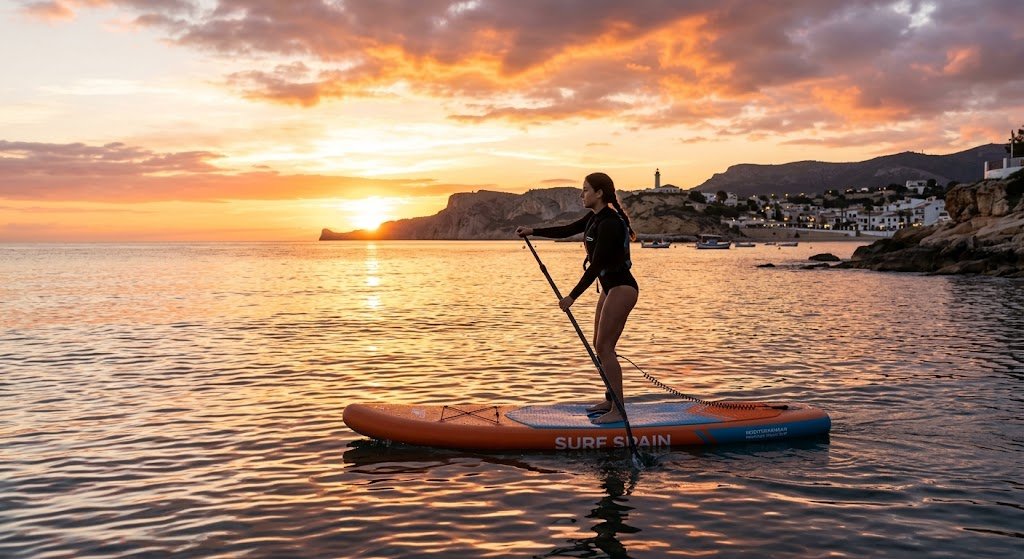
Sunrise SUP in Spain: Mediterranean Morning Magic

There is a moment on the Mediterranean that no photograph truly captures — the precise instant when the first orange light breaks over the Sierra del Cid mountains and sets the flat, glassy sea ablaze with amber and gold. For members of the FreeWIND community, this is the reason to set an alarm at 06:00 AM and drive to the coast before the rest of the world wakes up. Sunrise SUP in Spain is not just a paddleboarding session — it is a moving meditation, a social ritual, and one of the most genuinely peaceful experiences the Mediterranean offers.

Why Morning is the Magic Hour on the Mediterranean

The answer lies in Mediterranean sea-breeze physics. During the night, land cools faster than the sea, meaning by pre-dawn the air over the land is cold and dense, and the air over the warmer sea is slightly warmer. These temperature gradients are small — negligible — and there is simply no thermal engine to drive wind. The sea surface sits undisturbed, built up by whatever offshore breeze (usually calm) moved across it during the dark hours.

As the sun rises, it heats the land mass rapidly. By 09:00–10:00 AM, the land temperature exceeds the sea temperature, warm air rises off the heated earth, and cool sea air rushes in to replace it. This is the virazón — the classic Mediterranean thermal sea breeze. On Costa Blanca in summer, it builds reliably from 10:00–11:30 AM, reaching 10–18 knots by midday, and often strengthening to 20–25 knots by 2–3 PM on hot days.

The window before the virazón — roughly 06:30 AM to 09:30 AM in summer — is a meteorological gift. The sea is glass. Currents are minimal. There are no powerboats, jet skis, or beach crowds. Just you, the warm pastel light, and the sound of your paddle dipping cleanly into perfectly flat water.

The Best Sunrise SUP Spots on Costa Blanca

Cala Ferris, Torrevieja

Cala Ferris (37.9421° N, 0.6924° W) faces due east and catches the first light of dawn directly on its amber sandstone cliffs and wild palm grove. Park on the road above and carry your board down the short path. The sheltered cove protects you from the light northerly that sometimes drifts along the coast at night. Once on the water, the palm trees are silhouetted against the rising sun, the sea glows in shades from deep violet through pink to gold, and every stroke of your paddle creates a V-shaped wake that ripples outward in perfect symmetry. This is the most photographed sunrise spot among FreeWIND community members.

Playa de los Locos, Torrevieja

The longest sandy beach in Torrevieja offers easy board entry and a long, flat-water corridor perfect for fitness paddles and distance sessions. Arriving before 07:00 AM, you will share the sea only with local swimmers doing their morning laps and possibly a small fishing boat heading out. The distinctive pink water of the nearby salt lake (Laguna Rosa) is visible from the sea, creating an extraordinary colour contrast. An easy 3 km out-and-back paddle makes this ideal for early-morning cardio sessions.

Cabo Cervera Headland

Launching from the small rocky inlet at Cabo Cervera and paddling the sea caves and arches to the north at dawn is an otherworldly experience. The low angled light cuts into the sea cave mouths, illuminating the underwater rocks in electric turquoise. Schools of striped sea bream are visible in the shallows. The watchtower silhouette against the brightening sky makes for outstanding photographs. This route requires slightly more experience due to the rocky entry point, but rewards with scenery unavailable at any other time of day.

Safety During Low-Light Morning Paddles

Paddling at dawn introduces specific safety considerations that mid-morning sessions do not. The most important is visibility. You are on dark water, in reduced light, and you may encounter early-morning fishing vessels and small motorboats that are looking ahead into the rising sun — not behind them at dark water. Make yourself visible:

  • LED headlamp or chest light: A red or white flashing LED worn on your body or attached to your leash makes you visible from 200+ metres.
  • Reflective accents on your board: Many boards and paddles have reflective strips. Supplement with reflective tape if yours does not.
  • Bright board or clothing colours: Yellow, orange, and lime green boards are far more visible than navy, grey, or clear inflatable boards in low light.
  • Sound signal: Carry a whistle or aerosol horn. Under Colregs (maritime collision regulations), any vessel in reduced visibility must signal with sound.
  • Paddle with a partner: Solo dawn paddling carries additional risk. The FreeWIND community organises group sunrise sessions for this reason — there is genuine safety in numbers, and they are incomparably more fun.

Morning SUP Nutrition and Hydration

Early starts mean your last meal was many hours ago. Paddling on a completely empty stomach leads to early fatigue and poor concentration. A light, easily digestible pre-paddle snack 30–45 minutes before launch makes a meaningful difference: a banana, a handful of dates, or a small bowl of porridge provides quick energy without the discomfort of paddling on a full stomach.

Hydration is critical even before the heat of the day arrives. You are working muscles, breathing hard, and sweating (even in the cool morning air at exertion levels). Carry at least 750ml of water in a bungee-secured bottle or hydration bladder. Electrolyte tablets dissolved in water are particularly valuable for longer morning sessions exceeding 90 minutes.

Photography: Capturing the Golden Hour from a Paddleboard

The golden hour — the 30–60 minutes after sunrise — produces the most extraordinary natural light available to photographers. On a paddleboard, you have a unique low-water-level perspective unavailable to drone operators or beach photographers: the cliffs appear towering, reflections are immaculate on flat water, and the horizon seems impossibly wide.

Most waterproof action cameras (GoPro, Insta360) and smartphone waterproof cases work perfectly for SUP photography. Mount your camera on your paddle shaft for dynamic forward-looking shots, attach a selfie mount to your board nose for wide-angle seascapes, or simply hold your waterproof phone to capture the moment. RAW format captures maximum dynamic range in the challenging high-contrast conditions of sunrise over water.

The Social Dimension: Morning Paddle Clubs on Costa Blanca

Some of the strongest friendships in the FreeWIND community have formed at 07:00 AM on a flat sea at Cala Ferris. There is a special camaraderie among people who voluntarily rise before the rest of the world to do something they love. Morning paddle groups on Costa Blanca are informal, welcoming, and diverse — you will meet retired expats with decades of sea experience, young families fitting in a session before children wake, competitive distance paddlers training for crossing events, and beginners taking their first trembling strokes on a board.

After the paddle, the group reconvenes at a nearby beach bar for coffee, fresh orange juice, and toast with olive oil and tomáte — the essential Spanish breakfast. This post-paddle social element is, for many regulars, equally important as the paddling itself.


🧭 GUIDE & FAQ: Sunrise SUP in Spain

Q1: What time exactly should I launch for the best sunrise conditions?

In summer (June–August), sunrise on Costa Blanca occurs approximately 06:30–06:45 AM. Aim to be on the water by 06:45–07:00 AM to catch the full golden hour. In spring and autumn, sunrise times shift (05:45 AM in June, 07:30 AM in October), so adjust accordingly. The virazón sea breeze typically builds by 10:00–10:30 AM — giving you a comfortable 3–3.5 hour morning window of flat water.

Q2: Is it legal to paddleboard before official beach opening hours?

Yes. Paddling in the sea outside the designated swim zone (beyond the 200-metre buoy line) is not restricted by beach opening hours. Beach safety regulations govern swimming within the cordoned area and lifeguard operating hours — they do not restrict sea access for paddle craft. You can legally enter the water at any time of day or night, though safety considerations around visibility make solo night paddling inadvisable.

Q3: What if the sea is calm when I check the forecast but picks up while I am out?

Sea breezes on Costa Blanca can occasionally build earlier or stronger than forecast. If conditions deteriorate while you are on the water, head immediately toward the nearest land (not your starting point if it is far away). Lie down on your board to reduce wind resistance, paddle with long efficient strokes, and angle 45 degrees into the wind rather than directly against it. If genuinely unable to make progress, call 112 or use VHF Channel 16 to request maritime assistance. The Salvamento Marítimo rescue service monitors Channel 16 continuously.

Q4: Do I need a wetsuit for early morning paddling in summer?

In July and August, water temperatures reach 25–27°C and a wetsuit is unnecessary. A rash vest or long-sleeve UV shirt provides sun protection without warmth. In May, June, September, and October, water temperatures drop to 18–23°C — comfortable for active paddling but cold for extended floating. A 2mm summer wetsuit provides warmth without restricting movement. In November–April, a 3mm full wetsuit is recommended for comfortable extended morning sessions.

Q5: How do I find other paddlers to join for morning sessions?

Follow the FreeWIND blog and social channels where we share planned morning session meetups at Cala Ferris and other spots. The FreeWIND WhatsApp community group is the most immediate way to connect with local paddlers — details on the contact page. The broader maritime community on Costa Blanca can be found through seamen.es, who also facilitate connections with watersports clubs across the region.

Join the FreeWIND community at freewind.es and explore more SUP guides for Costa Blanca. For maritime services and boat support on the Spanish Mediterranean, visit seamen.es.

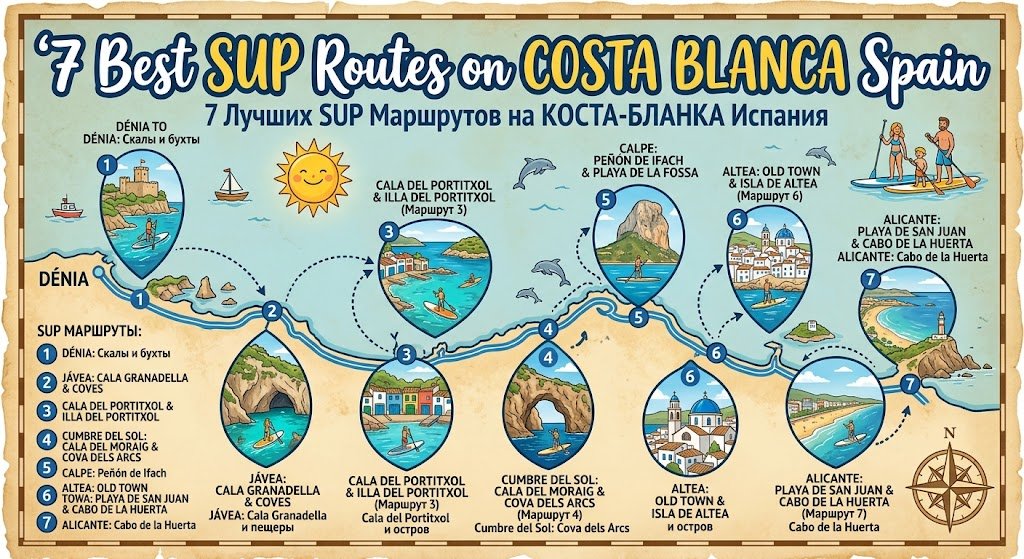
7 Best SUP Routes on Costa Blanca Spain

Stand Up Paddleboarding (SUP) on the Costa Blanca is one of the most rewarding ways to explore Spain’s Mediterranean coastline. With glassy morning waters, crystal-clear visibility reaching 10–15 metres, warm temperatures from May through November, and a diverse mix of sandy beaches, limestone sea caves, and dramatic sandstone cliffs — this region offers paddlers of every level an extraordinary range of routes. This guide reveals the 7 best SUP routes on Costa Blanca, with GPS launch points, distances, expected conditions, and insider tips from people who paddle here every week.

Why Costa Blanca is a SUP Paradise

The Costa Blanca stretches roughly 200 km along the Alicante province coastline, from Dénia in the north to Pilar de la Horadada in the south. Unlike Spain’s Atlantic coasts where powerful oceanic swells make sea kayaking and paddleboarding challenging for beginners, the Mediterranean provides sheltered, manageable conditions. Water temperatures range from 14°C in February to 27°C in August, with peak paddling season running April through October.

The thermal virazón sea breeze typically builds between 10:00 and 12:00, meaning early birds who hit the water before 09:30 AM are rewarded with mirror-flat conditions perfect for distance touring, photography, and wildlife spotting. By afternoon, a 10–18 knot onshore breeze creates playful chop — fun for experienced paddlers, but challenging for beginners.

Route 1: Playa de los Locos to Cala de la Higuera (Torrevieja)

Distance: 3.5 km one-way | Difficulty: Easy–Intermediate | Launch Point: 37.9691° N, 0.6753° W

This is the signature local route for Torrevieja paddlers. Starting from the sheltered northern end of Playa de los Locos — one of Costa Blanca’s finest blue-flag beaches — you paddle south along a rocky limestone coastline dotted with sea urchins, wrasse, and occasional octopus visible in the shallows. The water clarity is exceptional here thanks to Torrevieja’s famous salt lakes that prevent river sediment runoff.

After approximately 2 km you round Cabo Cervera, a dramatic headland topped with a restored watchtower. From here, continue south into the sheltered Cala de la Higuera — a stunning cove framed by wild fig trees and golden sandstone, accessible only from the sea. Snorkeling around the rocky boulders reveals bream, mullet, and damselfish. Return north with the afternoon sea breeze behind you for an easy paddle back.

Route 2: Cala Ferris Palm Cove Circuit (Torrevieja)

Distance: 2 km circuit | Difficulty: Easy | Launch Point: 37.9421° N, 0.6924° W

Cala Ferris is arguably the most photogenic SUP spot on the entire Costa Blanca. A natural palm grove descends to a sheltered pebble cove protected from prevailing winds. Morning light illuminates the amber cliffs and creates extraordinary photographic opportunities. This is a favourite spot for the local FreeWIND community’s sunrise sessions.

The circular route paddles north from Cala Ferris around a series of sea arches and small rock stacks before turning south past Cala Mosca’s red-ochre cliffs. Water depths in this area range from 3–8 metres with sandy-bottom anchorages and dense Posidonia oceanica meadows — home to the Mediterranean’s rich marine ecosystem. Total circuit time: approximately 45–60 minutes at a relaxed touring pace.

Route 3: Santa Pola Cape Lighthouse Traverse

Distance: 6 km one-way | Difficulty: Intermediate | Launch Point: 38.1834° N, 0.5397° W

Launching from Playa Lisa in Santa Pola, this route takes you around the rugged Cape of Santa Pola, past the historic lighthouse at 38.2001° N, 0.4982° W, and into the sheltered waters of the salt flats nature reserve — the Salinas de Santa Pola. The shallow lagoons beside the saltpans host remarkable birdlife: flamingos, avocets, stilts, and numerous wading birds make this route as much a wildlife spectacle as a paddling adventure.

The exposed section around the cape itself can be sporty in northeast Levante conditions — check the marine weather forecast carefully before attempting this route. On calm mornings it is a stunning passage. The lighthouse turnaround point offers views across to Tabarca Island, 8 km offshore. Allow 3–4 hours for the full round trip.

Route 4: Guardamar River Mouth & Sand Dunes

Distance: 5 km return | Difficulty: Easy | Launch Point: 38.0944° N, 0.6484° W

The mouth of the Segura River at Guardamar del Segura offers one of the most unique and sheltered paddling environments on Costa Blanca. The river mouth creates a natural protected channel behind a barrier of spectacular sand dunes (the Dunas de Guardamar) — a protected natural park covering 800 hectares.

Paddling upstream into the calm river channel, you move through a microhabitat completely unlike the open sea. Herons stand motionless in the reeds, terrapins sun themselves on fallen branches, and mullet leap from the brackish water. This is an outstanding route for beginners, families, and anyone looking for a calmer, wildlife-rich experience rather than open coastal paddling. No swell, no waves — just glassy, shallow water stretching inland.

Route 5: Altea Old Town Coastal Passage (Northern Costa Blanca)

Distance: 4 km one-way | Difficulty: Intermediate | Launch Point: 38.5892° N, 0.0489° W

Altea, with its white-domed church overlooking the cerulean sea, is widely considered the most visually beautiful town on the Costa Blanca. Launching from the pebbly Cala dels Andragons just south of the old town, you paddle northward past the Altea marina with its luxury sailing yachts, around rocky headlands plastered with brilliant-white plaster villas, and into secluded coves backed by pine forest.

This is a more advanced route best attempted in calm conditions. The coastline here is exposed to northeast swell during Levante episodes. On settled days, the scenery is extraordinary — you’ll paddle past private boat moorings, beneath overhanging cliffs, and through small natural arches. The turnaround point at Playa de Olla offers a perfect beach landing for a rest and swim.

Route 6: Mar Menor Flatwater Crossing (La Manga)

Distance: 2–10 km (variable) | Difficulty: Beginner | Launch Point: 37.7041° N, 0.7214° W

Just south of the Alicante province border lies Mar Menor — Europe’s largest saltwater lagoon, stretching 170 km² and separated from the Mediterranean by a narrow sand spit, La Manga. For paddleboarders, Mar Menor is a unique gem: water temperatures reach 30°C in summer, depths rarely exceed 6 metres, and the lagoon’s sheltered nature makes it entirely wind-protected. SUP beginners can paddle confidently without fear of offshore winds or strong swell.

The highly saline water also provides extra buoyancy — making balancing on a paddleboard notably easier than in the open sea. Multiple launch spots along La Manga del Mar Menor allow you to choose your distance. The crossing to the volcanic islands (Las Encañizadas) is a magical 4 km tour through shallow, turquoise water resembling the Caribbean.

Route 7: Benidorm Bay Island Circuit

Distance: 8 km circuit | Difficulty: Advanced | Launch Point: 38.5361° N, 0.1208° W

For experienced paddlers seeking a genuine challenge and extraordinary scenery, the circuit around Isla de Benidorm — the dramatic rock island visible from Benidorm’s famous beaches — is a bucket-list paddle. The island sits 1.6 km offshore and is a protected natural park hosting nesting sea birds including Audouin’s Gulls and Shags.

Launching from Playa de Levante at dawn, you cross the channel to the island in approximately 30 minutes on a calm morning. Circling the island reveals spectacular sea cliffs rising 50 metres from the water, sea caves you can paddle into at low swell, and dense underwater kelp forests visible beneath your board. The return crossing requires careful wind timing — afternoon Levante can make this exposed channel challenging. Only attempt in good weather with a safety leash, whistle, and mobile phone in a waterproof case.

Essential Kit for Paddling the Costa Blanca

Whatever route you choose, the right equipment significantly improves both safety and enjoyment. For Mediterranean coastal paddling, an all-around or touring inflatable SUP in the 10’6″ to 11’6″ range, inflated to 15–18 PSI, provides excellent stability and tracking. A carbon or hybrid fibreglass paddle reduces fatigue on longer routes. Always wear a coiled ankle leash to prevent your board drifting away if you fall, and carry a personal flotation device (PFD) as required under Spanish maritime law for SUP craft outside the 200-metre swimming zone.

A waterproof phone case or VHF radio (channel 16) allows emergency communication. Apply high-factor sunscreen (SPF 50+) generously — Mediterranean sun reflects intensely off the water surface. For longer routes, carry at least 1.5 litres of drinking water in a deck bag bungee-strapped to your board.

Best Season and Timing for SUP on Costa Blanca

The golden window for Costa Blanca paddling is May through October. April and November offer good conditions on calm days but water temperatures drop noticeably. June through September provides warm water, stable high-pressure systems, and reliably glassy mornings. The daily thermal wind cycle (glassy water before 10 AM, growing sea breeze 11 AM to 5 PM, dying evening calm) creates a predictable rhythm that experienced local paddlers follow religiously.

For the most magical experience, plan your launch for 07:00–08:30 AM during summer. The golden morning light, absence of other water users, and glassy conditions make these early sessions worth the early alarm. Members of the FreeWIND community meet regularly at Cala Ferris for sunrise paddles — follow our blog for scheduled group sessions.


🧭 GUIDE & FAQ: SUP on Costa Blanca

Q1: Do I need any permit or license to paddleboard on the Costa Blanca?

For paddleboarding within the 200-metre coastal swimming zone you do not need any license or permit. Beyond the 200-metre buoy line, Spanish maritime regulations classify SUP boards as artefactos flotantes (or in some interpretations, small recreational craft), and you are required to carry a personal flotation device and a sound-signalling device (whistle). No skipper’s license is required for SUP under current Spanish law. See our full SUP laws and safety guide for complete details.

Q2: What is the best beginner route on Costa Blanca?

Route 4 (Guardamar River Mouth) and Route 6 (Mar Menor flatwater) are ideal for first-time or nervous paddleboarders. Both offer completely sheltered, flat water with no swell, shallow depths, and easy entry/exit points. Mar Menor’s extra buoyancy from high salinity also makes balancing noticeably easier.

Q3: How far in advance should I check the marine weather forecast?

Check the forecast the evening before and again on the morning of your paddle. The AEMET (Spanish national meteorological service) app provides official coastal warnings. Windy.com with the ECMWF model is excellent for visualizing wind direction and timing. Aim to be on the water before the thermal sea breeze builds — this typically happens between 10:00 and 11:30 AM in summer. See our marine weather guide for full details on Mediterranean wind patterns.

Q4: Are there SUP rental points near these routes?

Several beach clubs and watersports operators along the Costa Blanca offer SUP board rentals by the hour or half-day. Look for rental kiosks at Playa de los Locos (Torrevieja), Playa Lisa (Santa Pola), and various La Manga del Mar Menor beach clubs. For organized tours and community group paddles on the Costa Blanca, the team at seamen.es can recommend vetted local operators and route guidance.

Q5: What should I do if offshore wind pushes me out to sea?

Lie flat on your board immediately to reduce wind resistance (kneeling or standing dramatically increases your sail profile). Paddle at 45 degrees into the wind — never fight directly into a strong headwind. Signal for assistance using your whistle and phone. If conditions deteriorate significantly, call 112 (Spain’s emergency number) or the maritime rescue service on VHF Channel 16. Always paddle with a buddy when conditions are uncertain, and never paddle offshore alone in unfamiliar conditions.

Q6: Can I paddleboard in winter on the Costa Blanca?

Yes, with appropriate gear. Winter water temperatures average 14–16°C — cold for a swimsuit, but comfortable in a 3mm wetsuit. Costa Blanca receives very few storm days in winter, and calm, sunny December and January days offer some of the most peaceful and uncrowded paddling of the year. The low winter sun creates stunning soft light perfect for photography. Check forecasts carefully and avoid paddling in Tramontana or Poniente gale conditions.

Discover more SUP routes and connect with local paddlers at FreeWIND. For nautical services, boat charters, and maritime support on the Costa Blanca, visit our partners at seamen.es.

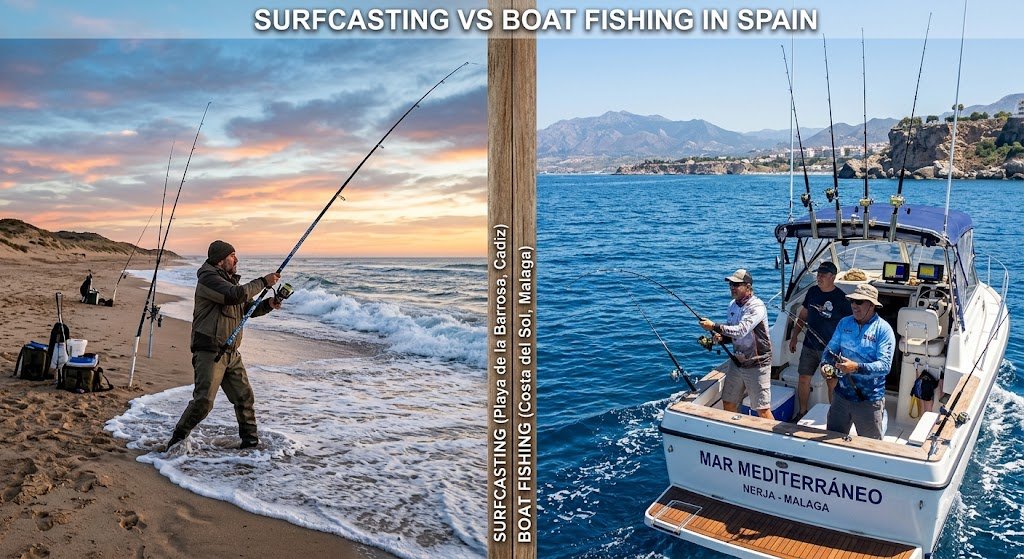
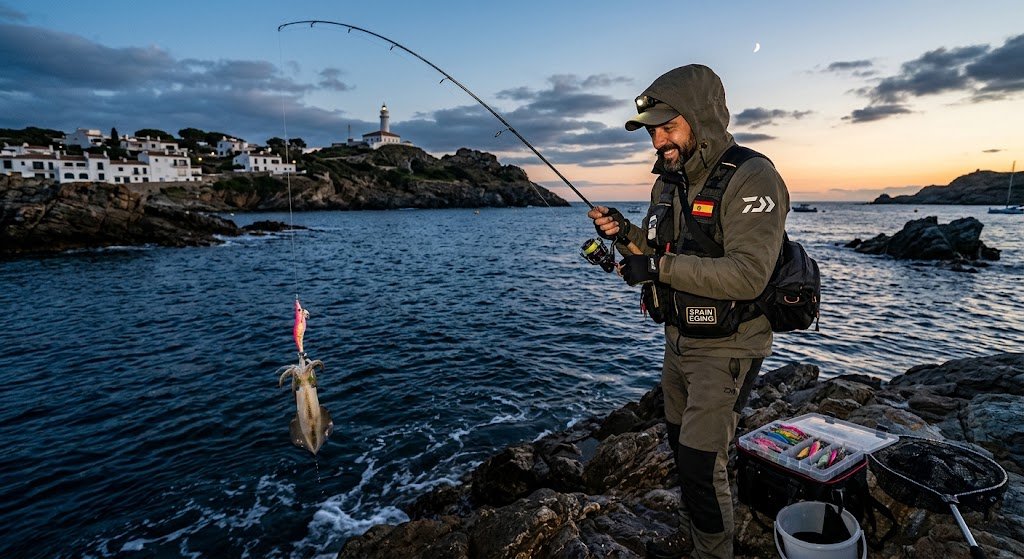
Surfcasting vs Boat Fishing in Spain

Choosing between shore-based angling and offshore vessel expeditions is one of the most common dilemmas for anglers arriving on the Iberian Peninsula. When weighing surfcasting vs boat fishing Spain along the sun-drenched waters of Costa Blanca (Alicante, Torrevieja, Santa Pola), both modalities deliver exhilarating sport, but they demand vastly different financial investments, tackle configurations, legal permits, and tactical knowledge.

While surfcasting allows you to walk onto a golden Mediterranean beach at sunset with rod holders and sand spikes, boat angling grants access to deep drop-offs, underwater canyons, and offshore pelagics beyond casting range. This guide compares expenses, target species, summer regulations, gear essentials, and practical trade-offs to help you decide which style suits your maritime adventure.

Surfcasting in Spain: Beach Logistics and Coastal Regulations

Surfcasting enjoys immense popularity across Spain. With thousands of kilometers of coastline, finding accessible sandy beaches and shingle shores is easy. However, shore angling comes with distinct logistical considerations:

  • Summer Curfews (Bathing Season Regulations): During peak tourism months (June to September), Spanish municipal ordinances strictly ban beach angling during daytime bathing hours. Surfcasting is permitted only between 21:00 and 09:00 (or once municipal lifeguards lower flags and swimmers depart). This turns summer surfcasting into a nocturnal pursuit under moonlit skies.
  • Casting Distance & Mechanics: Mediterranean beaches often shelve gently. Reaching productive feeding zones (100 to 160 meters offshore) requires 4.2 to 4.5-meter three-piece carbon rods, low-diameter mainlines (0.14 mm to 0.18 mm nylon with tapered shock leaders), and aerodynamic casting techniques like the Off-The-Ground (OTG) or pendulum cast.
  • Beach Mobility: Experienced surfcasters utilize heavy-duty beach carts (carros de pesca) with balloon sand wheels to haul long rod holders (pinchos), tackle boxes, bait coolers, and folding chairs across soft sand.

Boat Fishing in Spain: Sonar Tactics, Drift, and Pelagics

Heading out onto Mediterranean waters by motor vessel or sports fishing boat bypasses coastal beach crowds and opens up entirely new marine territories:

  • Access to Deep Structure: Depth drops rapidly off capes like Cabo de Santa Pola and Cabo Cervera. Boat anglers easily reach rocky reefs, wrecks, and drop-offs at depths from 30 to over 150 meters, holding apex predators that never venture near surf beaches.
  • Marine Electronics: Modern CHIRP sonar, GPS chartplotters, and down-scan imaging eliminate guesswork, pinpointing baitfish schools, underwater drop-offs, and bottom transitions accurately.
  • Anchoring vs Drift Fishing: Depending on wind and current, skippers anchor over isolated pinnacles or deploy a sea anchor (ancla de capa) to control drift speed while slow jigging, working inchiku lures, or bottom bouncing natural sardine baits.
  • Pelagic Trolling (Curricán): High-speed offshore trolling allows boats to cover miles of open sea, intercepting migratory pelagic schools of Atlantic bonito, mahi-mahi (llampuga), and albacore.

If you do not own a vessel in Spain, maintaining private boats, marina berths, insurance, and fuel can be demanding. Booking a skippered charter or hiring a well-equipped vessel through verified providers like SEAMEN maritime services provides full offshore access with expert guidance and zero ownership overhead.

Species Accessibility Breakdown: Beach vs Offshore

The species you can expect to encounter differ substantially between the two disciplines:

  • Surfcasting Primary Targets: Gilthead Seabream (dorada), Sand Steenbras (herrera), European Seabass (lubina), White Seabream (sargo), flatfish, and coastal rays. These species forage in sandy depressions and surf breaks.
  • Boat Angling Primary Targets: Dentex (dentón), Dusky Grouper (mero), Red Pandora (pagel), Blackspot Seabream (besugo), Atlantic Bonito, Little Tunny (bacoreta), Mahi-mahi (llampuga), and Amberjack (serviola).

Gear, Licensing, and Financial Investment Comparison

Budget and logistics play a major role when deciding between shore and boat fishing:

  • Licensing: Surfcasting requires an individual Clase 1 shore license (€12 to €28 for several years). Boat angling requires a Clase 2 boat license (or booking a commercial vessel with a collective charter license).
  • Surfcasting Investment: A competitive two-rod beach setup (quality 4.2m rods, high-capacity surf reels, line, tripod/spikes, beach cart, and terminal tackle) costs between €350 and €900. Ongoing expenses are minimal, limited to fresh worms, lead sinkers, and hooks.
  • Boat Angling Investment: Boat ownership involves substantial recurring costs: vessel purchase, mooring fees in local marinas (€2,000 to €6,000+ annually), engine servicing, fuel, and safety gear. Alternatively, chartering a private sports fishing boat for a half-day costs between €400 and €800, split among friends.

The Hybrid Approach: Which Style Should You Choose?

For visiting anglers, expats, and residents along Costa Blanca, a hybrid strategy offers the best of both worlds:

  • Weekly Shore Sessions: Invest in a reliable surfcasting or coastal spinning outfit for spontaneous evening sessions after work or weekend night trips along local beaches.
  • Seasonal Offshore Charters: When the autumn pelagic migration arrives (September to November), pool resources with fellow anglers to charter a dedicated fishing boat for offshore bonito and dentex.

To learn more about Mediterranean fishing methods and gear selection, explore our FreeWIND Sea Fishing section and read our overview on Mediterranean species, techniques, and charter trips.

Frequently Asked Questions About Surfcasting vs Boat Fishing in Spain

1. Can I fish from beaches during the day in summer in Spain?

Generally no. Between June and September, municipal beach regulations prohibit angling while swimmers and sunbathers are present. Fishing is allowed only from 21:00 to 09:00, or in remote rocky coves away from official bathing zones.

2. Is boat fishing more productive than surfcasting in the Mediterranean?

Boat fishing typically yields higher numbers and larger pelagic species (bonito, dentex, grouper) because vessels access deep structure. However, surfcasting remains the premier method for targeting specimen dorada and sea bass in surf shallows.

3. Do I need separate licenses for surfcasting and boat fishing in Spain?

Yes. Spanish maritime recreational permits are divided into Clase 1 (from shore) and Clase 2 (from boat). If you fish from both the beach and your own private vessel, you must hold both endorsements.

4. Can I use a kayak for sea fishing in Spain?

Yes, kayak fishing is very popular. You must hold a Clase 2 (boat) recreational license, wear a certified life vest, carry mandatory safety gear, and remain within approved coastal distances.

5. Where can I find professional fishing boat charters on Costa Blanca?

Reputable maritime platforms like SEAMEN connect anglers with certified boat skippers, vessel charters, and marine logistics in Alicante, Torrevieja, and surrounding marinas.

Recognized Skipper Licenses in Spain Guide

Few nautical adventures match cruising Spain’s sun-drenched coastline, dropping anchor in turquoise coves, and tying up at lively marina quays. However, Spanish maritime authorities, governed by the Directorate General of Merchant Marine (Dirección General de la Marina Mercante – DGMM) and enforced by the Guardia Civil del Mar, uphold strict standards for skipper qualifications. Knowing which recognized skipper licenses in Spain authorize you to take the helm is essential whether chartering or owning a boat.

Whether you hold a British RYA qualification, an International Certificate of Competence (ICC), or wish to earn a Spanish license, here is your definitive guide to recognized qualifications, cruising limits, and required onboard documentation in Spain.

The Spanish Recreational Qualification Hierarchy

Recreational boating qualifications in Spain are codified under Real Decreto 875/2014, de 10 de octubre. The system comprises four primary leisure skipper tiers:

1. Licencia de Navegación (Formerly “Titulín”)

The entry-level Spanish nautical license is ideal for day cruisers. It authorizes skippering motorboats and sailboats up to 6 meters in hull length with unlimited engine power (up to manufacturer limit), as well as all jet skis (motos de agua). Limitations: daylight navigation only, up to 2 nautical miles from a port or shelter. The course requires 6 hours of instruction (2 hours theory, 4 hours practice) with no official exam required.

2. Patrón de Navegación Básica (PNB)

The PNB permit authorizes commanding motorboats and sailboats up to 8 meters in hull length. It permits both day and night navigation up to 5 nautical miles from a port or coastal refuge. Earning a PNB requires passing a 27-question theory exam, 8 hours of basic safety practices, and 4 hours of radio training.

3. Patrón de Embarcaciones de Recreo (PER)

The PER is the benchmark recreational qualification in Spain. In standard form, it authorizes skippering vessels up to 15 meters in length up to 12 nautical miles offshore, day and night, including coastal passages between islands in the Balearic and Canary archipelagos.

With an optional 24-hour continuous navigation practice module (habilitación a 24 metros y Baleares), PER authority expands to command vessels up to 24 meters and conduct mainland-to-Balearic open-sea crossings.

4. Patrón de Yate & Capitán de Yate

For offshore skippers, Patrón de Yate covers vessels up to 24 meters navigating up to 150 nautical miles offshore. The highest recreational grade, Capitán de Yate, carries no geographical or boat size limits, permitting worldwide oceanic navigation.

Are Foreign Skipper Licenses Recognized in Spain?

If you hold a nautical qualification issued outside Spain, its validity depends on international treaties, vessel flag, and your residency status:

The International Certificate of Competence (ICC – Resolution 40)

Spain adheres to the United Nations Economic Commission for Europe (UNECE) Resolution 40. The ICC is the most universally accepted foreign boating permit in Spain. If your national maritime authority issues an ICC for coastal motor vessels, it is accepted by charter agencies, port authorities, and maritime insurance companies.

UK RYA Qualifications

British Royal Yachting Association (RYA) certifications are widely respected across Spain. For bareboat charters on Spanish-flagged rental vessels (Lista 6ª):

  • RYA Day Skipper (Practical): Authorizes daytime cruising in coastal waters (typically up to 12 miles offshore). Widely accepted by charter companies, especially when paired with an ICC.
  • RYA Coastal Skipper & Yachtmaster: Accepted for extended offshore passages and night cruising within certified limits.

US, Canadian, and Australian Boat Licenses

Certifications from US Sailing, the American Sailing Association (ASA 104 Bareboat Cruising), or Australian State Authorities are recognized for non-resident tourists chartering boats, provided the charter company verifies equivalency under Annex IX of Real Decreto 875/2014.

Crucial Legal Distinction: Tourists vs. Spanish Residents: Foreign certifications are recognized for visiting tourists. However, if you become a registered resident of Spain (empadronado), Spanish law requires you to obtain a Spanish certificate (PNB, PER) or formally homologate your foreign license through the DGMM.

Mandatory Documentation Required on Board

When cruising Spanish waters, the Guardia Civil del Mar or maritime customs can conduct inspections. You must have original documents aboard:

  • Original Skipper License: Valid Spanish certificate, ICC, or approved national license matching vessel size and cruising zone.
  • Identification: Valid passports, national IDs, or NIE certificates for everyone aboard.
  • Boat Registration & Inspection: For Spanish vessels, the Hoja de Asiento, Permiso de Navegación, and valid Certificado de Navegabilidad (ITB).
  • Marine Liability Insurance: Proof of mandatory third-party insurance complying with Real Decreto 607/1999, along with current payment receipt.
  • Charter Agreement: If renting, a signed charter contract and passenger crew list.

Professional Skipper Training and Maritime Services in Spain

Navigating maritime regulations, preparing for PER exams, or homologating foreign skipper titles in Spain can be intricate. For accredited nautical courses, English-language skipper training, boat registration, and legal consulting, partner with the experts at SEAMEN.es. To explore top cruising routes and community boat trips, browse our FreeWIND Motor Boats guides.

Frequently Asked Questions (FAQ)

Can I charter a motorboat in Spain with an RYA Day Skipper certificate?

Yes. The vast majority of professional charter companies across Spain accept the RYA Day Skipper (Practical) certificate for bareboat motorboat charters. Having your RYA certificate endorsed with an ICC provides extra assurance.

Can a foreign boat license be converted into a Spanish PER?

Direct license conversion (convalidación) is possible primarily for qualifications issued by EU member states with bilateral agreements with Spain, processed through the DGMM with certified translations and medical fitness proof.

What are the fines for skippering without a recognized license?

Operating a boat that requires a license without a legally recognized qualification is a serious maritime offense under the Ley de Puertos del Estado. Fines range from €3,000 to €10,000, and the boat will be immobilized by maritime police.

Do I need a separate marine radio license in Spain?

The entry-level Licencia de Navegación does not require radio certification. However, both PNB and PER qualifications include mandatory Short Range Radio Operator modules (Operador de Corto Alcance – ROC) covering VHF DSC radio.

Is a medical exam required for a Spanish boat license?

Yes. Obtaining or renewing a Spanish nautical qualification requires a specialized psychophysical medical certificate (Certificado Médico de Aptitud Psicofísica) issued by an authorized driver/nautical medical clinic assessing vision, hearing, and coordination.

Squid Fishing (Eging) in Spain: Pro Tips

Originating in Japan and embraced across the Mediterranean, the art of eging—lure angling for cephalopods with specialized prawn jigs (egis)—has transformed coastal fishing. When targeting squid fishing in Spain along Costa Blanca (Torrevieja, Santa Pola, Alicante, Calpe), anglers discover an exciting discipline combining light tackle, subtle bite detection, and exquisite culinary rewards.

As Mediterranean waters cool from late October through February, European Common Squid (calamar) migrate from offshore depths into coastal shallows and breakwaters under cover of dusk. Adapting Japanese eging methods to Spanish conditions produces consistent action. This guide covers jig sizes, sink rates, UV glow technology, darting retrieves, and caring for your fresh catch.

Japanese Eging Adapted to Mediterranean Waters

Unlike tidal ocean shores, the Mediterranean features exceptional water clarity and subtle currents. Squid in Spanish waters are cautious, making finesse gear essential:

  • Eging Rods: Sensitive 8’0″ to 8’6″ rods rated for PE 0.4 to 0.8 braids and Egi sizes #2.0 to #3.5. A responsive blank absorbs the pulsing runs of hooked squid without tearing delicate tentacles.
  • Micro Braid & Leaders: Spool a 2500 reel with smooth 8-strand PE braided line (PE #0.6 to #0.8). Tie a 1.5-meter leader of 100% fluorocarbon (0.20 mm to 0.24 mm) for invisibility and abrasion resistance.
  • Quick-Snap Clips: Attach jigs with a rounded, ultra-light egi snap (size #0 or #1) to preserve natural side-to-side darting action.

Egi Jig Sizes, Sink Rates, and Color Selection

Selecting the appropriate jig size and sink rate keeps your lure in the strike zone:

  • Size #2.5 (10-12g): Ideal for early autumn (October/November), calm bays, and shallow weed edges. Sinks slowly at 5.0 to 5.5 seconds per meter.
  • Size #3.0 (15-16g): The versatile Mediterranean workhorse for depths of 4 to 10 meters along outer breakwaters. Sinks at 3.5 to 4.0 seconds per meter.
  • Size #3.5 (20-22g): Used for winter trophy squid, deeper reefs (12+ meters), boat drifting, or windy days. Sinks faster at 2.8 to 3.2 seconds per meter.

Color selection depends on lighting conditions and moon phases:

  • Full Moon & Clear Water: Natural patterns (mackerel, sardine, prawn) with silver or transparent bases. Keimura (UV-reactive) bodies excel at twilight.
  • New Moon & Murky Water: High-visibility luminous green or blue glow bases with pink or orange cloth.
  • Dusk & Dawn: Pink, orange, and red-bellied patterns simulate distressed prey.

Rod Action: The “Bichi-Bichi” Jerk and the Critical Drop

The cardinal rule of squid fishing in Spain is that squid attack on the slow, horizontal descent. Master this retrieve rhythm:

  1. Cast & Count Down: Cast your egi and let it sink near the seabed. Count down seconds based on depth and jig sink rate.
  2. The Jerk Sequence: Impart two to four sharp upward rod snaps (“bichi-bichi”). This causes the jig to dart erratically, attracting squid from a distance.
  3. The Controlled Fall: Lower the rod tip with light line tension, letting the egi glide downward at a 45-degree angle.
  4. Detecting the Bite: Cephalopod takes feel like sudden dead weight, a subtle tug, or sudden slack line as tentacles grip the lure.
  5. The Sweep Set: Avoid violent strikes. Lift firmly and reel steadily. The needle crowns (coronas) will penetrate cleanly. Keep steady tension without pumping the rod.

Top Coastal Locations and Boat Drifting Tactics

Costa Blanca offers prime eging environments during cooler months:

  • Breakwaters and Outer Walls: Ports in Torrevieja, Santa Pola, and Alicante provide deep water access. Focus on transition zones where port lights meet dark water. Note: Always fish permitted outer breakwaters; operational dock basins are off-limits.
  • Rocky Capes and Points: Cabo de las Huertas and Cabo Cervera create tidal eddies where squid gather to hunt.
  • Boat Drifting: Over 15 to 30 meter sandy gravel beds, deploy a sea anchor (ancla de capa) to slow drift while working jigs. For private boat charters and skipper support, consult verified experts at SEAMEN maritime services.

Caring for Your Catch: From Dispatch to Plancha

Fresh Mediterranean squid deserves culinary care:

  • Humane Dispatch (Ikejime): Insert a squid spike between the eyes. The squid turns white instantly, preserving natural sweetness and texture.
  • Avoid Fresh Water: Keep squid dry in a cooler with ice packs inside a sealed plastic bag. Washing with chlorinated tap water ruins delicate skin texture.
  • Calamar a la Plancha: Sear briefly on a screaming-hot griddle with extra-virgin olive oil, coarse sea salt, garlic, and parsley for two minutes per side.

For more coastal fishing advice, visit our FreeWIND Sea Fishing section and read our overview on Mediterranean species, techniques, and charter trips.

Frequently Asked Questions About Squid Fishing in Spain

1. When is the peak season for squid fishing (eging) in Spain?

The season runs from late October through February, peaking in November and December when large winter calamari approach coastal breakwaters to hunt and spawn.

2. What is the difference between squid (calamar) and cuttlefish (sepia)?

Squid swim actively in the water column and strike falling lures. Cuttlefish dwell directly on sandy beds and weed edges, requiring jigs dragged or hopped slowly along the bottom.

3. Why do squid jigs use barbless crown needles instead of treble hooks?

Squid have soft, muscular tentacles that tear on barbed hooks. Fine circular crown needles distribute tension evenly, keeping the squid secure under steady reeling without ripping flesh.

4. Is night fishing better than daytime for squid in Spain?

Yes. Shore eging is primarily nocturnal. The two hours after dusk and calm moonlit midnight hours produce the highest activity, as squid move into shallower water to feed.

5. Do I need a fishing license to catch squid in Spain?

Yes. Squid are regulated under regional recreational maritime fishing laws. A standard Class 1 (shore) or Class 2 (boat) license is required across all Spanish autonomous communities.