
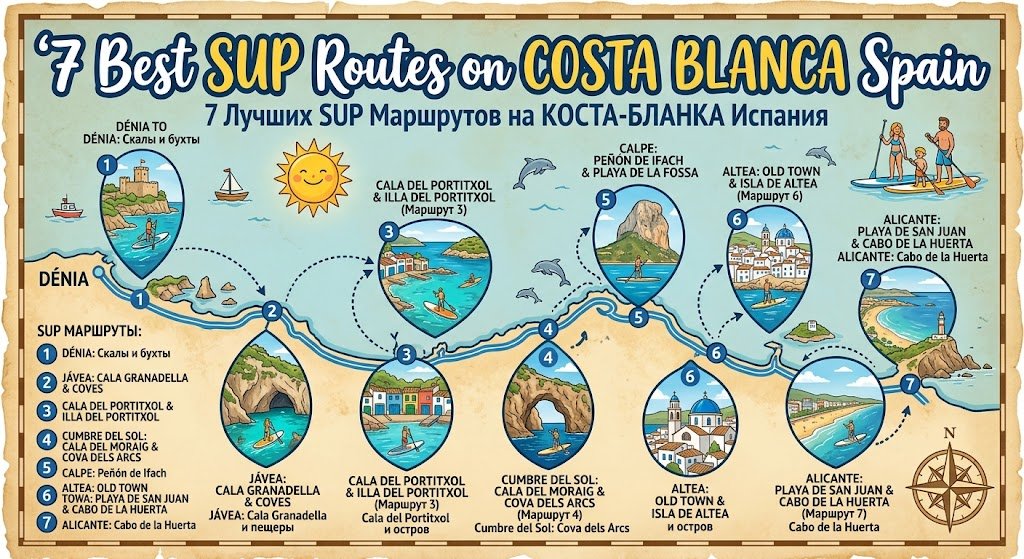
7 Best SUP Routes on Costa Blanca Spain
Stand Up Paddleboarding (SUP) on the Costa Blanca is one of the most rewarding ways to explore Spain’s Mediterranean coastline. With glassy morning waters, crystal-clear visibility reaching 10–15 metres, warm temperatures from May through November, and a diverse mix of sandy beaches, limestone sea caves, and dramatic sandstone cliffs — this region offers paddlers of every level an extraordinary range of routes. This guide reveals the 7 best SUP routes on Costa Blanca, with GPS launch points, distances, expected conditions, and insider tips from people who paddle here every week.
Why Costa Blanca is a SUP Paradise
The Costa Blanca stretches roughly 200 km along the Alicante province coastline, from Dénia in the north to Pilar de la Horadada in the south. Unlike Spain’s Atlantic coasts where powerful oceanic swells make sea kayaking and paddleboarding challenging for beginners, the Mediterranean provides sheltered, manageable conditions. Water temperatures range from 14°C in February to 27°C in August, with peak paddling season running April through October.
The thermal virazón sea breeze typically builds between 10:00 and 12:00, meaning early birds who hit the water before 09:30 AM are rewarded with mirror-flat conditions perfect for distance touring, photography, and wildlife spotting. By afternoon, a 10–18 knot onshore breeze creates playful chop — fun for experienced paddlers, but challenging for beginners.
Route 1: Playa de los Locos to Cala de la Higuera (Torrevieja)
Distance: 3.5 km one-way | Difficulty: Easy–Intermediate | Launch Point: 37.9691° N, 0.6753° W
This is the signature local route for Torrevieja paddlers. Starting from the sheltered northern end of Playa de los Locos — one of Costa Blanca’s finest blue-flag beaches — you paddle south along a rocky limestone coastline dotted with sea urchins, wrasse, and occasional octopus visible in the shallows. The water clarity is exceptional here thanks to Torrevieja’s famous salt lakes that prevent river sediment runoff.
After approximately 2 km you round Cabo Cervera, a dramatic headland topped with a restored watchtower. From here, continue south into the sheltered Cala de la Higuera — a stunning cove framed by wild fig trees and golden sandstone, accessible only from the sea. Snorkeling around the rocky boulders reveals bream, mullet, and damselfish. Return north with the afternoon sea breeze behind you for an easy paddle back.
Route 2: Cala Ferris Palm Cove Circuit (Torrevieja)
Distance: 2 km circuit | Difficulty: Easy | Launch Point: 37.9421° N, 0.6924° W
Cala Ferris is arguably the most photogenic SUP spot on the entire Costa Blanca. A natural palm grove descends to a sheltered pebble cove protected from prevailing winds. Morning light illuminates the amber cliffs and creates extraordinary photographic opportunities. This is a favourite spot for the local FreeWIND community’s sunrise sessions.
The circular route paddles north from Cala Ferris around a series of sea arches and small rock stacks before turning south past Cala Mosca’s red-ochre cliffs. Water depths in this area range from 3–8 metres with sandy-bottom anchorages and dense Posidonia oceanica meadows — home to the Mediterranean’s rich marine ecosystem. Total circuit time: approximately 45–60 minutes at a relaxed touring pace.
Route 3: Santa Pola Cape Lighthouse Traverse
Distance: 6 km one-way | Difficulty: Intermediate | Launch Point: 38.1834° N, 0.5397° W
Launching from Playa Lisa in Santa Pola, this route takes you around the rugged Cape of Santa Pola, past the historic lighthouse at 38.2001° N, 0.4982° W, and into the sheltered waters of the salt flats nature reserve — the Salinas de Santa Pola. The shallow lagoons beside the saltpans host remarkable birdlife: flamingos, avocets, stilts, and numerous wading birds make this route as much a wildlife spectacle as a paddling adventure.
The exposed section around the cape itself can be sporty in northeast Levante conditions — check the marine weather forecast carefully before attempting this route. On calm mornings it is a stunning passage. The lighthouse turnaround point offers views across to Tabarca Island, 8 km offshore. Allow 3–4 hours for the full round trip.
Route 4: Guardamar River Mouth & Sand Dunes
Distance: 5 km return | Difficulty: Easy | Launch Point: 38.0944° N, 0.6484° W
The mouth of the Segura River at Guardamar del Segura offers one of the most unique and sheltered paddling environments on Costa Blanca. The river mouth creates a natural protected channel behind a barrier of spectacular sand dunes (the Dunas de Guardamar) — a protected natural park covering 800 hectares.
Paddling upstream into the calm river channel, you move through a microhabitat completely unlike the open sea. Herons stand motionless in the reeds, terrapins sun themselves on fallen branches, and mullet leap from the brackish water. This is an outstanding route for beginners, families, and anyone looking for a calmer, wildlife-rich experience rather than open coastal paddling. No swell, no waves — just glassy, shallow water stretching inland.
Route 5: Altea Old Town Coastal Passage (Northern Costa Blanca)
Distance: 4 km one-way | Difficulty: Intermediate | Launch Point: 38.5892° N, 0.0489° W
Altea, with its white-domed church overlooking the cerulean sea, is widely considered the most visually beautiful town on the Costa Blanca. Launching from the pebbly Cala dels Andragons just south of the old town, you paddle northward past the Altea marina with its luxury sailing yachts, around rocky headlands plastered with brilliant-white plaster villas, and into secluded coves backed by pine forest.
This is a more advanced route best attempted in calm conditions. The coastline here is exposed to northeast swell during Levante episodes. On settled days, the scenery is extraordinary — you’ll paddle past private boat moorings, beneath overhanging cliffs, and through small natural arches. The turnaround point at Playa de Olla offers a perfect beach landing for a rest and swim.
Route 6: Mar Menor Flatwater Crossing (La Manga)
Distance: 2–10 km (variable) | Difficulty: Beginner | Launch Point: 37.7041° N, 0.7214° W
Just south of the Alicante province border lies Mar Menor — Europe’s largest saltwater lagoon, stretching 170 km² and separated from the Mediterranean by a narrow sand spit, La Manga. For paddleboarders, Mar Menor is a unique gem: water temperatures reach 30°C in summer, depths rarely exceed 6 metres, and the lagoon’s sheltered nature makes it entirely wind-protected. SUP beginners can paddle confidently without fear of offshore winds or strong swell.
The highly saline water also provides extra buoyancy — making balancing on a paddleboard notably easier than in the open sea. Multiple launch spots along La Manga del Mar Menor allow you to choose your distance. The crossing to the volcanic islands (Las Encañizadas) is a magical 4 km tour through shallow, turquoise water resembling the Caribbean.
Route 7: Benidorm Bay Island Circuit
Distance: 8 km circuit | Difficulty: Advanced | Launch Point: 38.5361° N, 0.1208° W
For experienced paddlers seeking a genuine challenge and extraordinary scenery, the circuit around Isla de Benidorm — the dramatic rock island visible from Benidorm’s famous beaches — is a bucket-list paddle. The island sits 1.6 km offshore and is a protected natural park hosting nesting sea birds including Audouin’s Gulls and Shags.
Launching from Playa de Levante at dawn, you cross the channel to the island in approximately 30 minutes on a calm morning. Circling the island reveals spectacular sea cliffs rising 50 metres from the water, sea caves you can paddle into at low swell, and dense underwater kelp forests visible beneath your board. The return crossing requires careful wind timing — afternoon Levante can make this exposed channel challenging. Only attempt in good weather with a safety leash, whistle, and mobile phone in a waterproof case.
Essential Kit for Paddling the Costa Blanca
Whatever route you choose, the right equipment significantly improves both safety and enjoyment. For Mediterranean coastal paddling, an all-around or touring inflatable SUP in the 10’6″ to 11’6″ range, inflated to 15–18 PSI, provides excellent stability and tracking. A carbon or hybrid fibreglass paddle reduces fatigue on longer routes. Always wear a coiled ankle leash to prevent your board drifting away if you fall, and carry a personal flotation device (PFD) as required under Spanish maritime law for SUP craft outside the 200-metre swimming zone.
A waterproof phone case or VHF radio (channel 16) allows emergency communication. Apply high-factor sunscreen (SPF 50+) generously — Mediterranean sun reflects intensely off the water surface. For longer routes, carry at least 1.5 litres of drinking water in a deck bag bungee-strapped to your board.
Best Season and Timing for SUP on Costa Blanca
The golden window for Costa Blanca paddling is May through October. April and November offer good conditions on calm days but water temperatures drop noticeably. June through September provides warm water, stable high-pressure systems, and reliably glassy mornings. The daily thermal wind cycle (glassy water before 10 AM, growing sea breeze 11 AM to 5 PM, dying evening calm) creates a predictable rhythm that experienced local paddlers follow religiously.
For the most magical experience, plan your launch for 07:00–08:30 AM during summer. The golden morning light, absence of other water users, and glassy conditions make these early sessions worth the early alarm. Members of the FreeWIND community meet regularly at Cala Ferris for sunrise paddles — follow our blog for scheduled group sessions.
🧭 GUIDE & FAQ: SUP on Costa Blanca
Q1: Do I need any permit or license to paddleboard on the Costa Blanca?
For paddleboarding within the 200-metre coastal swimming zone you do not need any license or permit. Beyond the 200-metre buoy line, Spanish maritime regulations classify SUP boards as artefactos flotantes (or in some interpretations, small recreational craft), and you are required to carry a personal flotation device and a sound-signalling device (whistle). No skipper’s license is required for SUP under current Spanish law. See our full SUP laws and safety guide for complete details.
Q2: What is the best beginner route on Costa Blanca?
Route 4 (Guardamar River Mouth) and Route 6 (Mar Menor flatwater) are ideal for first-time or nervous paddleboarders. Both offer completely sheltered, flat water with no swell, shallow depths, and easy entry/exit points. Mar Menor’s extra buoyancy from high salinity also makes balancing noticeably easier.
Q3: How far in advance should I check the marine weather forecast?
Check the forecast the evening before and again on the morning of your paddle. The AEMET (Spanish national meteorological service) app provides official coastal warnings. Windy.com with the ECMWF model is excellent for visualizing wind direction and timing. Aim to be on the water before the thermal sea breeze builds — this typically happens between 10:00 and 11:30 AM in summer. See our marine weather guide for full details on Mediterranean wind patterns.
Q4: Are there SUP rental points near these routes?
Several beach clubs and watersports operators along the Costa Blanca offer SUP board rentals by the hour or half-day. Look for rental kiosks at Playa de los Locos (Torrevieja), Playa Lisa (Santa Pola), and various La Manga del Mar Menor beach clubs. For organized tours and community group paddles on the Costa Blanca, the team at seamen.es can recommend vetted local operators and route guidance.
Q5: What should I do if offshore wind pushes me out to sea?
Lie flat on your board immediately to reduce wind resistance (kneeling or standing dramatically increases your sail profile). Paddle at 45 degrees into the wind — never fight directly into a strong headwind. Signal for assistance using your whistle and phone. If conditions deteriorate significantly, call 112 (Spain’s emergency number) or the maritime rescue service on VHF Channel 16. Always paddle with a buddy when conditions are uncertain, and never paddle offshore alone in unfamiliar conditions.
Q6: Can I paddleboard in winter on the Costa Blanca?
Yes, with appropriate gear. Winter water temperatures average 14–16°C — cold for a swimsuit, but comfortable in a 3mm wetsuit. Costa Blanca receives very few storm days in winter, and calm, sunny December and January days offer some of the most peaceful and uncrowded paddling of the year. The low winter sun creates stunning soft light perfect for photography. Check forecasts carefully and avoid paddling in Tramontana or Poniente gale conditions.
Discover more SUP routes and connect with local paddlers at FreeWIND. For nautical services, boat charters, and maritime support on the Costa Blanca, visit our partners at seamen.es.