Search for:
5 Secret Coves on Costa Blanca by Boat

The Costa Blanca is world-famous for its sweeping sandy beaches, bustling marinas, and lively coastal towns. Yet for motorboat skippers, the true magic of this Mediterranean coast lies hidden beneath towering limestone cliffs, sea caves, and turquoise anchorages inaccessible by road. Setting out to explore secret coves Costa Blanca by boat transforms a regular day on the water into an unforgettable coastal expedition.
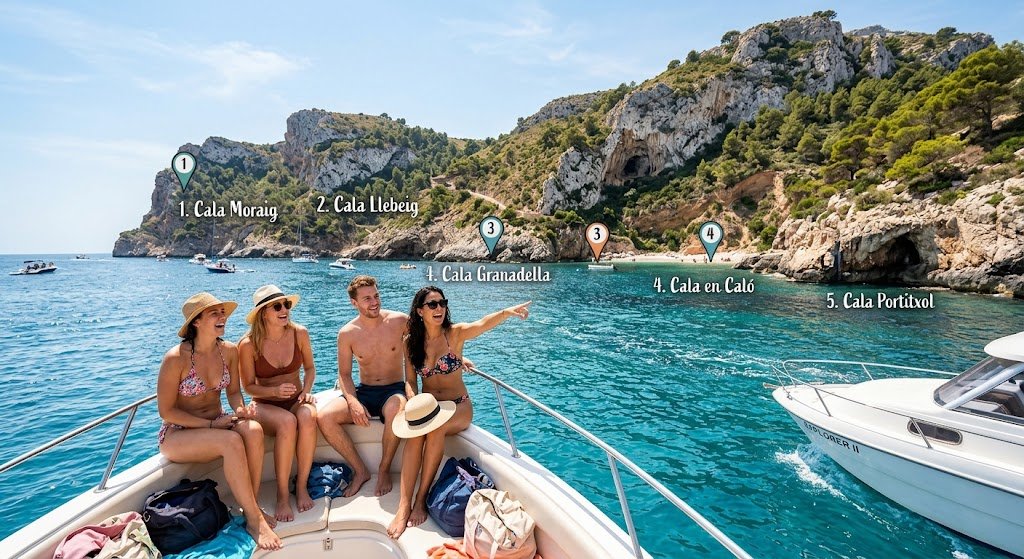
From the wild palm-fringed sands of Torrevieja to the dramatic sea cliffs of Sierra Helada and Moraira, here are five secluded coves every motorboater should visit, complete with GPS coordinates, anchoring depths, and local seamanship tips.

Why Discovering the Costa Blanca Coastline by Boat is Unmatched

While urban beaches fill with thousands of sunbathers, motoring just a few miles offshore unlocks complete tranquility. Dramatic underwater topography, sea arches, and lush meadows of Posidonia oceanica filter the water to pristine clarity, offering visibility of 15 to 25 meters. Whether dropping anchor for lunch on deck or snorkeling with Mediterranean fish, a motorboat is your ticket to Spain’s untouched coastal sanctuaries.

The 5 Best Secret Coves on Costa Blanca Accessible by Boat

1. Cala Ferris (Torrevieja) – The Palm-Fringed Haven

Located just south of Torrevieja’s marina, Cala Ferris is a dreamlike oasis. Backed by sand dunes and a grove of wild coconut palms, it feels completely detached from the bustling resort town nearby.

  • GPS Position: 37°57’02” N, 00°41’48” W
  • Anchoring Depth & Seabed: 2.5 to 4.5 meters in fine golden sand. Look for bright turquoise sand patches between dark reef bands.
  • Wind Protection: Sheltered from westerly (Poniente) and southwesterly breezes. Avoid during strong easterly (Levante) swells.
  • Highlights: Swimming, paddleboarding in shallow basins, and snorkeling among striped sea bream and cuttlefish.

2. Cala Mosca & Cabo Peñas (Orihuela Costa) – Red Sandstone Bluffs

Just south of Punta Prima, the coastline forms the rugged headland of Cabo Peñas, framing the secluded cove of Cala Mosca. The reddish-ochre sandstone cliffs form natural windbreaks and small sea caves.

  • GPS Position: 37°56’08” N, 00°42’30” W
  • Anchoring Depth & Seabed: 3.5 to 6.0 meters over mixed sand and flat rock shelves.
  • Wind Protection: Excellent shelter from north-northwesterly winds.
  • Highlights: A serene escape from busy southern beaches. The rocky shoreline shelters octopuses, groupers, and starfish.

3. Cabo Roig Watchtower Anchorage (Cala Capitán / Cabo Roig)

Crowned by a historic 16th-century stone watchtower that once guarded the coast against Barbary pirates, the promontory of Cabo Roig creates one of the safest natural anchorages in southern Alicante province.

  • GPS Position: 37°54’32” N, 00°43’15” W
  • Anchoring Depth & Seabed: 4.0 to 7.0 meters on firm sand with excellent holding.
  • Wind Protection: The headland provides outstanding shelter against easterly (Levante) chop, making it the preferred refuge when open bays get rough.
  • Highlights: Calm, pool-like water ideal for an onboard lunch or swimming ashore to the marina beach bar.

4. Sierra Helada Sea Coves & Cala Mina (Benidorm Headland)

For spectacular drama, cruise beneath the vertical cliffs of Sierra Helada Natural Park, towering over 300 meters above the sea between Benidorm and El Albir. Tucked at the foot of these precipices lies Cala Mina and the cove beneath the Albir Lighthouse.

  • GPS Position: 38°32’04” N, 00°04’20” W
  • Anchoring Depth & Seabed: 7.0 to 12.0 meters in crystal-clear water over sand channels and submerged boulders.
  • Wind Protection: Sheltered from northerly and westerly winds. Open to southern swells.
  • Highlights: Deep-water snorkeling along sheer underwater drop-offs where groupers, amberjacks, and morays hunt.

5. Cala Llebeig (Benitachell / Moraira Cliffs) – Smugglers’ Sea Canyon

Considered one of the most picturesque secret coves in eastern Spain, Cala Llebeig is a narrow canyon carved between towering cliffs. Because land access requires a strenuous 2-hour cliff hike, arriving by boat feels like finding a secluded hideaway, complete with rustic fishermen’s stone shacks.

  • GPS Position: 38°43’11” N, 00°09’22” E
  • Anchoring Depth & Seabed: 5.0 to 9.0 meters in aquamarine water over white sand pockets.
  • Wind Protection: Superb shelter from westerly and northwesterly winds.
  • Highlights: Exploring sea caves by paddleboard (SUP) and swimming through rock arches in transparent water.
Crucial Anchoring Rule: Posidonia Protection: Valencian regional law strictly forbids dropping anchor onto protected Posidonia oceanica seagrass beds. Always anchor strictly in bright white sand patches. Environmental patrol boats deploy aerial drones and underwater cameras to issue heavy fines for anchor damage.

Essential Anchoring Technique for Secluded Coves

To safely anchor in narrow coves, follow these seamanship steps:

  • Inspect the Seabed: Post a crew member at the bow with polarized sunglasses to spot the difference between white sand (safe anchor ground) and dark green Posidonia or rocks.
  • Calculate Chain Scope: In calm conditions, deploy anchor rode equal to at least 3 to 4 times the water depth with all-chain, or 5 times when using rope with chain lead.
  • Set the Anchor: Once the anchor reaches bottom and rode pays out, reverse at idle (1,000 RPM) for 15 seconds to dig flukes firmly into the sand.
  • Set an Anchor Alarm: Activate an anchor drag alarm on your marine GPS or smartphone boating app before swimming.

Plan Your Costa Blanca Cove Cruising Adventure

Exploring these hidden coves is the pinnacle of the Mediterranean boating lifestyle. If you want to charter modern motorboats, hire professional skippers, or need marine maintenance and vessel logistics on the Costa Blanca, contact the nautical experts at SEAMEN.es. For more cruising routes and watersports tips, visit our FreeWIND Motor Boats hub.

Frequently Asked Questions (FAQ)

Which secret cove offers the best shelter from easterly Levante winds?

The south anchorage of Cabo Roig offers outstanding shelter from Levante winds. The high promontory blocks easterly swells, keeping waters calm while exposed beaches experience heavy surf.

Can I bring Stand-Up Paddleboards (SUP) along to explore coves?

Yes. Bringing an inflatable SUP or tender on your motorboat is the best way to explore shallow sea caves, reach tiny pebble beaches, and access rock arches where motorboats cannot safely go.

How do I know if I am anchoring legally away from Posidonia?

Posidonia appears as dark brown, green, or black patches on the sea bottom, while safe anchoring sand appears radiant turquoise or pale white. You can also consult the free GVA Posidonia app to view real-time mapping of protected seagrass zones.

What should I do if my anchor gets stuck in rocks?

Never apply full engine throttle to pull a stuck anchor, as this can damage your windlass or break the rode. Motor slowly directly above the anchor or slightly past it in the reverse direction of the set, applying gentle upward pull.

Can I leave my motorboat unattended at anchor while swimming ashore?

Only do so if conditions are calm, your anchor has been thoroughly dug in and visually checked with a mask, an anchor drag alarm is running, and you remain within close sight of your boat.
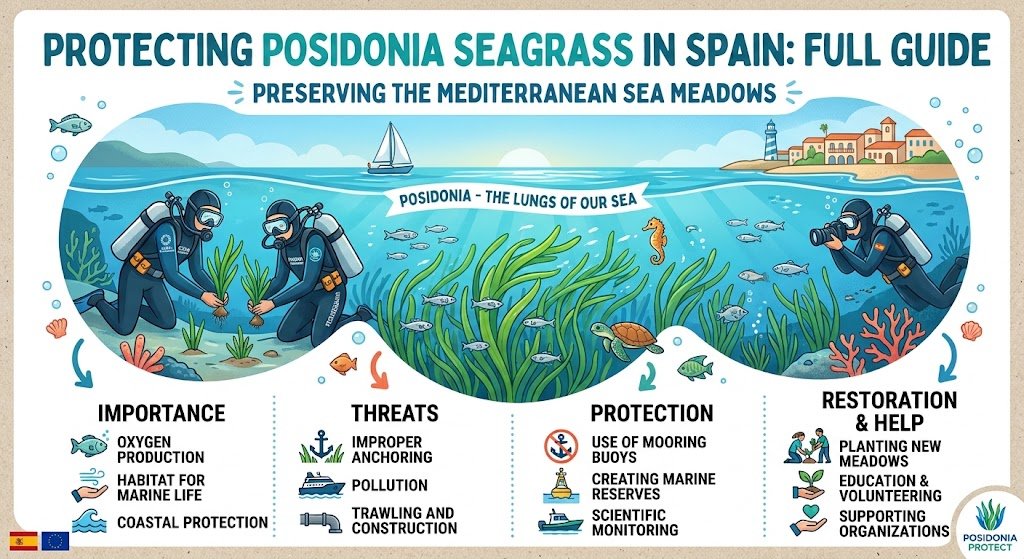
Protecting Posidonia Seagrass in Spain: Full Guide

Beneath the surface of the Mediterranean — spread across the seabed of Costa Blanca’s iconic turquoise bays, stretching from Torrevieja to Dénia in vast underwater meadows — lives one of Europe’s most important and most endangered ecosystems. Posidonia oceanica seagrass is not simply aquatic vegetation. It is the engine of the western Mediterranean’s marine environment: the primary oxygen producer, the cornerstone of the food web, the nursery for hundreds of commercial and recreational fish species, and the direct reason that the water off Spain’s Mediterranean coast is among the clearest in the world. Understanding Posidonia seagrass anchoring rules in Spain is not optional for any responsible boater or sea user — it is fundamental to protecting an ecosystem that supports every activity FreeWIND celebrates.

What Is Posidonia Oceanica?

Posidonia oceanica is an endemic Mediterranean seagrass — it exists nowhere else on Earth. Unlike algae (which are simple, single-celled or filamentous organisms), Posidonia is a true flowering plant with roots, rhizomes, leaves, and flowers, though it completes its entire life cycle underwater. The plant grows in dense underwater meadows (praderas) at depths from the surface (in exceptionally clear water) down to 40–45 metres where sufficient light penetrates. Costa Blanca’s exceptional water clarity allows Posidonia to grow at greater depths than in more turbid European waters.

Posidonia meadows are the marine equivalent of ancient rainforests. A single square metre of healthy Posidonia meadow produces approximately 14 litres of oxygen per day through photosynthesis. A large coastal meadow equivalent to a few football fields produces more oxygen than a terrestrial forest of the same area. The meadows also sequester carbon at extraordinary rates — dead Posidonia accumulates in dense organic mats called matte that can be several metres deep and thousands of years old, locking away carbon that would otherwise contribute to atmospheric warming.

Why Posidonia Creates Crystal-Clear Mediterranean Water

The water clarity that Costa Blanca is famous for — the turquoise and ultramarine colours that make its beaches among Europe’s most photographed — is directly produced by healthy Posidonia ecosystems. The mechanism is elegant: Posidonia leaves trap fine sediment particles that would otherwise remain suspended in the water column, reducing turbidity. The dense root and rhizome systems stabilise the seabed, preventing sediment resuspension by currents and boat wakes. And the meadows’ biological productivity creates water chemistry (low nutrient concentrations, high dissolved oxygen) hostile to the algal blooms that turn water green and murky.

Wherever Posidonia is damaged or destroyed — by anchor drag, coastal construction, aquaculture runoff, or pollution — water clarity decreases noticeably within years. Areas of the Spanish coast where historic Posidonia decline has been documented show water turbidity 30–50% higher than adjacent healthy meadow areas. The crystal-clear water that attracts millions of visitors to Costa Blanca each year exists only because of healthy Posidonia meadows.

How Anchor Damage Destroys Posidonia

Posidonia grows extraordinarily slowly. The rhizomes (horizontal stems from which leaves grow) extend at approximately 1–6 centimetres per year. A meadow covering one hectare may represent 1,000–3,000 years of continuous growth. When a boat anchor is dropped onto a Posidonia meadow, the physical damage occurs in seconds — but recovery requires decades:

  • Initial impact: The anchor itself smashes through the leaf canopy, cutting and uprooting rhizomes over an area of 0.5–2 m².
  • Chain drag: As the anchor digs in and the boat swings on its rode in changing wind and current, the chain sweeps back and forth across the seabed in a circular pattern. A 10-metre boat on a 15-metre anchor rode with moderate wind can have its chain sweep an area of 200–400 m² of seabed with every wind shift.
  • Cumulative damage: A popular anchorage visited by 20–50 boats per summer day for ten years creates barren sand scars covering thousands of square metres that were once productive Posidonia meadow.

Scientific studies of popular Costa Blanca anchorages (Tabarca Island, Cala Ferris, and sections of the Cabo Roig coast) have documented anchor scar formation and quantified the decades-long recovery timescales. The ecological case for preventing anchor damage is scientifically unambiguous.

Spanish Law on Posidonia Protection

Spain has some of Europe’s most robust legal protection for Posidonia meadows, and the enforcement framework has strengthened significantly since 2020:

National and European Framework

Posidonia oceanica meadows are listed in Annex I of the EU Habitats Directive (92/43/EEC) as a Priority Habitat requiring the highest level of protection. Spain’s national implementation through Ley 42/2007 (Natural Heritage and Biodiversity Law) prohibits any activity that causes deterioration of priority natural habitats, including anchor damage to Posidonia meadows.

Valencian Community Decree: Specific Anchoring Prohibition

The Generalitat Valenciana has implemented some of Spain’s most specific and enforceable Posidonia protection regulations. The Decreto 64/2022 and predecessor regulations prohibit anchoring on mapped Posidonia meadows throughout the Valencian Community’s coastal waters (covering all of the Costa Blanca from Pilar de la Horadada to the Valencian city coast).

The regulation establishes three anchoring zones in areas with Posidonia presence:

  • Green zones: Sandy bottom confirmed free from Posidonia. Anchoring permitted.
  • Amber zones: Mixed areas with Posidonia patches. Anchoring with caution, must locate sandy patch visually before dropping hook.
  • Red zones: Dense continuous Posidonia meadows. Anchoring strictly prohibited. Use ecological mooring buoys only.

Penalties for Anchoring on Posidonia

This is where the legal framework has real teeth. Penalties under Spanish environmental legislation for anchoring on or damaging Posidonia meadows:

  • Minor infraction (anchoring on protected meadow without causing significant measurable damage): €1,000–6,000 fine
  • Serious infraction (repeated or significant anchor damage to mapped Posidonia zone): €6,000–60,000 fine
  • Very serious infraction (large-scale damage to priority habitat): up to €300,000 fine

Enforcement is carried out by the Servicio de Vigilancia de Posidonia — dedicated patrol vessels specifically tasked with monitoring anchoring behaviour in Posidonia protection zones on the Costa Blanca and Valencia coast. These patrol boats operate throughout the summer season and issue fines on-the-spot. They carry underwater cameras to document anchor damage at time of inspection.

How to Identify Safe Sandy Anchoring Spots

Finding a safe, sandy anchorage in Posidonia-rich coastal waters requires preparation and on-water skill:

Visual Identification from the Surface

In Costa Blanca’s clear water at depths up to 8–10 metres, Posidonia and sandy seabed are often visually distinguishable from above. Posidonia meadows appear as dark green-brown patches (the canopy of long strap-like leaves). Sandy seabed appears bright white-gold. The contrast is often dramatically clear in good visibility. Circle the potential anchorage at slow speed, looking straight down through the water at the seabed, before dropping the anchor.

Chartplotter Seagrass Overlay Maps

The Spanish environmental authority (Ministerio para la Transición Ecológica) has published detailed Posidonia distribution maps covering the entire Spanish Mediterranean coast. These have been incorporated into several chartplotter software packages including Navionics (available as a layer in Navionics Boating app and Navionics Web). Activating the ‘Posidonia’ or ‘sensitive habitat’ layer shows mapped Posidonia zones as coloured overlays on the nautical chart. This tool is essential for cruise planning and should be standard on any boat operating in Costa Blanca waters.

Sonar / Fish Finder Seabed Discrimination

Modern colour fish finders with CHIRP sonar can discriminate between hard seabed (rock, compacted sand — shown as a strong red or orange return), soft sandy seabed (weaker yellow return), and biological growth including Posidonia (diffuse, cloud-like signal above the seabed return due to the leaves’ acoustic scattering). With practice, reading your sonar to identify sandy patches versus Posidonia is a learnable skill that significantly improves anchoring accuracy.

Ecological Mooring Buoys: The Sustainable Alternative

In response to the Posidonia protection requirements, the Valencian and Murcian coastal authorities have installed networks of boyas ecológicas (ecological mooring buoys) in the most popular anchorages. These buoys are anchored to the seabed by helical ground screws or concrete blocks placed on rock or compacted sand substrate — causing zero damage to Posidonia. The mooring lines connect to a surface buoy with a pickup loop accessible by boat hook.

Ecological buoys at Tabarca Island, Cala Ferris, and other popular Costa Blanca anchorages are available free-of-charge on a first-come, first-served basis. Buoy capacity is typically limited to vessels of 12–15 metres maximum. During peak summer months, popular ecological buoy fields fill by 10–11 AM — arrive early or accept that you will need to find a genuine sandy-bottom alternative anchorage.


🧭 GUIDE & FAQ: Posidonia Seagrass Rules in Spain

Q1: How can I tell from above water if I’m anchoring on Posidonia?

In water depths up to 8–10 metres and good visibility (which is normal on Costa Blanca), you can see the seabed clearly from your boat. Look straight down — dark green-brown patches are Posidonia meadows, bright white-gold areas are clean sand. If you cannot see the seabed clearly enough to identify it (visibility impaired by choppy water or depth exceeding 10m), use your chartplotter’s Navionics Posidonia layer and your fish finder’s seabed type discrimination. When in doubt about seabed composition, use an ecological buoy instead of anchoring.

Q2: What is the ‘matte’ and why should I avoid anchoring on it?

The matte is the accumulated layer of dead Posidonia rhizomes and sediment that builds up beneath living Posidonia meadows over centuries. It can be 1–8 metres thick in old, undisturbed meadows and represents thousands of years of carbon sequestration. The matte is structurally fragile — an anchor penetrating the matte layer causes irreversible structural collapse that exposes the underlying material to erosion. Living Posidonia on top of matte is considered the most sensitive anchoring substrate of all, and anchoring regulations specifically protect matte areas with the highest level of restriction.

Q3: Are there areas of Costa Blanca coast where anchoring on Posidonia is more common due to lack of alternatives?

Yes. Some of the most beautiful and popular anchorages on Costa Blanca — including sections of the Tabarca Island coast, areas of Cala Ferris, and several coves along the Sierra Helada near Benidorm — have extensive Posidonia cover with limited sandy patches. In these locations, ecological mooring buoys are the only environmentally acceptable option. Where buoys are full and no clean sandy bottom is available, the responsible choice is to find an alternative anchorage rather than anchor on Posidonia.

Q4: Does chain damage to Posidonia count under the same penalties as anchor impact?

Yes. Anchor chain sweeping across Posidonia as the vessel swings on its rode constitutes damage to the protected habitat under Spanish law. The patrol vessels of the Posidonia surveillance service can inspect the seabed beneath an anchored vessel and document chain scars in progress. Some of the heaviest fines documented in recent years have involved vessels with anchors on clean sand but chain cutting through adjacent Posidonia as the boat swung in a change of wind direction. Using all-chain or chain-and-rope rodes and ensuring sufficient scope to prevent chain touching the seabed is advisable in sensitive areas.

Q5: Where can I find the official Posidonia distribution maps for Costa Blanca?

Official Posidonia maps are available from the Ministerio para la Transición Ecológica y el Reto Demogrfico (MITERD) through the Banco de Datos de la Naturaleza. Navionics Boating app includes a Posidonia sensitive habitat overlay (enable ‘Advanced Map’ settings). The Centro de Investigación Submarina at Torrevieja has published detailed local Posidonia surveys. For coastal cruise planning and navigation briefings including current Posidonia protection zone information on the Costa Blanca, the team at seamen.es can provide up-to-date local knowledge and navigation support.

Explore more responsible boating guides at FreeWIND Motor Boats. For expert nautical services and sea-responsible maritime support on Costa Blanca, visit seamen.es.

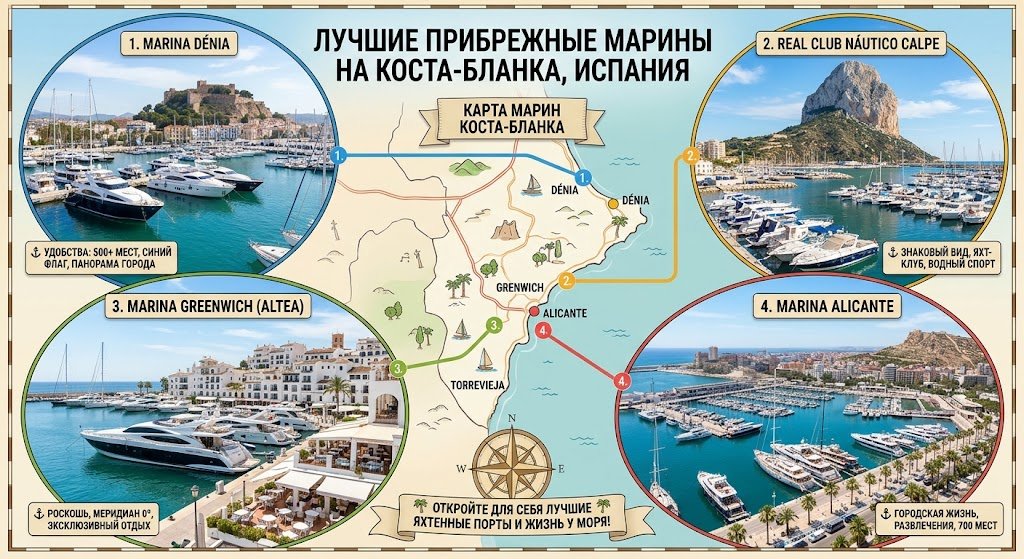
Best Coastal Marinas on Costa Blanca Spain

The quality of a marina defines the quality of your life afloat. For sea lovers living on or visiting the Costa Blanca — whether you own a motor cruiser, a sailing yacht, a RIB, or simply seek the vibrant social atmosphere of a working nautical community — choosing the right marina is as important as choosing the right vessel. This comprehensive guide covers the best coastal marinas on Costa Blanca, from their facilities and berth dimensions to their local water sports culture, visitor mooring options, haul-out services, and the distinctive social character that makes each one a destination in its own right.

Why Costa Blanca Marinas Stand Out in Spain

The Alicante province coastline hosts a remarkable concentration of well-developed marina facilities along its 200 km stretch. Unlike some Spanish coastal areas where marinas are spaced far apart or limited in services, Costa Blanca’s marinas range from compact local club harbours to large international-standard facilities with full haul-out, engine servicing, chandlery, waterfront dining, and year-round visitor mooring.

Several factors make this coast particularly attractive for visiting and resident mariners:

  • Climate: Over 300 days of sunshine annually with mild winters allowing year-round boating.
  • Prevailing winds: Predominantly offshore winds (Poniente and Tramontana) and the predictable daily sea breeze (virazón) create reliable sailing and boating conditions.
  • Protected anchorages: Numerous natural coves provide sheltered overnight anchorages between marinas for cruising yachts and motorboats.
  • Marine reserves: Tabarca Island, the Columbretes Islands (accessible from Castellon), and multiple coastal marine protected areas make Costa Blanca a destination of genuine ecological interest for responsible sea users.

Marina Salinas — Torrevieja

Located at the northern end of Torrevieja’s urban waterfront, Marina Salinas is one of the most characterful marinas on the southern Costa Blanca. The marina takes its name from the adjacent salt lakes (Salinas de Torrevieja) — the pink-tinted lagoon visible from the sea that gives Torrevieja its distinctive identity.

  • Total berths: Approximately 320
  • Maximum vessel length: 30 metres
  • Visitor mooring: Visitor berths available, pre-book advised in summer (July–August)
  • Services: Fuel dock (diesel and petrol), fresh water, electricity (220V), pump-out station, marine mechanic workshop, winter storage yard
  • Social scene: The marina-front promenade (paseo marítimo) hosts excellent seafood restaurants, particularly known for fresh Mediterranean fish and the local signature dish of rice dishes (arroces)
  • Access to Tabarca: This is the southernmost mainland departure point for boat trips to Tabarca Island — the route of approximately 14 nautical miles passes through productive dolphin habitat

Real Club Náutico Torrevieja

Adjacent to Marina Salinas and operating as a traditional yacht club, the Real Club Náutico de Torrevieja (RCNT) is the social heart of Torrevieja’s nautical community. Founded in 1981, the club organises an extensive calendar of sailing races, powerboat events, open water swimming, and SUP competitions throughout the year. For FreeWIND community members, RCNT represents the intersection of organised sport, community, and sea culture on Costa Blanca.

The club’s facilities include a slipway, storage for smaller craft including kayaks and SUP boards, changing rooms, and a bar-restaurant with direct waterfront views. Membership is open to all nationalities, and the club has a notably international membership including large British, German, Scandinavian, and Dutch expatriate communities.

Club Náutico Santa Pola

Santa Pola, 25 km north of Torrevieja, hosts what is arguably the most strategically important marina on the southern Costa Blanca — the closest mainland port to Tabarca Island (just 4.5 nautical miles) and the primary departure point for boat trips to the marine reserve.

  • Total berths: Approximately 500 (a mix of yacht club and commercial marina)
  • Maximum vessel length: 25 metres
  • Visitor mooring: Available in the commercial port section; the yacht club section requires membership or reciprocal club arrangement
  • Services: Fuel dock, chandlery, marine mechanic (authorised Mercury, Yamaha service), haul-out (travel lift to 30 tonnes), storage yard, boat cleaning services
  • Slipway: Public slipway available for launching trailered vessels — fees apply in summer
  • Water sports scene: Santa Pola hosts an active kitesurfing community (the area south of the town offers consistent sea breeze conditions), sailing training clubs, and the primary embarkation point for sport fishing charters targeting the offshore waters around Tabarca

Puerto de Guardamar del Segura

Situated at the mouth of the Segura River, Guardamar’s fishing port and marina complex offers a more authentic, working-port atmosphere compared to the polished tourist-oriented marinas further north. The river mouth location means interesting tidal and current dynamics (unusual on the virtually tideless Mediterranean), and the adjacent dune nature park creates a remarkable natural backdrop for moored vessels.

  • Character: Working fishing port with a small recreational marina section. More authentic and less expensive than tourist marinas.
  • Best for: Sport fishing boat owners, cruisers seeking an economical overnight stop between Torrevieja and Alicante, and kayak/SUP paddlers using the river mouth as a sheltered base.
  • Special attraction: The Guardamar fish market (lonja) operates early morning auctions of fresh-landed Mediterranean fish — a fascinating spectacle and opportunity to buy the freshest possible seafood directly from the auction.

Marina de Dénia

At the northern end of the Costa Blanca, Dénia marina serves as the premier departure point for ferry crossings to Ibiza and Mallorca and as a major hub for Costa Blanca sailing and charter activity. Dénia occupies a distinctive geographic position: the towering rock of Mongo, rising 750 metres above sea level directly behind the town, creates a dramatic navigational landmark visible from 30+ nautical miles offshore.

  • Total berths: Over 700, making it one of the largest marinas on the Costa Blanca
  • Maximum vessel length: 40 metres
  • Ferry service: Regular Balearia Lines and Transmediterranea ferry services to Ibiza and Palma de Mallorca depart from Dénia — for sailors, this makes Dénia the gateway to the Balearic Islands circuit
  • Services: Full marina services including live-aboard facilities, long-term mooring, large chandlery, sail maker, diesel and petrol, 150-tonne travel lift
  • Water sports: Dénia’s beach south of the harbour (Les Marines) offers excellent windsurfing and kitesurfing, and the sheltered Portitxol cove north of town is a popular scuba diving and snorkeling spot

Marina Cabo Roig — Orihuela Costa

Tucked beneath the dramatic sandstone cliffs of Cabo Roig between Torrevieja and Cabo Cervera, this compact and attractive marina offers a more intimate atmosphere than the larger facilities. It caters primarily to day boats and small motor cruisers belonging to the residential communities of Orihuela Costa — one of the largest British expatriate settlements in Europe.

  • Total berths: Approximately 150
  • Character: Quiet, residential marina with strong British expat community feel
  • Best for: Small day boats, RIBs, and SUP paddlers using the adjacent sheltered bay as a launch point for the secret coves between Cabo Roig and Cabo Cervera
  • Waterfront dining: Several excellent seafood restaurants directly on the marina’s quayside — the grilled fresh fish menus here are outstanding value

🧭 GUIDE & FAQ: Costa Blanca Marinas

Q1: How far in advance should I book visitor mooring on Costa Blanca in summer?

For July and August visits, contact marinas at least 4–6 weeks in advance. Peak summer is extremely busy on Costa Blanca — particularly Santa Pola (Tabarca day-trippers) and Torrevieja. Marina Dénia handles high volumes of Balearic-bound cruising yachts in summer. Shoulder season (May–June and September–October) usually allows last-minute arrivals. Most Costa Blanca marinas can be contacted for visitor berth enquiries through the Puertos del Estado port authority system or directly via marina office.

Q2: What are typical visitor mooring costs on Costa Blanca?

In 2024, visitor mooring rates for a 10-metre vessel ranged from approximately €35–80 per night depending on location and season. Santa Pola and Torrevieja represent mid-range pricing. Dénia commands slightly higher rates reflecting its larger facility. All rates include electricity and water. Fuel is priced at the current Spanish market rate (significantly cheaper than France or Italy for marine diesel). Haul-out and storage costs vary by vessel length and duration — contact marinas directly for quotes.

Q3: Can I launch my own trailered boat at Costa Blanca marinas?

Several Costa Blanca marinas and port facilities have public slipways available for trailered vessel launching. Santa Pola has the most accessible and well-maintained public slipway in the southern Costa Blanca. Guardamar’s river mouth area also has slipway access. Slipway fees typically range from €10–30 per launch and retrieval, with seasonal passes available from some facilities. Call ahead to confirm slipway depth (minimum 1.2m at low tide recommended for most trailered boats) and tidal conditions.

Q4: Are SUP boards and kayaks allowed in marina areas?

Non-motorised watercraft (SUP, kayak, canoe) are generally permitted to transit marina entrance channels and access adjacent coastal waters. However, most marinas have specific designated non-motorised craft access routes and timing restrictions — paddlers should not paddle through active vessel traffic in main fairway channels. Several Costa Blanca marinas have dedicated non-motorised sports areas or beaches adjacent to the main facility. Always yield to all powered vessels in confined marina waters.

Q5: Where can I find professional nautical services across Costa Blanca marinas?

For comprehensive nautical services spanning multiple marinas on the Costa Blanca — including vessel management, crew placement, charter organisation, and professional boat maintenance coordination — the team at seamen.es operates across the region and provides expert support for vessel owners and visiting mariners. Whether you need a skilled mechanic, a licensed skipper for a day charter, or advice on the best marina for your vessel’s specifications, their local expertise is invaluable.

Explore all our boating guides at FreeWIND Motor Boats. For professional maritime services on the Spanish Mediterranean, visit seamen.es.

Boat Maintenance & Winterizing in Spain Guide

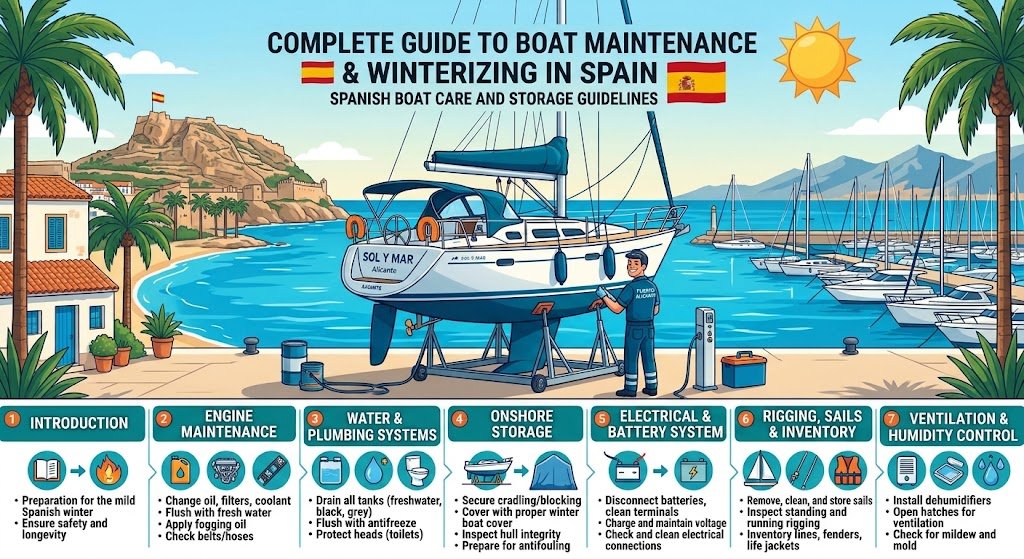
Owning or regularly using a boat in the Mediterranean presents unique maintenance challenges that differ fundamentally from freshwater or cold northern European environments. The combination of high salinity, intense UV radiation, warm water temperatures that accelerate biological growth, and extended summer operating seasons creates a demanding environment for every component from the engine to the hull antifouling. This comprehensive guide covers boat maintenance in Mediterranean Spain, from the specific corrosion threats unique to the Alicante and Murcia coastlines to practical winterising approaches, marina storage options, and the annual maintenance schedule that keeps Mediterranean boats performing safely and reliably.

Understanding Mediterranean Saltwater Corrosion

The Mediterranean Sea has an average salinity of approximately 38 parts per thousand (ppt) — significantly higher than the Atlantic (approximately 35 ppt) due to the near-enclosed basin’s high evaporation rate and limited freshwater inflow. This elevated salinity accelerates electrolytic and galvanic corrosion in all metal components below and above the waterline.

The specific corrosion mechanisms affecting Mediterranean boats include:

  • Galvanic corrosion occurs when two dissimilar metals are in electrical contact in a saltwater electrolyte. The most common example on a Mediterranean day boat: an aluminium outboard engine bracket paired with a stainless steel transom fitting. The aluminium dissolves as the ‘sacrifice’ metal in the galvanic couple.
  • Crevice corrosion attacks fittings, bolts, and hardware where saltwater can penetrate narrow gaps and become trapped — particularly common in bilge areas, under cleats, and behind instrument panels where ventilation is poor.
  • Salt spray above the waterline attacks aluminium windscreen frames, stainless steel railings, electrical connectors, and painted surfaces. Boats moored in marinas with prevailing afternoon sea breezes accumulate salt deposits rapidly on deck fittings.

Engine Flushing: The Most Important Routine Maintenance Task

For outboard and sterndrive engines — the most common powerplants on day boats and RIBs along Costa Blanca — flushing with fresh water after every use is the single most impactful maintenance action you can take. Salt crystals left in engine cooling passages, water pump impellers, and thermostat housings cause progressive restriction of cooling flow, leading to overheating damage that can write off an engine.

Outboard Engine Flushing Procedure

The standard procedure for most modern outboards (Yamaha, Mercury, Honda, Suzuki, Evinrude/BRP):

  1. Connect a garden hose to the engine’s fresh water flush port (most modern outboards have a dedicated flush connection on the engine body or lower unit) or use earmuff-style flushing cups placed over the lower unit water intakes.
  2. Turn on the fresh water supply to provide strong flow.
  3. Start the engine and run at idle for 5–8 minutes. Confirm a steady stream of water exits the engine’s water tell-tale (the thin stream of water that should pour from a small hole above the propeller when the engine runs).
  4. Shut off the engine, then the water supply.
  5. While the engine is still warm, spray an engine corrosion protector (CorrosionX, Boeshield T-9, or similar) into the carburetor air intake and over all external metal surfaces.

This procedure takes 10 minutes and should happen after every single use in salt water. Skipping even occasional post-use flushes allows salt deposits to build progressively in internal passages.

Sacrificial Anodes: Essential Galvanic Protection

Sacrificial anodes (also called ‘zincs’, though modern high-performance anodes use aluminium-indium-zinc alloys rather than pure zinc) protect the more valuable metal components of your drive system by providing a more reactive metal for galvanic corrosion to consume first. Anodes must be replaced regularly — once consumed beyond 50% of their original mass, they provide insufficient protection.

On a typical outboard motor, anodes are located on:

  • The cavitation plate (just above the propeller)
  • The trim tabs (on either side of the lower unit)
  • The mounting bracket (on bracket-mounted engines)
  • The transom plate (transom-mounted engines)

In the warm, high-salinity Mediterranean, anodes typically require replacement every 6–12 months rather than the 12–18 month cycles common in colder, lower-salinity Atlantic environments. Inspect anodes every 3 months and replace when they reach 50% consumption.

Critical tip for Mediterranean mooring: If your boat is permanently moored in a marina (afloat, not dry), shore power connections introduce stray current that dramatically accelerates anode consumption. Boats on shore power may require quarterly anode replacement. Invest in a galvanic isolator for your shore power connection to minimise this accelerated consumption.

Antifouling Paint: Schedule and Product Selection

The Mediterranean’s warm water temperatures support prolific biological growth on boat hulls: barnacles, mussels, tube worms, algae, and various encrusting organisms. Without antifouling bottom paint, a hull left in the water for one Mediterranean summer will accumulate 3–5 cm of biological fouling that dramatically increases drag, reduces speed by 20–40%, and creates habitats for electrolytic corrosion.

For Mediterranean conditions, self-polishing copolymer (SPC) antifouling paints provide the most effective long-term protection. Recommended products for the Costa Blanca environment:

  • International Micron Extra (self-polishing, biocide-rich, excellent for hot Mediterranean waters)
  • Hempel Antifouling Classic (widely available in Spanish chandleries, cost-effective)
  • Seajet 034 Shogun (hard matrix, suitable for boats that spend periods out of the water during winter)

Apply antifouling annually for boats permanently moored. For boats on dry storage over winter, the annual slipway visit provides the opportunity for proper hull inspection, antifouling application, and anode replacement. Most Spanish marinas have haul-out facilities — Club Náutico Santa Pola, Marina Salinas (Torrevieja), and Puerto de Guardamar all offer boat haul-out and dry storage services.

Winterising vs. Year-Round Operation in Spain

Unlike northern European boating environments where October signals the end of the season and full winterisation is mandatory, the Mediterranean Costa Blanca climate allows extended operating seasons. Many boaters use their vessels through November and December on settled weather days, and some small boat operators use their craft year-round.

For those who do take their boat out of active use over winter, the following procedures protect against the specific threats of the Mediterranean winter environment:

  • Fresh water flush all engine cooling circuits thoroughly.
  • Fog internal engine cylinders with storage oil (spray through spark plug holes after removing plugs).
  • Fill the fuel tank to 90% capacity to prevent condensation build-up in the tank, and add a fuel stabiliser (Star Tron, Techron Marine, STA-BIL) to prevent petrol degradation.
  • Remove and fully charge the battery, store in a cool, dry location, and connect to a smart maintenance charger to prevent sulphation.
  • Cover the boat with a well-ventilated custom cover or breathable canvas — not plastic sheeting, which traps moisture and accelerates mould growth in Mediterranean humidity.
  • Treat all upholstery with mildew protector — cockpit cushions and helm seats are particularly vulnerable to mildew in the mild, humid Mediterranean winter.

Marina Storage Options on Costa Blanca

Two primary storage approaches are available in the Alicante and Murcia region:

Wet Berth (Afloat Mooring)

Your boat remains in the water year-round at a marina pontoon. This is the most convenient option — the boat is always ready to use — but requires proactive antifouling maintenance and accelerated anode replacement due to permanent immersion. Marina berth costs on Costa Blanca range from approximately €150–600/month for a 6–8 metre day boat at facilities like Marina Salinas (Torrevieja) or Puerto de Guardamar, depending on beam, location in the marina, and services included.

Dry Stack (Marina Seca)

Dry stack storage involves keeping the boat ashore in a secure, racked storage facility. A forklift launches and retrieves the boat when needed — typically within 30 minutes of notification. Dry stack dramatically reduces antifouling costs (hulls require antifouling less frequently when not permanently immersed), eliminates anode acceleration from stray current, and reduces osmotic blistering in fibreglass hulls. Several facilities in the Alicante region offer dry stack services — the team at seamen.es can provide current recommendations for dry storage facilities in the Torrevieja and Santa Pola area.


🧭 GUIDE & FAQ: Boat Maintenance in Mediterranean Spain

Q1: How often should I service my outboard engine in Mediterranean conditions?

Follow the manufacturer’s service intervals (typically 100 hours or annually for the primary service), but in Mediterranean conditions, an annual pre-season service is essential regardless of hours used. The service should include: water pump impeller replacement (every 2 years minimum in Mediterranean heat), spark plug inspection and replacement, gearbox oil change (vital — saltwater ingress through the propeller shaft seal contaminates gearbox oil, which appears milky-white when water contamination is present), fuel filter replacement, and a full check of all anodes.

Q2: My hull has osmotic blisters. Is this serious and can it be repaired?

Osmotic blistering affects fibreglass (GRP) hulls when water permeates the outer gelcoat and reacts with materials within the laminate, creating blisters filled with acidic fluid. In warm Mediterranean water, this process is faster than in cold northern waters. Small blisters (under 5mm) are cosmetic. Larger or numerous blisters indicate genuine osmosis that requires professional treatment: haul the boat, remove antifouling, open and dry all blisters, apply multiple coats of epoxy barrier coat after full drying, and re-antifoul. Do not ignore extensive blistering — severe osmosis compromises laminate structural integrity.

Q3: How do I prevent mould on boat upholstery during the Spanish winter?

Mediterranean winters are mild but humid. Mould thrives in warm, damp, poorly ventilated spaces — exactly what a covered boat cockpit becomes. Prevention: remove all cushions and store indoors (or in breathable mesh bags) during periods of non-use. Treat remaining fabric with marine mildew inhibitor spray. Keep the boat cover well-ventilated (ridge-tent-style covers work better than flat tarps that pool moisture). Leave lockers and hatches slightly ajar to allow airflow through the interior. A moisture-absorbing product (Damp Rid, silica gel containers) inside the cabin significantly reduces humidity.

Q4: What should I do if my engine overheats on the water?

Stop immediately if the engine overheat warning alarm sounds or the tell-tale stream of cooling water stops. Running an overheated outboard even briefly can cause permanent damage (warped cylinder heads, melted pistons). Shut off the engine, let it cool for 20–30 minutes (do not cool with seawater — thermal shock risk), then check the tell-tale with engine running. Most outboard overheat issues in Mediterranean summer are caused by plastic bags, seagrass, or jellyfish (common in Mediterranean summer) blocking the water intake. Inspect and clear the intake before restarting. If the problem persists, call for assistance via 112 or Salvamento Marítimo on VHF Channel 16.

Q5: Are there qualified marine mechanics on Costa Blanca for outboard servicing?

Yes. The major marinas (Santa Pola, Torrevieja, Guardamar, Denia, Alicante) all have marine mechanic workshops or relationships with certified mobile marine technicians. Authorised service centres for the major outboard brands (Yamaha, Mercury, Suzuki, Honda) are present in the Alicante and Murcia region. For recommendations on reputable marine mechanics and boat maintenance services on Costa Blanca, the nautical services team at seamen.es maintains relationships with vetted professionals across the region and can connect you with the right expertise for your engine and hull type.

Explore more boating guides for the Mediterranean at FreeWIND Motor Boats. For professional nautical services, boat management, and maritime support on Costa Blanca, visit seamen.es.

Recognized Skipper Licenses in Spain Guide

Few nautical adventures match cruising Spain’s sun-drenched coastline, dropping anchor in turquoise coves, and tying up at lively marina quays. However, Spanish maritime authorities, governed by the Directorate General of Merchant Marine (Dirección General de la Marina Mercante – DGMM) and enforced by the Guardia Civil del Mar, uphold strict standards for skipper qualifications. Knowing which recognized skipper licenses in Spain authorize you to take the helm is essential whether chartering or owning a boat.

Whether you hold a British RYA qualification, an International Certificate of Competence (ICC), or wish to earn a Spanish license, here is your definitive guide to recognized qualifications, cruising limits, and required onboard documentation in Spain.

The Spanish Recreational Qualification Hierarchy

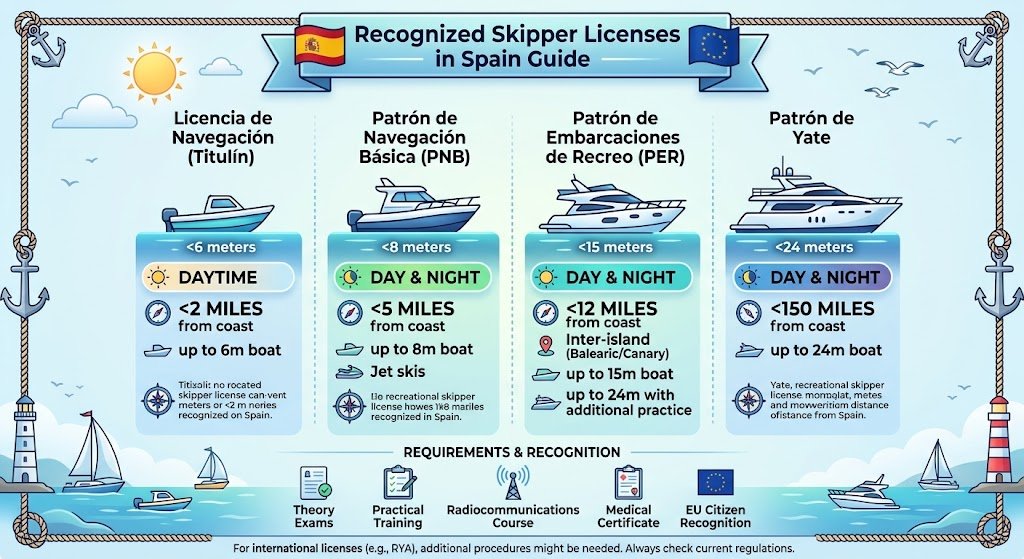
Recreational boating qualifications in Spain are codified under Real Decreto 875/2014, de 10 de octubre. The system comprises four primary leisure skipper tiers:

1. Licencia de Navegación (Formerly “Titulín”)

The entry-level Spanish nautical license is ideal for day cruisers. It authorizes skippering motorboats and sailboats up to 6 meters in hull length with unlimited engine power (up to manufacturer limit), as well as all jet skis (motos de agua). Limitations: daylight navigation only, up to 2 nautical miles from a port or shelter. The course requires 6 hours of instruction (2 hours theory, 4 hours practice) with no official exam required.

2. Patrón de Navegación Básica (PNB)

The PNB permit authorizes commanding motorboats and sailboats up to 8 meters in hull length. It permits both day and night navigation up to 5 nautical miles from a port or coastal refuge. Earning a PNB requires passing a 27-question theory exam, 8 hours of basic safety practices, and 4 hours of radio training.

3. Patrón de Embarcaciones de Recreo (PER)

The PER is the benchmark recreational qualification in Spain. In standard form, it authorizes skippering vessels up to 15 meters in length up to 12 nautical miles offshore, day and night, including coastal passages between islands in the Balearic and Canary archipelagos.

With an optional 24-hour continuous navigation practice module (habilitación a 24 metros y Baleares), PER authority expands to command vessels up to 24 meters and conduct mainland-to-Balearic open-sea crossings.

4. Patrón de Yate & Capitán de Yate

For offshore skippers, Patrón de Yate covers vessels up to 24 meters navigating up to 150 nautical miles offshore. The highest recreational grade, Capitán de Yate, carries no geographical or boat size limits, permitting worldwide oceanic navigation.

Are Foreign Skipper Licenses Recognized in Spain?

If you hold a nautical qualification issued outside Spain, its validity depends on international treaties, vessel flag, and your residency status:

The International Certificate of Competence (ICC – Resolution 40)

Spain adheres to the United Nations Economic Commission for Europe (UNECE) Resolution 40. The ICC is the most universally accepted foreign boating permit in Spain. If your national maritime authority issues an ICC for coastal motor vessels, it is accepted by charter agencies, port authorities, and maritime insurance companies.

UK RYA Qualifications

British Royal Yachting Association (RYA) certifications are widely respected across Spain. For bareboat charters on Spanish-flagged rental vessels (Lista 6ª):

  • RYA Day Skipper (Practical): Authorizes daytime cruising in coastal waters (typically up to 12 miles offshore). Widely accepted by charter companies, especially when paired with an ICC.
  • RYA Coastal Skipper & Yachtmaster: Accepted for extended offshore passages and night cruising within certified limits.

US, Canadian, and Australian Boat Licenses

Certifications from US Sailing, the American Sailing Association (ASA 104 Bareboat Cruising), or Australian State Authorities are recognized for non-resident tourists chartering boats, provided the charter company verifies equivalency under Annex IX of Real Decreto 875/2014.

Crucial Legal Distinction: Tourists vs. Spanish Residents: Foreign certifications are recognized for visiting tourists. However, if you become a registered resident of Spain (empadronado), Spanish law requires you to obtain a Spanish certificate (PNB, PER) or formally homologate your foreign license through the DGMM.

Mandatory Documentation Required on Board

When cruising Spanish waters, the Guardia Civil del Mar or maritime customs can conduct inspections. You must have original documents aboard:

  • Original Skipper License: Valid Spanish certificate, ICC, or approved national license matching vessel size and cruising zone.
  • Identification: Valid passports, national IDs, or NIE certificates for everyone aboard.
  • Boat Registration & Inspection: For Spanish vessels, the Hoja de Asiento, Permiso de Navegación, and valid Certificado de Navegabilidad (ITB).
  • Marine Liability Insurance: Proof of mandatory third-party insurance complying with Real Decreto 607/1999, along with current payment receipt.
  • Charter Agreement: If renting, a signed charter contract and passenger crew list.

Professional Skipper Training and Maritime Services in Spain

Navigating maritime regulations, preparing for PER exams, or homologating foreign skipper titles in Spain can be intricate. For accredited nautical courses, English-language skipper training, boat registration, and legal consulting, partner with the experts at SEAMEN.es. To explore top cruising routes and community boat trips, browse our FreeWIND Motor Boats guides.

Frequently Asked Questions (FAQ)

Can I charter a motorboat in Spain with an RYA Day Skipper certificate?

Yes. The vast majority of professional charter companies across Spain accept the RYA Day Skipper (Practical) certificate for bareboat motorboat charters. Having your RYA certificate endorsed with an ICC provides extra assurance.

Can a foreign boat license be converted into a Spanish PER?

Direct license conversion (convalidación) is possible primarily for qualifications issued by EU member states with bilateral agreements with Spain, processed through the DGMM with certified translations and medical fitness proof.

What are the fines for skippering without a recognized license?

Operating a boat that requires a license without a legally recognized qualification is a serious maritime offense under the Ley de Puertos del Estado. Fines range from €3,000 to €10,000, and the boat will be immobilized by maritime police.

Do I need a separate marine radio license in Spain?

The entry-level Licencia de Navegación does not require radio certification. However, both PNB and PER qualifications include mandatory Short Range Radio Operator modules (Operador de Corto Alcance – ROC) covering VHF DSC radio.

Is a medical exam required for a Spanish boat license?

Yes. Obtaining or renewing a Spanish nautical qualification requires a specialized psychophysical medical certificate (Certificado Médico de Aptitud Psicofísica) issued by an authorized driver/nautical medical clinic assessing vision, hearing, and coordination.

Marine Weather & Wind Apps for Spain Boating

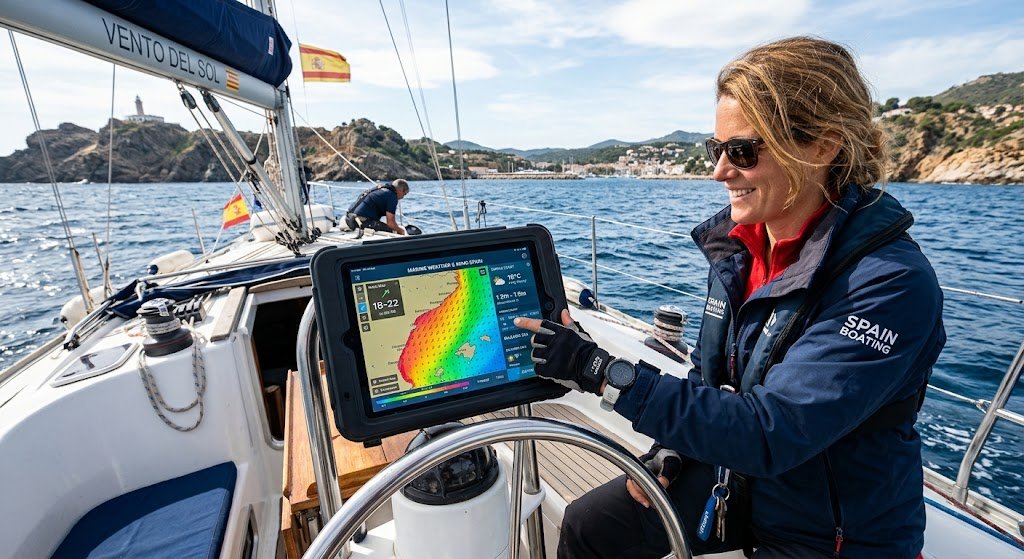
The Mediterranean waters of Spain’s Costa Blanca are famed for sunny cruising, calm anchorages, and turquoise coves. Yet every experienced skipper knows that the sea commands respect. What looks like a calm morning can turn into steep, choppy waves within an hour. Mastering regional weather patterns and choosing the best marine weather apps Spain skippers rely upon is essential for safe motor boating.

From understanding the contrast between humid Levante and scorching Poniente winds to reading wave periods and coastal alerts, here is your essential guide to Mediterranean marine meteorology and navigation apps.

Understanding Costa Blanca Wind Regimes: Levante vs. Poniente

Navigating Spanish coastal waters requires a solid grasp of regional wind systems that govern the Alicante coastline:

The Levante (East / Northeast Wind)

Originating over the central Mediterranean, the Levante gathers moisture across open sea before hitting eastern Spain. It brings humid air, haze, and persistent rolling swells with steep chop. Even a moderate 12-to-15 knot Levante wind can generate 1.0 to 1.5-meter waves along exposed beaches and harbor entrances in Torrevieja and Santa Pola. When Levante blows, seek shelter in west-facing coves or stay moored in the marina.

The Poniente (West / Southwest Wind)

Blowing from continental Spain towards the sea, the Poniente is hot, dry, and gusty during summer. Because it blows offshore, it flattens coastal water near the shore, creating a deceptive mirror-like surface. Warning: Calm nearshore water is deceptive! Poniente winds push drifting vessels, small boats, and paddleboards rapidly away from shore into open waters.

The Thermal Sea Breeze (Virazón)

On sunny summer days without strong regional winds, the land heats up faster than the sea, creating a dependable sea breeze called the Virazón. Starting around 13:00, it blows from the southeast (Garbí), peaks between 15:00 and 17:30 at 12 to 18 knots, and subsides cleanly before sunset. Plan outbound cruising in the morning calm and factor afternoon chop into your return trip.

Swell Height vs. Wave Period: The Critical Safety Factor

Novice boaters frequently check only the forecasted wave height (e.g., “0.8 meters”). However, wave period (the seconds between wave crests) is far more critical for motorboat safety and comfort.

  • Short Period (3 to 5 seconds): Classic Mediterranean wind chop (mar de viento). A 1.0m wave with a 4-second period produces violent, jarring motion that slams against motorboat hulls, causing heavy spray and seasickness.
  • Long Period (8 to 12 seconds): Groundswell (mar de fondo). A 1.0m swell with a 9-second period feels like a smooth, gentle roller that modern motorboats glide over with ease.
Pro-Boater Rule: Prioritize high wave periods over low wave heights. If the wave period in seconds is shorter than wave height in feet multiplied by two, conditions will be steep, close together, and bumpy.

Top Marine Weather Apps Spain Boaters Depend On

Modern mobile tools deliver accurate supercomputer forecasting to your helm console. Here are the top apps for cruising Spanish waters:

1. Windy.com

The definitive multi-model forecasting app for coastal skippers. Windy allows toggling between Europe’s benchmark ECMWF model (9km resolution), the American GFS model, and the German ICON-EU model (7km resolution). It displays wind gusts, wave height, swell period, sea surface temperature, and animated wind arrows.

2. PredictWind

Renowned among offshore sailors and cruisers, PredictWind features high-resolution PWG and PWE micro-models (1km and 8km grids). It delivers precise localized thermal wind predictions around headlands like Cabo Cervera and Cabo de Santa Pola.

3. AEMET (Agencia Estatal de Meteorología)

Spain’s official government meteorological agency provides legal maritime forecasts and coastal alerts (Avisos Costeros):

  • Yellow Alert (Aviso Amarillo): Coastal winds force 7 (28–33 knots) or rough seas (waves 2.5–3m). Exercise caution.
  • Orange Alert (Aviso Naranja): Gale-force winds or very rough seas (waves 4m+). Small leisure boats should remain in port.
  • Red Alert (Aviso Rojo): Extreme maritime danger. Total navigation ban for recreational craft.

4. Windfinder Pro

Known for its clear interface and Superforecast model (7km grid updated 4 times daily), Windfinder delivers 3-hour snapshots of wind speed, gusts, air pressure, and wave direction calibrated for marinas like Torrevieja and Alicante.

5. Puertos del Estado

While weather apps predict conditions, the Puertos del Estado marine network reveals real-time measurements from deep-sea buoys (such as Cabo de Palos). It provides actual measured wave height, water temperature, wind speed, and tidal curves.

VHF Radio Coastal Broadcasts from Salvamento Marítimo

Mobile phone reception can fade offshore or beneath steep cliffs. Spain’s maritime rescue agency, Salvamento Marítimo, broadcasts routine weather bulletins over VHF Channel 16, transferring to working channels (Ch 27 or 74) at scheduled times (typically 09:30, 15:30, and 21:30 UTC).

Pre-Departure Weather Checklist

  • Compare wind forecasts across two independent models (ECMWF vs. ICON on Windy).
  • Confirm the wave period exceeds 6 seconds if wave heights are above 0.7 meters.
  • Check that there are no active AEMET yellow or orange coastal alerts.
  • Plan arrival before afternoon thermal winds reach their peak.

For more boating safety guides and charter tips, visit FreeWIND Motor Boats. For professional skipper training, weather routing, and vessel management in Spain, consult the team at SEAMEN.es.

Frequently Asked Questions (FAQ)

Which forecast model is most accurate for the Spanish Mediterranean?

The European ECMWF model and German ICON-EU model prove most accurate for Mediterranean coastal waters, handling local sea breezes and thermal gradients far better than standard global GFS models.

What wind speed is too high for a small motorboat?

For small motorboats under 6 meters, sustained winds above 12 to 14 knots with short chop make cruising uncomfortable. For craft between 7 and 10 meters, winds up to 18 knots are manageable for experienced skippers in long-period swell.

Why does Poniente make nearshore waters look flat?

Poniente blows offshore from land out to sea. Near the beach, the wind has no distance (fetch) to generate waves, creating deceptive calm. However, offshore currents and waves build rapidly further out.

How can I check actual sea conditions before leaving port?

Check live harbor webcams at Marina Salinas Torrevieja or Santa Pola, and view real-time buoy telemetry on the Puertos del Estado app to see measured wave heights and periods.

What should I do if caught in an unexpected squall?

Put on life jackets, secure loose gear, throttle down to maintain steerage into waves at a 45-degree angle (bow-quartering), and motor towards nearest sheltered harbor. Broadcast a Pan-Pan call on VHF Channel 16 if vessel safety is threatened.

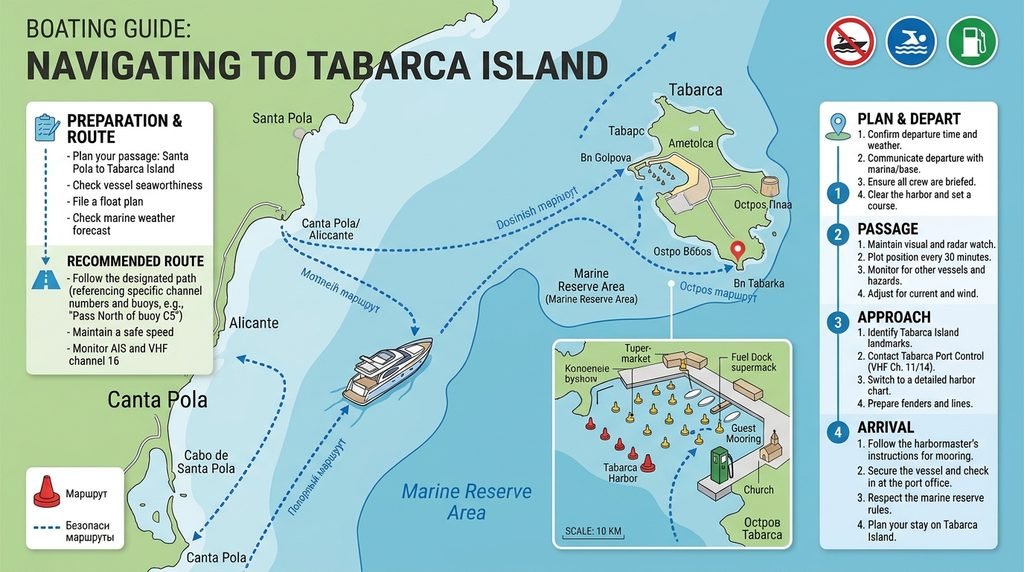
Navigating to Tabarca Island: Boating Guide

Rising like a jewel from the sapphire Mediterranean, the historic islet of Tabarca (Isla de Tabarca or Nueva Tabarca) is the quintessential offshore voyage for motorboaters along the Costa Blanca. Measuring 1,800 meters long and 400 meters wide, this fortified maritime sanctuary was designated Spain’s very first marine reserve in 1986. If you plan to navigate to Tabarca Island on your own vessel or a charter, thorough planning is essential to respect protected ecosystems and ensure a safe passage.

From navigating around shallow reefs and securing ecological mooring buoys to landing tenders and savoring authentic island gastronomy, here is your essential guide to navigating Tabarca safely from Torrevieja, Santa Pola, or Alicante.

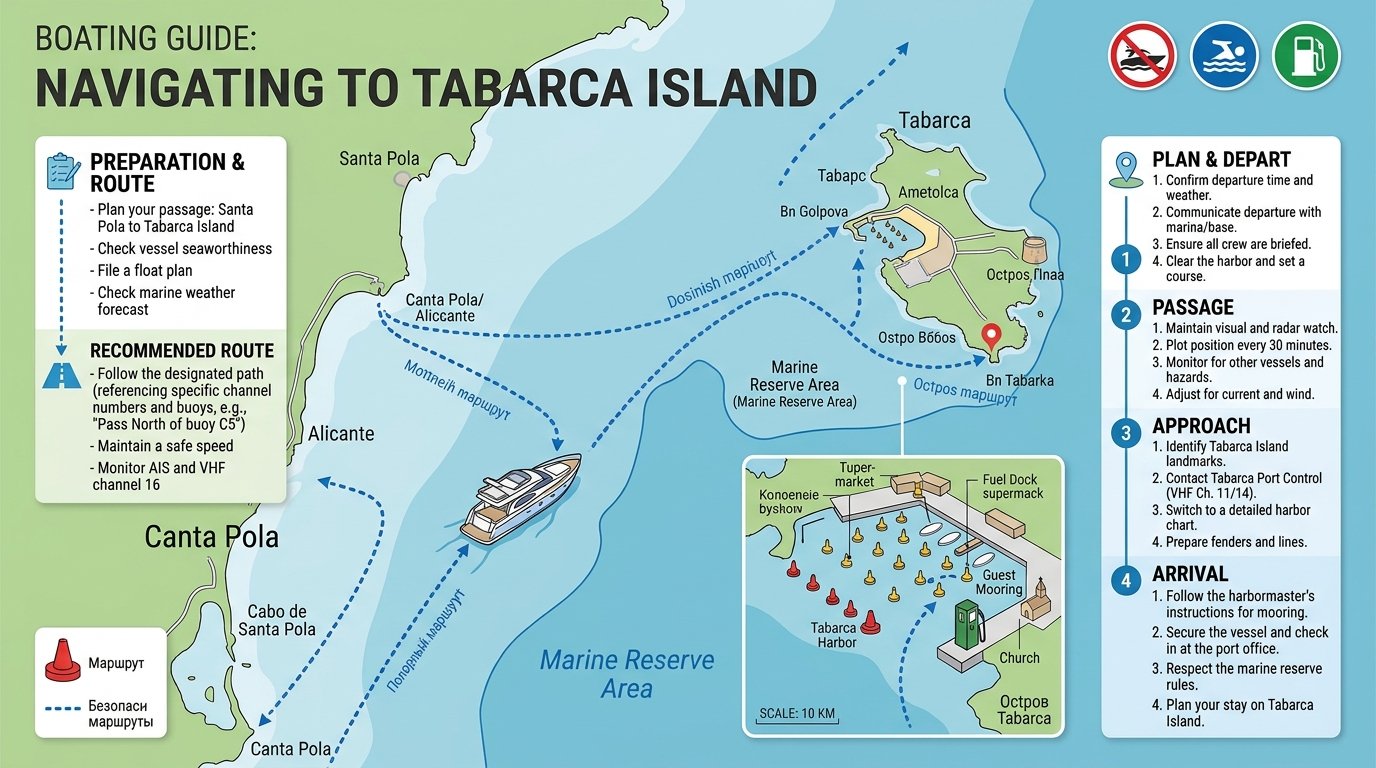
Sea Routes and Distances to Navigate to Tabarca Island Safely

Depending on your departure marina on the Costa Blanca, passages offer distinct conditions and navigation considerations:

Route from Santa Pola Marina (Shortest Crossing)

Santa Pola is the closest port to Tabarca. The passage spans just 4.5 nautical miles on a heading of 135° Southeast. At a cruising speed of 15 to 20 knots, the trip takes only 15 to 20 minutes. It is the smoothest route for small day cruisers, as Santa Pola Bay provides initial shelter before reaching the open passage.

Route from Torrevieja (Marina Salinas & RCNT)

Departing Torrevieja requires a northbound coastal run of approximately 14.0 nautical miles on a heading of 025° North-Northeast. You motor past Cabo Cervera, the sand dunes of Guardamar del Segura, and Santa Pola’s coastline before turning east towards the island. Cruising at 18 to 22 knots covers this distance in 45 to 55 minutes.

Route from Alicante Marina

Leaving Puerto de Alicante entails heading 165° South-Southeast across Alicante Bay for 11.5 nautical miles. The crossing takes approximately 35 to 45 minutes, with panoramic views of Santa Bárbara Castle.

Key Navigational Coordinates & Hazards

  • Tabarca Island Center / Village: 38°09’55” N, 00°28’30” W
  • Tabarca Lighthouse (Faro de Tabarca): 38°09’50” N, 00°28’10” W (Fl(2+1) W 12s, range 14 nautical miles).
  • The Llosa Shoal (Bajo de la Llosa): Located 0.6 miles south-southwest of Tabarca. This dangerous rocky pinnacle rises within 3.5 meters of the surface. Always give La Llosa a wide berth when approaching from Torrevieja.

Marine Reserve Rules & Posidonia Oceanica Protection

The waters surrounding Tabarca belong to the Reserva Marina de la Isla de Tabarca, managed under strict environmental regulations by Spain’s Ministry of Agriculture and Fisheries and the Generalitat Valenciana.

The fundamental rule: anchoring on Posidonia oceanica seagrass is strictly prohibited. Posidonia is a protected endemic marine plant that oxygenates Mediterranean waters and shelters aquatic life. Dropping an anchor into Posidonia rips up fragile roots that take decades to regenerate.

Under Valencian Decree 64/2022, marine surveillance boats (Vigilancia Marina) actively inspect anchorages using underwater cameras. Unlawful anchoring over Posidonia carries fines from €3,000 to over €30,000. Always anchor exclusively in clear white sandy patches or use authorized mooring buoys.

The Ecological Mooring Buoy System (Campos de Boyas)

To preserve the seabed, authorities maintain an ecological mooring buoy field during the summer boating season (June to September). Buoys are color-coded by boat size:

  • White Buoys: For craft up to 8 meters in length.
  • Yellow / Orange Buoys: For vessels between 8 and 12 meters.
  • Red Buoys: Reserved for larger motor yachts up to 15+ meters.

Approach buoys slowly heading into the wind, thread your forward bow line through the buoy ring, and cleat off with sufficient slack to absorb swell.

Dinghy Landing and Ashore Protocol

Tabarca’s small inner harbor is strictly reserved for official passenger catamarans (tabarqueras), local fishermen, and rescue vessels. Private recreational boats cannot dock inside the harbor basin.

To go ashore, anchor in the designated anchorage and launch your dinghy. Motor into the harbor at dead-slow speed (under 3 knots) and secure your dinghy at the public tender pontoon. Ensure your kill switch is attached and oars are aboard. Local water taxis are also available to ferry crew ashore for a small fee.

Snorkeling, History, and Island Gastronomy

Once settled, Tabarca offers extraordinary activities:

  • Marine Life Snorkeling: Marine reserve protections ensure fearless marine fauna. Snorkelers routinely encounter large groupers (meros), gilt-head sea bream (doradas), and schools of obladas in 15-meter visibility.
  • Cueva del Llop Marí: A dramatic sea cave beneath the cliffs, once home to Mediterranean monk seals, perfect for paddleboard exploration.
  • The Fortified Village: Walk through stone gates commissioned by King Carlos III in 1768 to house rescued Genoese fishermen.
  • Caldero Tabarquino: Taste Tabarca’s signature culinary dish: fresh local rockfish served in rich broth with alioli, followed by rice cooked in fish stock.
Pro-Skipper Weather Tip: In easterly Levante winds, anchor in the northern bay (El Portet). In westerly Poniente breezes, anchor south of the isthmus. Depart before afternoon thermal winds peak.

Plan Your Tabarca Cruise with Professional Support

Crossing open water to an offshore island requires confidence, reliable equipment, and sound seamanship. If you are chartering a boat, seeking skipper training, or need vessel management in Spain, contact the maritime specialists at SEAMEN.es. For local routes and boat rental guides, explore our FreeWIND Motor Boats hub.

Frequently Asked Questions (FAQ)

Can I drive a license-free 15 HP boat to Tabarca Island?

No. Under Spanish maritime law (Real Decreto 875/2014), license-free 15 HP boats are strictly limited to 2 nautical miles from shelter. Tabarca is 4.5 miles from Santa Pola and 14 miles from Torrevieja. Attempting this crossing without a license is illegal and dangerous.

Can I anchor anywhere around Tabarca Island?

No. Anchoring is strictly banned on Posidonia seagrass across the marine reserve. You may only anchor in white sand patches outside swimming zones or tie up to designated ecological buoys.

What should I do if all mooring buoys are occupied?

Find an open patch of white sand in 4 to 8 meters of depth on the sheltered side of the island. Drop anchor with 4:1 chain scope and check with a mask that your anchor is firmly set in pure sand.

Are jet skis allowed inside the Tabarca Marine Reserve?

Recreational jet skis are heavily restricted in the reserve. Free-riding, racing, or wave jumping is strictly forbidden, and transit speeds are capped at 3 knots.

What is the best departure time from Torrevieja?

Leave between 08:30 and 10:00 AM when the sea is calmest. Plan your return voyage by 16:30 or 17:00 PM before afternoon sea breezes generate choppy waves.

Driving a Boat in Spain Without a License

Dreaming of cruising the Mediterranean, feeling the sea breeze, and anchoring in secluded coves along the Costa Blanca? You might think skippering a vessel requires formal nautical academy courses and captain licenses. Fortunately, Spanish maritime regulations make sea life accessible: you can legally drive a boat in Spain without a license under specific statutory conditions.

Whether holidaying in Torrevieja, Santa Pola, or Alicante, license-free boats (barcos sin titulación) offer true maritime freedom. However, commanding any motorboat involves safety obligations and legal boundaries enforced by the Coast Guard (Guardia Civil del Mar) and Capitanía Marítima. Here is your complete guide to regulations, safety gear, and top routes.

Legal Rules to Drive a Boat in Spain Without a License

Recreational boating in Spain is governed by national maritime law under Real Decreto 875/2014, de 10 de octubre. Article 10 defines the exact vessel parameters exempt from licensing:

  • Maximum Length: Motorboats must not exceed 5.0 meters in hull length (6.0 meters for sailboats).
  • Maximum Engine Power: Engine output cannot exceed 11.2 kW (15 HP / CV). Any motor above 15 HP requires a certified license, regardless of boat size.
  • Daylight Hours Only: Navigation is permitted strictly from sunrise to sunset (orto a ocaso). Night sailing without a license and navigation lights is illegal.
  • 2 Nautical Mile Boundary: Vessels must remain within 2 nautical miles of a marina, port, or accessible coastal shelter (lugar de abrigo). Open sea crossings are prohibited.
  • Minimum Age: The skipper must be at least 18 years old (or 16 with written parental authorization).

Types of License-Free Boats Available

Modern license-exempt rental fleets on the Costa Blanca offer reliable, modern hulls designed for stability and fuel efficiency:

Rigid Inflatable Boats (RIBs / Semirrígidas)

Measuring 4.2 to 4.8 meters, RIBs feature tough inflatable tubes and deep-V fiberglass hulls. They provide unsinkable buoyancy and absorb wave chop smoothly. Powered by 15 HP four-stroke outboards, they cruise comfortably at 8 to 12 knots with 4 to 5 passengers.

Fiberglass Center-Console Boats

Open fiberglass runabouts feature bow solariums, bimini sunshades, swim ladders, and dry lockers. With higher freeboards, they keep spray out and offer ideal setups for sunbathing, swimming, and family coastal outings.

Mandatory Safety Equipment Required by Capitanía Marítima

As skipper, you are legally responsible for safety on board. Always verify that your boat carries required gear before untying lines:

  • Life Jackets (Chalecos Salvavidas): CE/SOLAS-approved (100N minimum) for 100% of passengers, with proper sizes for children.
  • Kill-Switch Lanyard (Hombre al Agua): Red spiral cord connected to the engine kill switch. Wear it around your wrist or life vest whenever the engine runs.
  • Bailing System: Manual bailer (achicador) or operational electric bilge pump.
  • Oars or Paddle: Auxiliary propulsion in case of mechanical breakdown.
  • Sound Signal: Marine foghorn or whistle to signal in reduced visibility.
  • Ground Tackle: Anchor with chain lead and rope line (minimum 3 times water depth).
  • Fire Extinguisher: Portable 21B extinguisher if the boat has an enclosed tank or engine compartment.
Pro-Skipper Tip: Keep your phone in a waterproof pouch and save Spain’s maritime search and rescue line: Salvamento Marítimo (+34 900 202 202) or call 112 in any emergency.

Essential Navigation Rules & Maritime Etiquette

Navigating safely requires following international collision regulations (COLREGs) and coastal environmental laws:

  • Bathing Zones: Keep at least 200m away from sandy beaches and 50m from rocky shorelines. Never enter yellow buoy swim zones. Only use designated boat channels (canales de varada) at under 3 knots.
  • Harbor Limits: Speed inside ports and marinas like Torrevieja or Santa Pola is restricted to 3 knots. Wake creation is strictly penalized.
  • Right of Way: Motorboats yield to sailboats and non-motorized paddle craft. When meeting head-on, both boats alter course to starboard (right). In crossing paths, give way to vessels on your starboard side.

Top Costa Blanca Routes for License-Free Boats

The protected coastline around Alicante and Torrevieja features idyllic cruising grounds within the 2-mile limit:

  • Torrevieja to Cala Ferris: Head south past the harbor to reach the palm-fringed sands of Cala Ferris. Anchor on sandy patches in 3m depth for superb snorkeling.
  • Santa Pola to Cabo Headland: Cruise east beneath towering cliffs towards the Santa Pola lighthouse for calm, clear swimming waters sheltered from westerly breezes.
  • Torrevieja North to Cabo Cervera: A scenic northbound route past historical coastal watchtowers, offering rocky reefs teeming with Mediterranean marine life.

Upgrading Your Boating License in Spain

A 15 HP boat is the ultimate introduction to seamanship. When you are ready to pilot larger boats, cruise offshore, navigate at night, or cross to Tabarca Island, consider getting an official nautical license like the Licencia de Navegación (Titulín—6-hour course with no exam) or the comprehensive PER (Patrón de Embarcaciones de Recreo).

For accredited skipper licensing, boat documentation, and maritime management, consult our partners at SEAMEN.es. Explore more coastal guides and community trips on our FreeWIND Motor Boats hub.

Frequently Asked Questions (FAQ)

Can foreign tourists drive a boat in Spain without a license?

Yes. The exemption under Real Decreto 875/2014 applies to all nationalities. Presenting a valid passport or national ID and being at least 18 years old is sufficient to charter and operate an eligible craft.

How fast can a 15 HP license-free boat cruise?

With 2 to 4 adults aboard, a 15 HP motorboat typically cruises between 8 and 12 knots (15 to 22 km/h). This speed provides comfortable, scenic cruising with minimal fuel consumption.

What are the fines for sailing beyond 2 miles or after sunset?

Navigating further than 2 nautical miles from shelter or operating after dark without a license constitutes a serious maritime violation. Fines from Capitanía Marítima start at €1,500 and increase depending on conditions and safety infractions.

Are alcohol limits enforced on license-free boats in Spain?

Yes. The Guardia Civil del Mar enforces identical limits to road traffic: 0.5 g/l blood alcohol or 0.25 mg/l breath alcohol. Operating while impaired triggers severe fines and vessel impoundment.

Where am I allowed to anchor safely?

You can anchor outside marked bathing areas (200m from beaches). Always drop anchor in clear sand, never on protected Posidonia oceanica seagrass beds, which is strictly prohibited and heavily fined across the Valencian Community.

Motor Boating in Spain: Coastal Cruising Guide & Best Routes on Costa Blanca

Looking for the ultimate maritime freedom on the Mediterranean? Exploring Spain’s coastline by motor boat—especially along the picturesque Costa Blanca—is one of the most rewarding adventures for water sports enthusiasts.

Why Costa Blanca is a Motor Boater’s Haven

The eastern coast of Spain enjoys over 300 days of sunshine each year, warm temperatures, and calm sea conditions. Torrevieja and neighboring ports (such as Cabo Roig and Santa Pola) provide ideal departure points for exploring secluded marine reserves, rocky coves, and scenic offshore routes.

Understanding Boating in Spain: License vs. License-Free Regulations

For visitors and residents in Spain, maritime regulations make getting on the water very accessible:

  • License-Free Boats (Sin Titulación): Under Spanish maritime law, anyone over 18 can skipper motor boats up to 5 meters in length with engine power up to 15 HP (11.2 kW) during daytime hours within coastal waters without requiring a skipper’s license. They are stable, safe, and intuitive to handle.
  • Licensed Cruising: Boaters holding recognized international qualifications (RYA Day Skipper, ICC, or Spanish PER/PNB) can navigate larger speedboats and offshore cruisers, opening up voyages to offshore islands and remote coastal stretches.

Pro Tip: If you are an expat residing in Spain and considering purchasing or mooring your own private vessel, registering under a European registry can minimize inspection bureaucracy. Check out our technical guide on registering a boat or yacht under the Polish flag in Spain for registration rules, survey exemptions, and tax requirements.

Top Coastal Spots to Explore by Motor Boat

  1. Tabarca Island (Isla de Tabarca): The premier marine reserve in the region, featuring crystal-clear snorkeling waters, historical pirate ramparts, and picturesque anchorage points.
  2. Cala Ferris & Cala Mosca: Secluded coves fringed by wild palm trees and golden sand, ideal for anchoring, swimming, and paddle sports (explore the local shore guide to Torrevieja beaches and natural coves).
  3. Cabo Roig & Campoamor Cliffs: Dramatic coastal topography with deep clear water, popular for scenic cruising and dolphin spotting.

Essential Safety & Navigation Tips

Before leaving the marina, always check the AEMET marine weather forecast (wind knots, swell direction), respect designated swimming buoy lines (200m from beaches), keep certified life jackets on board, and carry fresh drinking water and sun protection.