
Recognized Skipper Licenses in Spain Guide
Few nautical adventures match cruising Spain’s sun-drenched coastline, dropping anchor in turquoise coves, and tying up at lively marina quays. However, Spanish maritime authorities, governed by the Directorate General of Merchant Marine (Dirección General de la Marina Mercante – DGMM) and enforced by the Guardia Civil del Mar, uphold strict standards for skipper qualifications. Knowing which recognized skipper licenses in Spain authorize you to take the helm is essential whether chartering or owning a boat.
Whether you hold a British RYA qualification, an International Certificate of Competence (ICC), or wish to earn a Spanish license, here is your definitive guide to recognized qualifications, cruising limits, and required onboard documentation in Spain.
The Spanish Recreational Qualification Hierarchy
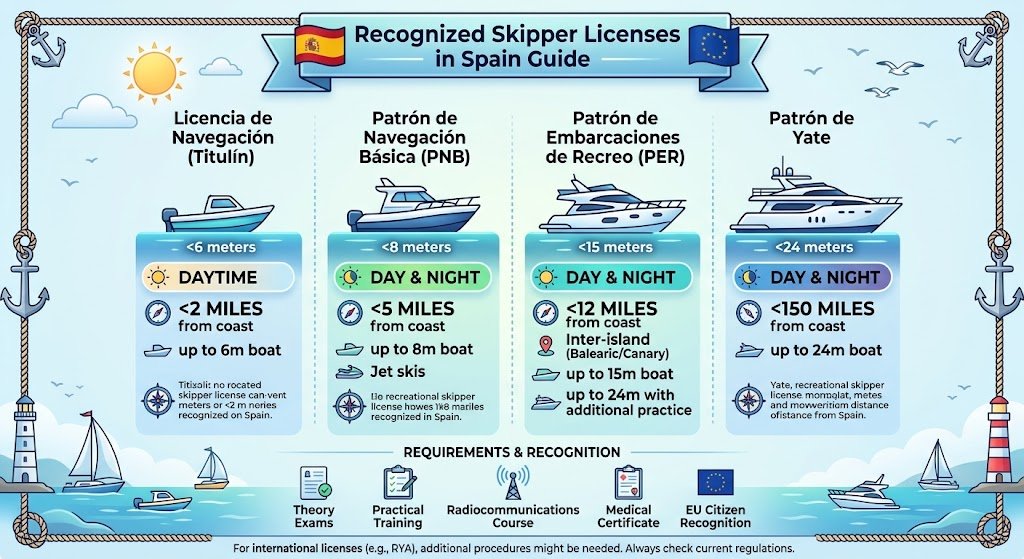
Recreational boating qualifications in Spain are codified under Real Decreto 875/2014, de 10 de octubre. The system comprises four primary leisure skipper tiers:
1. Licencia de Navegación (Formerly “Titulín”)
The entry-level Spanish nautical license is ideal for day cruisers. It authorizes skippering motorboats and sailboats up to 6 meters in hull length with unlimited engine power (up to manufacturer limit), as well as all jet skis (motos de agua). Limitations: daylight navigation only, up to 2 nautical miles from a port or shelter. The course requires 6 hours of instruction (2 hours theory, 4 hours practice) with no official exam required.
2. Patrón de Navegación Básica (PNB)
The PNB permit authorizes commanding motorboats and sailboats up to 8 meters in hull length. It permits both day and night navigation up to 5 nautical miles from a port or coastal refuge. Earning a PNB requires passing a 27-question theory exam, 8 hours of basic safety practices, and 4 hours of radio training.
3. Patrón de Embarcaciones de Recreo (PER)
The PER is the benchmark recreational qualification in Spain. In standard form, it authorizes skippering vessels up to 15 meters in length up to 12 nautical miles offshore, day and night, including coastal passages between islands in the Balearic and Canary archipelagos.
With an optional 24-hour continuous navigation practice module (habilitación a 24 metros y Baleares), PER authority expands to command vessels up to 24 meters and conduct mainland-to-Balearic open-sea crossings.
4. Patrón de Yate & Capitán de Yate
For offshore skippers, Patrón de Yate covers vessels up to 24 meters navigating up to 150 nautical miles offshore. The highest recreational grade, Capitán de Yate, carries no geographical or boat size limits, permitting worldwide oceanic navigation.
Are Foreign Skipper Licenses Recognized in Spain?
If you hold a nautical qualification issued outside Spain, its validity depends on international treaties, vessel flag, and your residency status:
The International Certificate of Competence (ICC – Resolution 40)
Spain adheres to the United Nations Economic Commission for Europe (UNECE) Resolution 40. The ICC is the most universally accepted foreign boating permit in Spain. If your national maritime authority issues an ICC for coastal motor vessels, it is accepted by charter agencies, port authorities, and maritime insurance companies.
UK RYA Qualifications
British Royal Yachting Association (RYA) certifications are widely respected across Spain. For bareboat charters on Spanish-flagged rental vessels (Lista 6ª):
- RYA Day Skipper (Practical): Authorizes daytime cruising in coastal waters (typically up to 12 miles offshore). Widely accepted by charter companies, especially when paired with an ICC.
- RYA Coastal Skipper & Yachtmaster: Accepted for extended offshore passages and night cruising within certified limits.
US, Canadian, and Australian Boat Licenses
Certifications from US Sailing, the American Sailing Association (ASA 104 Bareboat Cruising), or Australian State Authorities are recognized for non-resident tourists chartering boats, provided the charter company verifies equivalency under Annex IX of Real Decreto 875/2014.
Mandatory Documentation Required on Board
When cruising Spanish waters, the Guardia Civil del Mar or maritime customs can conduct inspections. You must have original documents aboard:
- Original Skipper License: Valid Spanish certificate, ICC, or approved national license matching vessel size and cruising zone.
- Identification: Valid passports, national IDs, or NIE certificates for everyone aboard.
- Boat Registration & Inspection: For Spanish vessels, the Hoja de Asiento, Permiso de Navegación, and valid Certificado de Navegabilidad (ITB).
- Marine Liability Insurance: Proof of mandatory third-party insurance complying with Real Decreto 607/1999, along with current payment receipt.
- Charter Agreement: If renting, a signed charter contract and passenger crew list.
Professional Skipper Training and Maritime Services in Spain
Navigating maritime regulations, preparing for PER exams, or homologating foreign skipper titles in Spain can be intricate. For accredited nautical courses, English-language skipper training, boat registration, and legal consulting, partner with the experts at SEAMEN.es. To explore top cruising routes and community boat trips, browse our FreeWIND Motor Boats guides.
Frequently Asked Questions (FAQ)
Can I charter a motorboat in Spain with an RYA Day Skipper certificate?
Yes. The vast majority of professional charter companies across Spain accept the RYA Day Skipper (Practical) certificate for bareboat motorboat charters. Having your RYA certificate endorsed with an ICC provides extra assurance.
Can a foreign boat license be converted into a Spanish PER?
Direct license conversion (convalidación) is possible primarily for qualifications issued by EU member states with bilateral agreements with Spain, processed through the DGMM with certified translations and medical fitness proof.
What are the fines for skippering without a recognized license?
Operating a boat that requires a license without a legally recognized qualification is a serious maritime offense under the Ley de Puertos del Estado. Fines range from €3,000 to €10,000, and the boat will be immobilized by maritime police.
Do I need a separate marine radio license in Spain?
The entry-level Licencia de Navegación does not require radio certification. However, both PNB and PER qualifications include mandatory Short Range Radio Operator modules (Operador de Corto Alcance – ROC) covering VHF DSC radio.
Is a medical exam required for a Spanish boat license?
Yes. Obtaining or renewing a Spanish nautical qualification requires a specialized psychophysical medical certificate (Certificado Médico de Aptitud Psicofísica) issued by an authorized driver/nautical medical clinic assessing vision, hearing, and coordination.