
Boat Maintenance & Winterizing in Spain Guide
Owning or regularly using a boat in the Mediterranean presents unique maintenance challenges that differ fundamentally from freshwater or cold northern European environments. The combination of high salinity, intense UV radiation, warm water temperatures that accelerate biological growth, and extended summer operating seasons creates a demanding environment for every component from the engine to the hull antifouling. This comprehensive guide covers boat maintenance in Mediterranean Spain, from the specific corrosion threats unique to the Alicante and Murcia coastlines to practical winterising approaches, marina storage options, and the annual maintenance schedule that keeps Mediterranean boats performing safely and reliably.
Understanding Mediterranean Saltwater Corrosion
The Mediterranean Sea has an average salinity of approximately 38 parts per thousand (ppt) — significantly higher than the Atlantic (approximately 35 ppt) due to the near-enclosed basin’s high evaporation rate and limited freshwater inflow. This elevated salinity accelerates electrolytic and galvanic corrosion in all metal components below and above the waterline.
The specific corrosion mechanisms affecting Mediterranean boats include:
- Galvanic corrosion occurs when two dissimilar metals are in electrical contact in a saltwater electrolyte. The most common example on a Mediterranean day boat: an aluminium outboard engine bracket paired with a stainless steel transom fitting. The aluminium dissolves as the ‘sacrifice’ metal in the galvanic couple.
- Crevice corrosion attacks fittings, bolts, and hardware where saltwater can penetrate narrow gaps and become trapped — particularly common in bilge areas, under cleats, and behind instrument panels where ventilation is poor.
- Salt spray above the waterline attacks aluminium windscreen frames, stainless steel railings, electrical connectors, and painted surfaces. Boats moored in marinas with prevailing afternoon sea breezes accumulate salt deposits rapidly on deck fittings.
Engine Flushing: The Most Important Routine Maintenance Task
For outboard and sterndrive engines — the most common powerplants on day boats and RIBs along Costa Blanca — flushing with fresh water after every use is the single most impactful maintenance action you can take. Salt crystals left in engine cooling passages, water pump impellers, and thermostat housings cause progressive restriction of cooling flow, leading to overheating damage that can write off an engine.
Outboard Engine Flushing Procedure
The standard procedure for most modern outboards (Yamaha, Mercury, Honda, Suzuki, Evinrude/BRP):
- Connect a garden hose to the engine’s fresh water flush port (most modern outboards have a dedicated flush connection on the engine body or lower unit) or use earmuff-style flushing cups placed over the lower unit water intakes.
- Turn on the fresh water supply to provide strong flow.
- Start the engine and run at idle for 5–8 minutes. Confirm a steady stream of water exits the engine’s water tell-tale (the thin stream of water that should pour from a small hole above the propeller when the engine runs).
- Shut off the engine, then the water supply.
- While the engine is still warm, spray an engine corrosion protector (CorrosionX, Boeshield T-9, or similar) into the carburetor air intake and over all external metal surfaces.
This procedure takes 10 minutes and should happen after every single use in salt water. Skipping even occasional post-use flushes allows salt deposits to build progressively in internal passages.
Sacrificial Anodes: Essential Galvanic Protection
Sacrificial anodes (also called ‘zincs’, though modern high-performance anodes use aluminium-indium-zinc alloys rather than pure zinc) protect the more valuable metal components of your drive system by providing a more reactive metal for galvanic corrosion to consume first. Anodes must be replaced regularly — once consumed beyond 50% of their original mass, they provide insufficient protection.
On a typical outboard motor, anodes are located on:
- The cavitation plate (just above the propeller)
- The trim tabs (on either side of the lower unit)
- The mounting bracket (on bracket-mounted engines)
- The transom plate (transom-mounted engines)
In the warm, high-salinity Mediterranean, anodes typically require replacement every 6–12 months rather than the 12–18 month cycles common in colder, lower-salinity Atlantic environments. Inspect anodes every 3 months and replace when they reach 50% consumption.
Critical tip for Mediterranean mooring: If your boat is permanently moored in a marina (afloat, not dry), shore power connections introduce stray current that dramatically accelerates anode consumption. Boats on shore power may require quarterly anode replacement. Invest in a galvanic isolator for your shore power connection to minimise this accelerated consumption.
Antifouling Paint: Schedule and Product Selection
The Mediterranean’s warm water temperatures support prolific biological growth on boat hulls: barnacles, mussels, tube worms, algae, and various encrusting organisms. Without antifouling bottom paint, a hull left in the water for one Mediterranean summer will accumulate 3–5 cm of biological fouling that dramatically increases drag, reduces speed by 20–40%, and creates habitats for electrolytic corrosion.
For Mediterranean conditions, self-polishing copolymer (SPC) antifouling paints provide the most effective long-term protection. Recommended products for the Costa Blanca environment:
- International Micron Extra (self-polishing, biocide-rich, excellent for hot Mediterranean waters)
- Hempel Antifouling Classic (widely available in Spanish chandleries, cost-effective)
- Seajet 034 Shogun (hard matrix, suitable for boats that spend periods out of the water during winter)
Apply antifouling annually for boats permanently moored. For boats on dry storage over winter, the annual slipway visit provides the opportunity for proper hull inspection, antifouling application, and anode replacement. Most Spanish marinas have haul-out facilities — Club Náutico Santa Pola, Marina Salinas (Torrevieja), and Puerto de Guardamar all offer boat haul-out and dry storage services.
Winterising vs. Year-Round Operation in Spain
Unlike northern European boating environments where October signals the end of the season and full winterisation is mandatory, the Mediterranean Costa Blanca climate allows extended operating seasons. Many boaters use their vessels through November and December on settled weather days, and some small boat operators use their craft year-round.
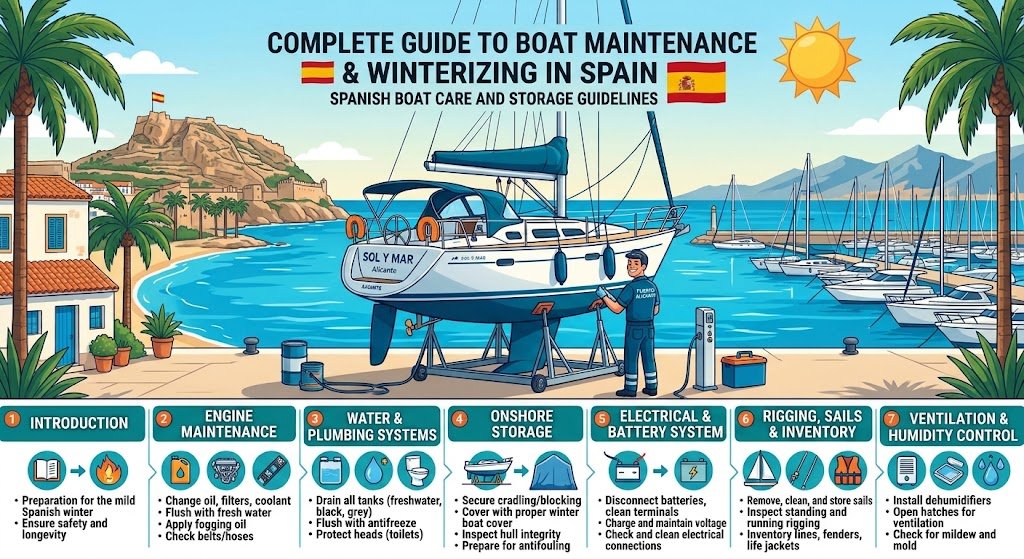
For those who do take their boat out of active use over winter, the following procedures protect against the specific threats of the Mediterranean winter environment:
- Fresh water flush all engine cooling circuits thoroughly.
- Fog internal engine cylinders with storage oil (spray through spark plug holes after removing plugs).
- Fill the fuel tank to 90% capacity to prevent condensation build-up in the tank, and add a fuel stabiliser (Star Tron, Techron Marine, STA-BIL) to prevent petrol degradation.
- Remove and fully charge the battery, store in a cool, dry location, and connect to a smart maintenance charger to prevent sulphation.
- Cover the boat with a well-ventilated custom cover or breathable canvas — not plastic sheeting, which traps moisture and accelerates mould growth in Mediterranean humidity.
- Treat all upholstery with mildew protector — cockpit cushions and helm seats are particularly vulnerable to mildew in the mild, humid Mediterranean winter.
Marina Storage Options on Costa Blanca
Two primary storage approaches are available in the Alicante and Murcia region:
Wet Berth (Afloat Mooring)
Your boat remains in the water year-round at a marina pontoon. This is the most convenient option — the boat is always ready to use — but requires proactive antifouling maintenance and accelerated anode replacement due to permanent immersion. Marina berth costs on Costa Blanca range from approximately €150–600/month for a 6–8 metre day boat at facilities like Marina Salinas (Torrevieja) or Puerto de Guardamar, depending on beam, location in the marina, and services included.
Dry Stack (Marina Seca)
Dry stack storage involves keeping the boat ashore in a secure, racked storage facility. A forklift launches and retrieves the boat when needed — typically within 30 minutes of notification. Dry stack dramatically reduces antifouling costs (hulls require antifouling less frequently when not permanently immersed), eliminates anode acceleration from stray current, and reduces osmotic blistering in fibreglass hulls. Several facilities in the Alicante region offer dry stack services — the team at seamen.es can provide current recommendations for dry storage facilities in the Torrevieja and Santa Pola area.
🧭 GUIDE & FAQ: Boat Maintenance in Mediterranean Spain
Q1: How often should I service my outboard engine in Mediterranean conditions?
Follow the manufacturer’s service intervals (typically 100 hours or annually for the primary service), but in Mediterranean conditions, an annual pre-season service is essential regardless of hours used. The service should include: water pump impeller replacement (every 2 years minimum in Mediterranean heat), spark plug inspection and replacement, gearbox oil change (vital — saltwater ingress through the propeller shaft seal contaminates gearbox oil, which appears milky-white when water contamination is present), fuel filter replacement, and a full check of all anodes.
Q2: My hull has osmotic blisters. Is this serious and can it be repaired?
Osmotic blistering affects fibreglass (GRP) hulls when water permeates the outer gelcoat and reacts with materials within the laminate, creating blisters filled with acidic fluid. In warm Mediterranean water, this process is faster than in cold northern waters. Small blisters (under 5mm) are cosmetic. Larger or numerous blisters indicate genuine osmosis that requires professional treatment: haul the boat, remove antifouling, open and dry all blisters, apply multiple coats of epoxy barrier coat after full drying, and re-antifoul. Do not ignore extensive blistering — severe osmosis compromises laminate structural integrity.
Q3: How do I prevent mould on boat upholstery during the Spanish winter?
Mediterranean winters are mild but humid. Mould thrives in warm, damp, poorly ventilated spaces — exactly what a covered boat cockpit becomes. Prevention: remove all cushions and store indoors (or in breathable mesh bags) during periods of non-use. Treat remaining fabric with marine mildew inhibitor spray. Keep the boat cover well-ventilated (ridge-tent-style covers work better than flat tarps that pool moisture). Leave lockers and hatches slightly ajar to allow airflow through the interior. A moisture-absorbing product (Damp Rid, silica gel containers) inside the cabin significantly reduces humidity.
Q4: What should I do if my engine overheats on the water?
Stop immediately if the engine overheat warning alarm sounds or the tell-tale stream of cooling water stops. Running an overheated outboard even briefly can cause permanent damage (warped cylinder heads, melted pistons). Shut off the engine, let it cool for 20–30 minutes (do not cool with seawater — thermal shock risk), then check the tell-tale with engine running. Most outboard overheat issues in Mediterranean summer are caused by plastic bags, seagrass, or jellyfish (common in Mediterranean summer) blocking the water intake. Inspect and clear the intake before restarting. If the problem persists, call for assistance via 112 or Salvamento Marítimo on VHF Channel 16.
Q5: Are there qualified marine mechanics on Costa Blanca for outboard servicing?
Yes. The major marinas (Santa Pola, Torrevieja, Guardamar, Denia, Alicante) all have marine mechanic workshops or relationships with certified mobile marine technicians. Authorised service centres for the major outboard brands (Yamaha, Mercury, Suzuki, Honda) are present in the Alicante and Murcia region. For recommendations on reputable marine mechanics and boat maintenance services on Costa Blanca, the nautical services team at seamen.es maintains relationships with vetted professionals across the region and can connect you with the right expertise for your engine and hull type.
Explore more boating guides for the Mediterranean at FreeWIND Motor Boats. For professional nautical services, boat management, and maritime support on Costa Blanca, visit seamen.es.