
SUP Yoga & Fitness on the Mediterranean Spain
The idea of practising yoga on a paddleboard sounds like a social media trend — pretty photos for Instagram, perhaps, but not something with genuine physical or mental substance. That assumption, held widely until you try it, evaporates within approximately two minutes of attempting your first Downward Dog on an inflatable SUP floating on the Mediterranean. The subtle, constant micro-adjustments your body makes to maintain balance engage muscle systems that a gym mat never accesses. SUP yoga on the Mediterranean in Spain is one of the most complete and genuinely therapeutic fitness practices available to anyone living near the Costa Blanca coast.
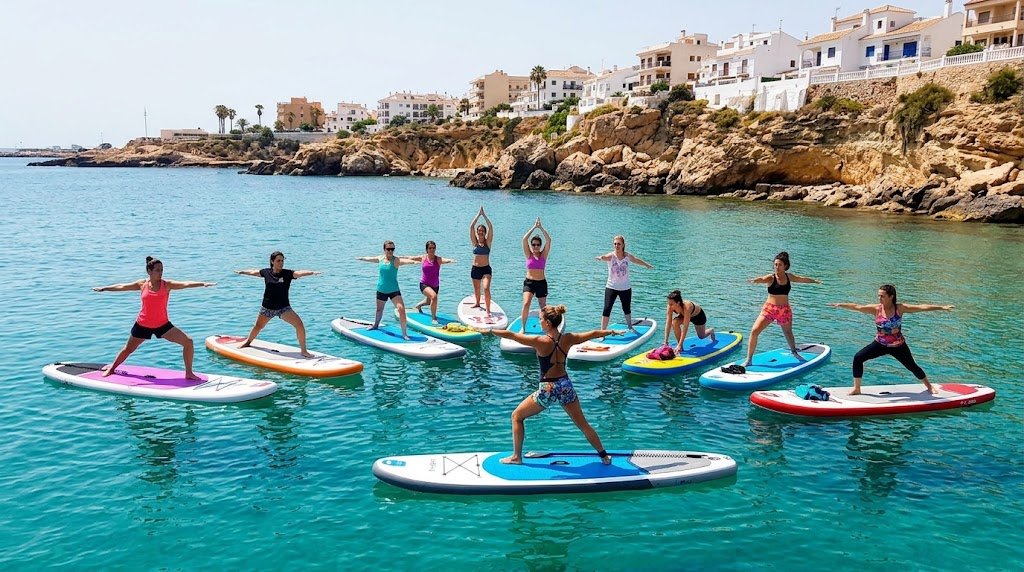
Why the Mediterranean is Perfect for SUP Yoga
The Mediterranean’s characteristically calm morning conditions — particularly between June and October — create near-ideal conditions for water yoga. Unlike Atlantic or Pacific swells that create a constant pitching motion, the Mediterranean morning sea is often so flat that the primary instability comes from your own body movement, not external wave action. This means you can control the challenge level precisely: early poses can be practised in near-perfect stability, while advancing practitioners can seek out gently rolling anchorages or post-sea-breeze chop for additional balance challenge.
The warm water temperature (24–27°C in summer) eliminates the fear of falling. Unlike cold-water environments where an unexpected dip creates an immediate physical shock, Mediterranean falls from a SUP board are simply a refreshing interruption. This psychological comfort fundamentally changes your relationship with balance practice — you commit more fully to challenging poses when you know the consequence of falling is a pleasant swim, not a hypothermic shock.
Choosing the Right Board for SUP Yoga
Not all paddleboards are suitable for yoga practice. The key parameters differ from those prioritised for racing or touring:
- Width: Minimum 32 inches (81 cm), ideally 34–36 inches. A wider board provides a dramatically more stable platform. High-performance narrow touring boards (28–30 inches) require extraordinary balance for yoga practice.
- Length: 10′ to 11′ for yoga-focused all-around boards. Longer touring shapes are less manoeuvrable in wind and harder to maintain stationary.
- Deck pad: Full-length EVA deck pad (covering the entire board, not just the central standing area) allows you to place hands, knees, and feet anywhere on the board surface without slipping on bare fibreglass or PVC.
- Volume: High-volume boards (above 250 litres) provide better stability for the weight distribution shifts that yoga involves. Standard all-around touring boards are typically designed around a standing paddler’s centre of mass — yoga moves that shift weight toward the nose or tail can unbalance a low-volume performance board.
- D-rings for anchoring: Front and rear D-rings allow attachment of an anchor line or mooring buoy cord. Being able to hold position while practising is important for focus and safety.
Anchoring Your Board for Stationary Practice
Unlike paddling sessions where movement is the goal, yoga practice requires your board to remain stationary or nearly so. Two practical solutions work well in Mediterranean coastal waters:
Folding Grapnel Anchor
A small folding grapnel anchor (1–1.5 kg) on 10–15 metres of light braided line works well in the sandy-bottom bays common on Costa Blanca. The anchor holds the board against gentle current and light wind drift. When deploying, check the depth (3–6 metres is ideal) and confirm you are anchoring on sand, not on Posidonia seagrass meadows — which are legally protected and must never be damaged by anchors. The anchor stores neatly in a small bow hatch or bungee-strapped to the board.
Ecological Mooring Buoys
Several popular coves on Costa Blanca (including sections of Cala Ferris and areas near Santa Pola) now have ecological mooring buoys (small blue or white balls) installed to prevent anchor damage to Posidonia. These buoys are accessible to all watercraft including SUP boards. Simply attach your board’s D-ring to the buoy via a short length of rope or caribiner, and you have a stable, environmentally responsible mooring point for your yoga session. Mooring priority goes to visiting boats, so if a boat needs the buoy, politely yield and relocate.
5 Foundational Poses for SUP Yoga on the Mediterranean
1. Child’s Pose (Balasana)
Begin every on-water yoga session here. Kneeling with knees wide and big toes touching, lower your chest and forehead to the deck pad, arms extended forward. This pose is extremely stable (your weight is distributed low and centrally), calming, and grounds you into the rhythm of the water’s gentle movement beneath you. Hold for 60–90 seconds, breathing deeply. The Mediterranean’s natural rocking motion massages your lower back and hips in a way that floor-based Child’s Pose cannot replicate.
2. Downward Facing Dog (Adho Mukha Svanasana)
From Child’s Pose, push up to Downward Dog with hands at the nose end of the board and feet toward the tail. The inverted-V position of the body shifts considerable weight forward — your board will respond by tipping slightly nose-down. Focus on pressing firmly through all ten fingers and toes, distributing weight evenly. Pedalling each foot alternately stretches the calves and hamstrings. This pose builds confidence with the board’s dynamic response to weight shifts. Advanced: lift one leg into Three-Legged Dog.
3. Warrior II (Virabhadrasana II)
Standing poses are the signature challenge of SUP yoga. Stand in the centre of the board, step one foot forward and one back (hip-width apart for stability), bend the front knee to 90 degrees, and extend arms wide — front arm pointing toward the nose, back arm toward the tail of the board. Gaze over your front hand. The lateral weight shift of Warrior II challenges your board’s roll stability significantly — engage your core actively and keep your gaze fixed on a point on the horizon. The expansive Mediterranean view from Warrior II at sunrise is extraordinary.
4. Cat-Cow (Chakravakasana)
One of the gentlest and most beneficial spinal mobilisation sequences, Cat-Cow on a paddleboard adds a proprioceptive challenge that makes the movement far more effective than floor practice. On all fours (tabletop position), inhale and let your belly drop toward the board (Cow), lifting your head and tailbone. Exhale and press your spine toward the sky (Cat), dropping your head and tailbone. The board’s response to your breathing and spinal movement creates a fascinating biofeedback loop that dramatically increases body awareness.
5. Savasana (Corpse Pose / Final Relaxation)
End every session lying flat on your back, arms slightly away from the body, eyes closed. On a paddleboard on the Mediterranean, this is genuinely transcendent. The gentle rocking of the water beneath you, the warmth of the morning sun, the sound of small waves lapping the board edges, and the vast blue sky above create a sensory environment that mat-based Savasana cannot approach. Remain here for 5–10 minutes. Your body temp drops rapidly when inactive — if the morning air is cool, have a towel ready to cover yourself. This is the pose that converts casual fitness paddlers into dedicated SUP yoga practitioners.
Best Sheltered Bays for SUP Yoga on Costa Blanca
Location matters enormously for yoga practice. Exposed stretches with boat traffic, afternoon chop, or strong current are unsuitable. The following sheltered bays on Costa Blanca offer ideal conditions for anchored SUP yoga sessions:
- Cala Ferris (Torrevieja): Sheltered from prevailing NE winds by the headland, sandy bottom suitable for lightweight grapnel anchoring, and one of the most beautiful natural settings on the coast. Arrive before 08:00 AM for guaranteed flat water.
- Inner bay, Playa Flamenca (Orihuela Costa): A calm, sheltered sandy bay with very gentle conditions suitable for beginners to SUP yoga. Boat traffic is minimal early morning.
- Mar Menor, La Manga: The sheltered lagoon offers zero swell, warm water, and shallow depth (<3m) making it the safest location for beginners. Anchor or simply allow gentle drift in the wide, calm lagoon.
🧭 GUIDE & FAQ: SUP Yoga on the Mediterranean
Q1: Do I need yoga experience to try SUP yoga?
No yoga experience is necessary. However, some basic familiarity with pose names and cues makes instruction easier if you’re following an online video. Total beginners often find that starting with grounding poses (Child’s Pose, Cat-Cow, seated twists) builds confidence before attempting standing poses. Paddleboarding experience, similarly, is not required — you can practise yoga on a board in ankle-deep water near the shore if you’re not yet confident on open water.
Q2: What should I wear for SUP yoga on the Mediterranean?
In summer (June–September), swimwear or a rash vest and board shorts are ideal. The deck pad grips bare skin and bare feet far better than socks or yoga pants, which can slip. In spring and autumn, a 2mm shorty wetsuit keeps you warm during the inactive periods of the session (particularly in Savasana). Always apply waterproof SPF 50+ sunscreen — you are horizontal, face-up, at high elevation relative to the water surface, exposed to direct and reflected UV radiation simultaneously.
Q3: How do I get back on the board after falling in?
Approach the board from the side (never the nose or tail, as these are the most unstable re-entry points). With one hand on the centre handle and your body horizontal in the water, kick your legs to generate momentum and pull yourself up onto the board in one smooth movement, ending in a prone (face-down) position. From there, push up to hands and knees. Practice this re-entry technique in shallow water before attempting it in deep water — it requires no strength but benefits significantly from practice.
Q4: Can I follow a yoga video during a SUP session?
Yes, with a waterproof phone holder or a bluetooth speaker on your board. Several YouTube channels and apps (Yoga by Adriene, SUP Yoga with Sydney Malseed, Down Dog app) offer sessions adaptable for paddleboard use. Alternatively, record yourself practising poses to analyse alignment later — a GoPro or action camera mounted on a board nose mount provides useful self-coaching footage. Keep devices in waterproof cases — Mediterranean saltwater corrodes electronics rapidly.
Q5: Are there SUP yoga classes or instructors on Costa Blanca?
SUP yoga is growing rapidly in popularity along the Costa Blanca. Several beach yoga instructors now offer SUP yoga sessions at Torrevieja, Guardamar, and Calpe. The FreeWIND community occasionally organises group SUP yoga mornings — follow our blog and social channels for upcoming events. For broader water sports activity connections across the region, including organised sea activities and club sessions, visit seamen.es.
Explore more Costa Blanca paddleboarding content in our SUP & Surfing section. For all things nautical on Spain’s Mediterranean coast, visit our partners at seamen.es.