
Minimum Fish Sizes in Mediterranean Spain: Full Guide
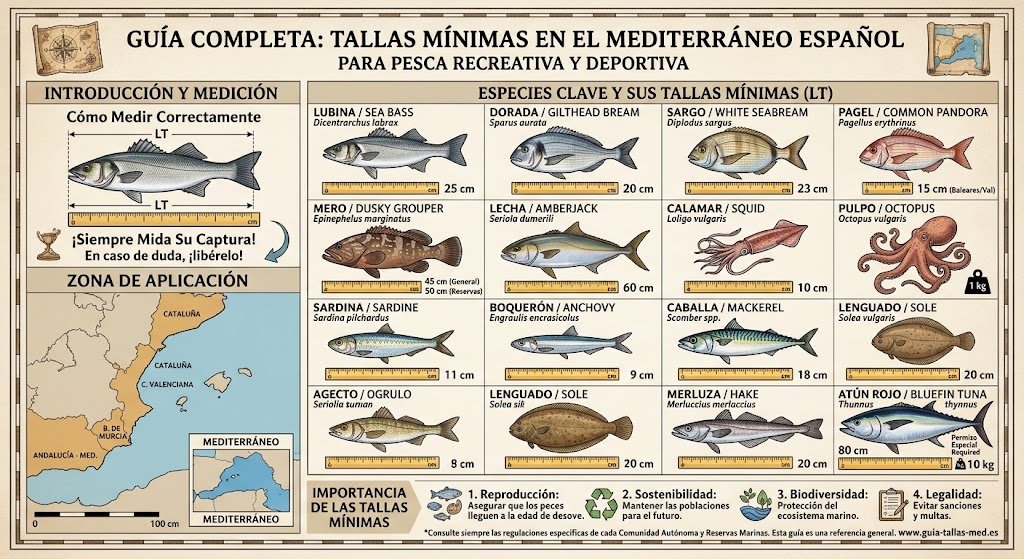
Every angler fishing in Spanish Mediterranean waters is legally obligated to understand and comply with the minimum size regulations for all species they target. These rules — established under EU and Spanish national law and regularly updated — define the minimum size at which a fish may legally be retained. Fish below these sizes must be returned to the sea immediately and carefully. Understanding minimum fish sizes in Spain’s Mediterranean is not only a legal requirement: it is the foundation of responsible, sustainable angling that protects the fish populations that make Spain’s coastline one of Europe’s finest sea fishing destinations.
The Legal Framework: Spanish and EU Fishing Regulations
Recreational sea fishing regulations in Spain operate under a layered legal framework:
- EU Level: EU Regulation 2019/1241 (Technical Measures Regulation) establishes baseline minimum conservation reference sizes (MCRS) for commercially and recreationally important species throughout EU waters. These are the absolute floor — member states cannot set lower minimums.
- National Level: Real Decreto 347/2011 and subsequent amendments regulate recreational maritime fishing in Spain, setting size limits, bag limits, and gear restrictions at national level.
- Regional Level: The Generalitat Valenciana (governing the Alicante/Torrevieja area) and Region de Murcia may impose additional restrictions more protective than the national baseline. Always check both national and regional regulations for your specific fishing location.
Enforcement is carried out by the Guardia Civil (Servicio Marítimo and SEPRONA — the nature protection service), Policia Local, and regional maritime surveillance vessels. Inspections at marina dock returns, on the water, and at shore fishing spots are increasingly common, particularly during summer months.
Official Minimum Fish Sizes: Mediterranean Spain Reference Table
The following table presents the most current minimum sizes for species commonly targeted by recreational sea anglers on Costa Blanca and the wider Mediterranean coast of Spain. Sizes are total length (tip of snout to end of tail fin) unless otherwise specified.
| Species | Spanish Name | Minimum Size |
|---|---|---|
| Gilthead Seabream | Dorada (Sparus aurata) | 20 cm |
| European Sea Bass | Lubina (Dicentrarchus labrax) | 25 cm |
| Dusky Grouper | Mero (Epinephelus marginatus) | 45 cm |
| Common Dentex | Dentón (Dentex dentex) | 25 cm |
| Atlantic Bonito | Bonito (Sarda sarda) | 30 cm |
| Little Tunny | Melva (Euthynnus alletteratus) | 30 cm |
| European Anchovy | Boquerón (Engraulis encrasicolus) | 9 cm |
| European Pilchard | Sardina (Sardina pilchardus) | 11 cm |
| Common Sole | Lenguado (Solea solea) | 24 cm |
| Red Mullet | Salmonete (Mullus surmuletus) | 11 cm |
| Greater Amberjack | Serviola (Seriola dumerili) | 70 cm |
| European Squid | Calamar (Loligo vulgaris) | 10 cm (mantle length) |
| Common Cuttlefish | Sepia (Sepia officinalis) | 10 cm (mantle length) |
Species Subject to Zero-Retention Rules: Bluefin Tuna
Atlantic Bluefin Tuna (Thunnus thynnus) — known in Spain as Atún Rojo — is subject to some of the most stringent restrictions in Mediterranean fishing regulations. Bluefin populations in the Mediterranean suffered catastrophic commercial over-exploitation through the 1990s and early 2000s, falling to less than 20% of their historical abundance. EU-mandated recovery plans implemented since 2010 have produced genuine population recovery, but recreational fishing access remains highly restricted.
For recreational anglers in Spain:
- Zero retention is the default rule: Recreational anglers fishing without a specific catch-and-release authorisation (Annex III permit, issued annually in limited numbers by the Secretaría General de Pesca) may not retain or kill any Atlantic Bluefin Tuna, regardless of size.
- Accidental capture: If a Bluefin Tuna takes your bait while you are legitimately targeting other species, you must release it immediately and carefully. Document the catch photographically if possible and report it via the Sistema de Información de Pesca Recreativa.
- Organised recreational Bluefin tournaments require specific national and EU authorisation and are subject to strict reporting requirements including mandatory observer presence on vessels.
The Overall Bag Limit: How Much Can You Keep?
Spanish recreational sea fishing regulations impose a daily bag limit of 5 kilograms per person per day plus one additional piece (the ‘one piece’ allowance accounts for a large fish that would push the total over 5 kg if retained whole). This bag limit applies to the combined total of all species retained — it is not a per-species limit.
Specific species may have additional individual limits. Sea bass (lubina) is limited to 3 fish per day per angler on the Atlantic coast — check current regulations for Mediterranean-specific bass limits as these have changed in recent years.
Catch and Release Best Practices in Mediterranean Conditions
Warm Mediterranean water temperatures — particularly from July through September when surface temperatures exceed 25°C — significantly reduce the survival rates of released fish if they are handled improperly. Dissolved oxygen content decreases as water temperature rises, meaning fish already stressed from the fight have less oxygen available for recovery. Best practices for responsible release in warm Mediterranean summer conditions:
- Minimise fight time: Use adequately strong tackle to land fish quickly. Prolonged exhaustion depletes lactic acid buffers and increases post-release mortality dramatically.
- Keep the fish in the water during hook removal wherever possible. Lip-grip tools allow hook removal and a brief vertical hold without fully extracting the fish from the water.
- Wet your hands before handling any fish to avoid removing the protective mucus layer that defends against infection.
- Never release a fish by dropping it from height — lower it gently to the water surface, hold horizontally, and allow it to swim away under its own power.
- Deep-water catch-and-release: Fish caught from depths exceeding 20 metres suffer from barotrauma (swim bladder expansion due to pressure change). Do not release deep-caught fish that float on the surface — use a release weight (a device that takes the fish back to depth where it can re-equilibrate) for best survival outcomes.
Inspections and Penalties
Guardia Civil SEPRONA (environmental protection officers) conduct both on-the-water checks and inspections at marina arrivals. Anglers returning to marina quays with fish on board should be prepared to present their fishing license and allow inspection of their catch for size compliance. Officers have the authority to measure all retained fish and issue on-the-spot fines for undersized specimens.
Penalties under Spanish maritime recreational fishing law:
- Minor infraction (undersized fish, minor gear violation): €150–1,500 fine
- Serious infraction (significant bag limit excess, prohibited gear use): €1,500–15,000 fine
- Very serious infraction (prohibited species retention, deliberate harm to protected marine species): €15,000–150,000 fine and potential criminal prosecution
🧭 GUIDE & FAQ: Minimum Fish Sizes in Spain
Q1: Where do I measure the fish — from where to where?
Total length is measured from the tip of the snout (closed mouth, fish lying flat) to the longest point of the tail fin (with the tail fin closed in its natural position, not spread). For cephalopods (squid, cuttlefish), mantle length is measured from the posterior end of the mantle to the anterior edge, not including the tentacles. Carry a simple folding fish ruler on every fishing trip.
Q2: Are minimum sizes the same along all Spanish Mediterranean coasts?
National and EU baseline minimums apply throughout Spanish Mediterranean waters. However, regional governments (Generalitat Valenciana, Region de Murcia, Catalonia) may impose stricter local protections for certain species or in certain marine protected areas. Always check regional rules for the specific autonomous community where you are fishing. Regional fishing regulations are available from the respective regional fisheries departments and in most large Spanish fishing tackle shops (tiendas de pesca).
Q3: Can I photograph and release a species like grouper or dentex without a license?
Yes. Catch-and-release fishing in Spain is legal and does not require special authorisation (except for Bluefin Tuna, which requires Annex III permit even for touch-and-release). You do need a recreational fishing license (Clase 2 for boat fishing) regardless of whether you retain your catch or not. See our detailed guide on getting a sea fishing license in Spain for the application process.
Q4: Are there protected marine reserves near Torrevieja where fishing is restricted?
Yes. The Reserva Marina de la Isla de Tabarca (established 1986) is Spain’s oldest marine protected area and has specific zones where recreational fishing is restricted or prohibited. The internal reserve zone around the island core prohibits all fishing. The buffer and general regulation zone allows recreational fishing but with stricter size limits and gear restrictions than the open sea. Always obtain the current reserve regulations before fishing near Tabarca. Other marine reserves exist along the Alicante coast — check the Spanish Ministry of Agriculture and Fisheries website for current boundaries and restrictions.
Q5: What happens if I accidentally keep an undersized fish without realising it?
If you discover a fish in your catch that is below minimum size before inspection, return it to the sea immediately. If an inspector finds an undersized fish during a check, cooperating fully and demonstrating genuine unawareness generally influences the outcome — inspectors in Spain have discretionary authority on minor infractions. However, the legal obligation is clear: any undersized fish must be released immediately. Ignorance of the regulations is not a legal defence. Carry a fish ruler and check every fish before placing it in your cooler.
For more sea fishing guides in Spain, explore the FreeWIND Sea Fishing section. For nautical and maritime services on the Costa Blanca, visit seamen.es.