
Inflatable vs Hard SUP for Mediterranean Spain
Choosing between an inflatable SUP (iSUP) and a hard paddleboard for use in the Mediterranean is one of the most important decisions any paddler makes — and the specific conditions of Spain’s rocky, sun-scorched coastline create unique requirements that differ significantly from, say, paddling on a calm lake or an Atlantic beach. This comprehensive guide covers every factor: durability against jagged limestone, PSI management under extreme Spanish summer heat, transport logistics along Costa Blanca, touring performance, and long-term maintenance.
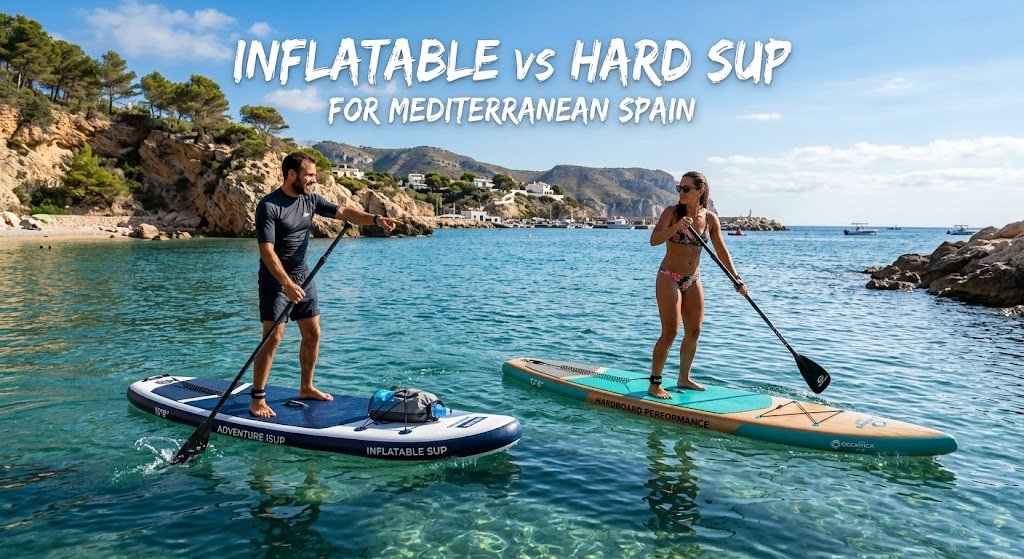
The Case for Inflatable SUPs on Mediterranean Coasts
The Costa Blanca’s coastline is dramatically rocky. Cala Ferris, Cabo Cervera, Sierra Helada, and dozens of other prime paddling spots involve carrying your board over sharp limestone rocks, setting it into water where submerged boulders lurk close beneath the surface, and occasional contact with barnacle-encrusted harbour walls. For these conditions, modern high-quality inflatable SUPs have significant practical advantages.
Durability Against Rocky Mediterranean Shores
Quality inflatable SUPs from brands such as Red Paddle Co, Starboard, Fanatic, and Decathlon Itiwit use military-grade PVC dropstitch construction with double or triple-layer reinforced rails. When struck against a submerged rock at paddling speed, an inflatable board flexes and bounces — absorbing impact energy elastically. A hard epoxy/fibreglass board in the same scenario receives a direct blow to its rigid shell, which can chip, crack, or delaminate. On Costa Blanca’s rocky entries, this flexibility is a genuine safety advantage.
It is worth noting that cheap inflatable SUPs (under €200) use single-layer PVC that is markedly less durable. Invest in double-layer construction for Mediterranean coastal use. The additional €150–300 pays back quickly in avoided repair costs.
The Critical Issue: PSI and Spanish Summer Heat
This is perhaps the most important technical consideration unique to paddling in southern Spain. Mediterranean summers are brutal. Air temperatures in July and August regularly reach 35–40°C, and the black or dark-coloured top surface of a paddleboard — left in direct sun — can reach internal air temperatures of 50–60°C or higher.
Inflatable SUPs expand with heat according to basic gas physics (Gay-Lussac’s Law: pressure increases proportionally with temperature). A board inflated to the manufacturer’s maximum of 15 PSI at 20°C in the morning can reach 18–20 PSI if left deflated (sic: left inflated) in direct midday sun. Most quality boards have a design safety margin of 20–25 PSI before structural failure — but cheaper boards and older boards with fatigued seams are at risk of seam separation or valve failure at elevated pressures.
Critical practical tip for Spain: Never inflate your board to maximum PSI in the cool morning and then leave it in a parked car boot or on the beach in full sun. Either under-inflate by 2–3 PSI to leave a thermal expansion margin, or keep the board in shade and top up pressure at the water’s edge. Always carry a pressure gauge and check PSI before launching.
Transport and Portability
The practical logistics of getting a paddleboard to Costa Blanca’s scattered coves are dramatically different for inflatable and hard boards. An inflatable rolls into a backpack roughly the size of a large rucksack (typically 80cm x 40cm x 30cm, 8–12 kg) that fits in any car boot, overhead locker, or Spanish domestic flight cargo hold. This makes spontaneous road trips to different coastal spots — from Guardamar to Moraira to Benidorm — completely practical.
Hard boards require roof racks, van loading, or specialised transport. They cannot be brought on flights without substantial surcharges. Many Costa Blanca expats and visitors choose inflatables precisely because they can be packed into a hire car and transported to any spot along 200 km of coastline without logistics complications.
The Case for Hard SUPs in the Mediterranean
Hard boards — typically constructed from EPS foam cores wrapped in fibreglass, carbon fibre, or bamboo composites — have genuine technical advantages that no honest inflatable review can dismiss.
Performance: Speed, Glide, and Efficiency
A quality hard touring SUP (11’6″ to 14′) glides significantly more efficiently than an equivalent inflatable at equivalent paddle input. The rigid hull generates less water resistance, and each stroke propels you further. On flat Mediterranean water, an experienced paddler on a hard touring board covers the same 3 km route in 15–18 minutes that an inflatable takes 22–26 minutes to complete. Over a 6 km round trip, that efficiency saving matters enormously if you are racing a building sea breeze back to the launch.
For fitness paddlers, racers, or those covering long coastal distances, the hard board is the performance choice. The Benidorm Island circuit (8 km), the Santa Pola lighthouse traverse (6 km), and the open-water crossing to Tabarca from Santa Pola (8 km) are significantly more accessible and less exhausting on a hard touring board.
Stability and Weight Distribution
Modern inflatable SUPs inflated to 15+ PSI achieve rigidity figures of 98–99% of an equivalent hard board — meaning flex underfoot is barely perceptible. Stability in Mediterranean conditions (flat to 0.3m swell) is broadly comparable between quality iSUPs and hard all-arounds. However, in choppier conditions — such as the afternoon Levante sea state that Coast Blanca regularly produces — the slightly stiffer hard board provides marginally superior platform stability that experienced paddlers appreciate.
Durability Over Multi-Year Use
A quality fibreglass or carbon hard board, properly stored and maintained, lasts 10–15 years without significant performance degradation. Ding repairs are straightforward with epoxy resin kits. A quality inflatable, by contrast, typically shows seam fatigue, minor valve degradation, and reduced rigidity after 4–7 years of heavy use in hot Mediterranean conditions. The initial higher investment in a quality hard board may be superior value over a 10-year ownership horizon for a regular paddler.
Verdict: Which Is Better for Mediterranean Spain?
For the majority of Costa Blanca paddlers — visitors, expats without a permanent storage solution, casual-to-moderate paddlers exploring different coastal spots — a quality inflatable SUP is the practical choice. The transport flexibility, rocky-coast resilience, and easy storage outweigh the performance gap for most recreational users.
For resident performance paddlers with secure storage at a marina or home, covering long coastal distances regularly, or competing in local SUP races — a hard touring board is the performance choice. Invest in a proper storage solution (shade cover, padded rack system) to protect it from the harsh Mediterranean sun.
🧭 GUIDE & FAQ: iSUP vs Hard Board in Mediterranean Spain
Q1: Can inflatable SUPs actually puncture on Mediterranean rocks?
Very rarely, if using quality double-layer boards. Sharp barnacle clusters or acute limestone edges in very shallow water can abrade or puncture single-layer boards, but quality double-layer dropstitch iSUPs are extraordinarily robust. Dragging boards along rocky seabeds should be avoided regardless of construction type. Always launch in knee-deep water minimum and carry the board over dry rocks — do not drag it. Most punctures occur from dragging, not from impact in the water.
Q2: How do I safely manage PSI in Spanish summer heat?
Inflate to 12–13 PSI in the cool morning rather than the manufacturer maximum (usually 15 PSI). By the time you are on the water, ambient temperature will slightly top up the pressure. Avoid leaving your inflated board in a sealed car boot — temperatures can exceed 70°C inside a parked car in Spanish summer sun, which creates genuine valve and seam risk. Keep the board in shade when not on the water and carry a pressure gauge to monitor PSI.
Q3: Can I take an inflatable SUP on a Ryanair/Vueling flight to Spain?
Yes. Packed iSUPs (board rolled, pump removed, fins bagged) typically fit within standard checked luggage weight limits (20–23 kg). The rolled board in its bag usually measures 80x40x30 cm, fitting within most airlines’ oversized sports equipment policies at low or no additional charge when booked as sports equipment in advance. Hard boards cannot be transported on commercial flights.
Q4: Which brands offer the best quality-to-value ratio for Mediterranean conditions?
Premium tier: Red Paddle Co Ride 10’6″ (industry-standard quality, excellent heat tolerance), Starboard Touring Zen (exceptional glide for an inflatable). Mid-tier excellent value: Fanatic Diamond Air, Decathlon Itiwit Race 12’6″ (exceptional performance-to-price). For hard boards: Naish Nalu (all-around), JP Australia SuperLight (touring), SIC Maui Tao Air (inflatable-hard hybrid). Always buy from established distributors with local repair support in Spain.
Q5: How do I store a hard SUP at a Costa Blanca marina or beach house?
UV degradation is the primary threat to hard boards in Spain — constant direct sunlight breaks down epoxy resin and causes yellowing and delamination. Store your hard board in a padded bag or under a UV-resistant board sock whenever not in use. Wall-mounted horizontal foam cradle racks allow safe indoor storage in a garage or storage room. Many marinas on Costa Blanca offer secure board storage facilities — ask at Club Náutico Santa Pola, Marina Salinas (Torrevieja), or through seamen.es for marina storage recommendations.
For more SUP guides, route maps, and community tips on the Costa Blanca, browse the FreeWIND SUP section. For nautical services and maritime support in Spain, visit seamen.es.