Search for:
Surfcasting vs Boat Fishing in Spain

Choosing between shore-based angling and offshore vessel expeditions is one of the most common dilemmas for anglers arriving on the Iberian Peninsula. When weighing surfcasting vs boat fishing Spain along the sun-drenched waters of Costa Blanca (Alicante, Torrevieja, Santa Pola), both modalities deliver exhilarating sport, but they demand vastly different financial investments, tackle configurations, legal permits, and tactical knowledge.
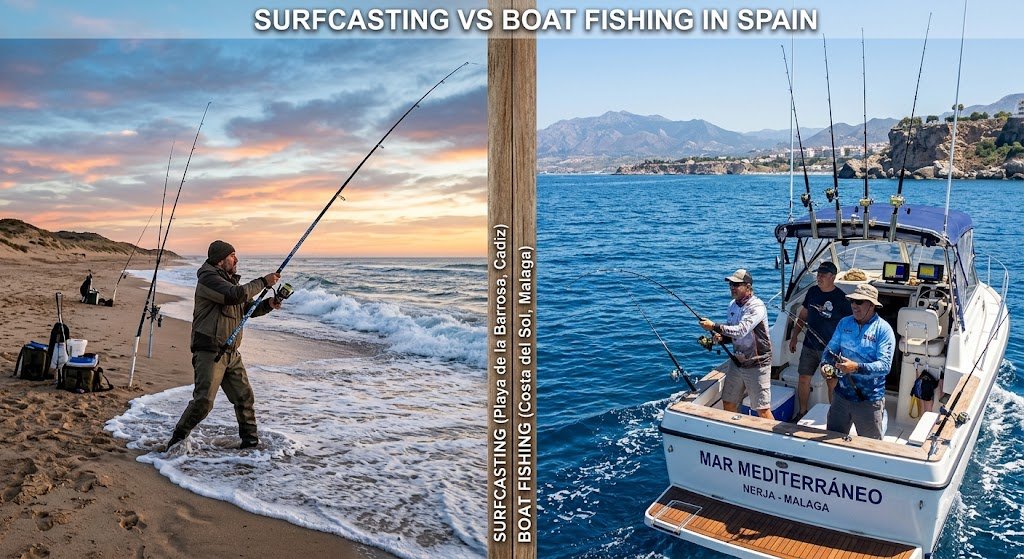
While surfcasting allows you to walk onto a golden Mediterranean beach at sunset with rod holders and sand spikes, boat angling grants access to deep drop-offs, underwater canyons, and offshore pelagics beyond casting range. This guide compares expenses, target species, summer regulations, gear essentials, and practical trade-offs to help you decide which style suits your maritime adventure.

Surfcasting in Spain: Beach Logistics and Coastal Regulations

Surfcasting enjoys immense popularity across Spain. With thousands of kilometers of coastline, finding accessible sandy beaches and shingle shores is easy. However, shore angling comes with distinct logistical considerations:

  • Summer Curfews (Bathing Season Regulations): During peak tourism months (June to September), Spanish municipal ordinances strictly ban beach angling during daytime bathing hours. Surfcasting is permitted only between 21:00 and 09:00 (or once municipal lifeguards lower flags and swimmers depart). This turns summer surfcasting into a nocturnal pursuit under moonlit skies.
  • Casting Distance & Mechanics: Mediterranean beaches often shelve gently. Reaching productive feeding zones (100 to 160 meters offshore) requires 4.2 to 4.5-meter three-piece carbon rods, low-diameter mainlines (0.14 mm to 0.18 mm nylon with tapered shock leaders), and aerodynamic casting techniques like the Off-The-Ground (OTG) or pendulum cast.
  • Beach Mobility: Experienced surfcasters utilize heavy-duty beach carts (carros de pesca) with balloon sand wheels to haul long rod holders (pinchos), tackle boxes, bait coolers, and folding chairs across soft sand.

Boat Fishing in Spain: Sonar Tactics, Drift, and Pelagics

Heading out onto Mediterranean waters by motor vessel or sports fishing boat bypasses coastal beach crowds and opens up entirely new marine territories:

  • Access to Deep Structure: Depth drops rapidly off capes like Cabo de Santa Pola and Cabo Cervera. Boat anglers easily reach rocky reefs, wrecks, and drop-offs at depths from 30 to over 150 meters, holding apex predators that never venture near surf beaches.
  • Marine Electronics: Modern CHIRP sonar, GPS chartplotters, and down-scan imaging eliminate guesswork, pinpointing baitfish schools, underwater drop-offs, and bottom transitions accurately.
  • Anchoring vs Drift Fishing: Depending on wind and current, skippers anchor over isolated pinnacles or deploy a sea anchor (ancla de capa) to control drift speed while slow jigging, working inchiku lures, or bottom bouncing natural sardine baits.
  • Pelagic Trolling (Curricán): High-speed offshore trolling allows boats to cover miles of open sea, intercepting migratory pelagic schools of Atlantic bonito, mahi-mahi (llampuga), and albacore.

If you do not own a vessel in Spain, maintaining private boats, marina berths, insurance, and fuel can be demanding. Booking a skippered charter or hiring a well-equipped vessel through verified providers like SEAMEN maritime services provides full offshore access with expert guidance and zero ownership overhead.

Species Accessibility Breakdown: Beach vs Offshore

The species you can expect to encounter differ substantially between the two disciplines:

  • Surfcasting Primary Targets: Gilthead Seabream (dorada), Sand Steenbras (herrera), European Seabass (lubina), White Seabream (sargo), flatfish, and coastal rays. These species forage in sandy depressions and surf breaks.
  • Boat Angling Primary Targets: Dentex (dentón), Dusky Grouper (mero), Red Pandora (pagel), Blackspot Seabream (besugo), Atlantic Bonito, Little Tunny (bacoreta), Mahi-mahi (llampuga), and Amberjack (serviola).

Gear, Licensing, and Financial Investment Comparison

Budget and logistics play a major role when deciding between shore and boat fishing:

  • Licensing: Surfcasting requires an individual Clase 1 shore license (€12 to €28 for several years). Boat angling requires a Clase 2 boat license (or booking a commercial vessel with a collective charter license).
  • Surfcasting Investment: A competitive two-rod beach setup (quality 4.2m rods, high-capacity surf reels, line, tripod/spikes, beach cart, and terminal tackle) costs between €350 and €900. Ongoing expenses are minimal, limited to fresh worms, lead sinkers, and hooks.
  • Boat Angling Investment: Boat ownership involves substantial recurring costs: vessel purchase, mooring fees in local marinas (€2,000 to €6,000+ annually), engine servicing, fuel, and safety gear. Alternatively, chartering a private sports fishing boat for a half-day costs between €400 and €800, split among friends.

The Hybrid Approach: Which Style Should You Choose?

For visiting anglers, expats, and residents along Costa Blanca, a hybrid strategy offers the best of both worlds:

  • Weekly Shore Sessions: Invest in a reliable surfcasting or coastal spinning outfit for spontaneous evening sessions after work or weekend night trips along local beaches.
  • Seasonal Offshore Charters: When the autumn pelagic migration arrives (September to November), pool resources with fellow anglers to charter a dedicated fishing boat for offshore bonito and dentex.

To learn more about Mediterranean fishing methods and gear selection, explore our FreeWIND Sea Fishing section and read our overview on Mediterranean species, techniques, and charter trips.

Frequently Asked Questions About Surfcasting vs Boat Fishing in Spain

1. Can I fish from beaches during the day in summer in Spain?

Generally no. Between June and September, municipal beach regulations prohibit angling while swimmers and sunbathers are present. Fishing is allowed only from 21:00 to 09:00, or in remote rocky coves away from official bathing zones.

2. Is boat fishing more productive than surfcasting in the Mediterranean?

Boat fishing typically yields higher numbers and larger pelagic species (bonito, dentex, grouper) because vessels access deep structure. However, surfcasting remains the premier method for targeting specimen dorada and sea bass in surf shallows.

3. Do I need separate licenses for surfcasting and boat fishing in Spain?

Yes. Spanish maritime recreational permits are divided into Clase 1 (from shore) and Clase 2 (from boat). If you fish from both the beach and your own private vessel, you must hold both endorsements.

4. Can I use a kayak for sea fishing in Spain?

Yes, kayak fishing is very popular. You must hold a Clase 2 (boat) recreational license, wear a certified life vest, carry mandatory safety gear, and remain within approved coastal distances.

5. Where can I find professional fishing boat charters on Costa Blanca?

Reputable maritime platforms like SEAMEN connect anglers with certified boat skippers, vessel charters, and marine logistics in Alicante, Torrevieja, and surrounding marinas.
Recognized Skipper Licenses in Spain Guide

Few nautical adventures match cruising Spain’s sun-drenched coastline, dropping anchor in turquoise coves, and tying up at lively marina quays. However, Spanish maritime authorities, governed by the Directorate General of Merchant Marine (Dirección General de la Marina Mercante – DGMM) and enforced by the Guardia Civil del Mar, uphold strict standards for skipper qualifications. Knowing which recognized skipper licenses in Spain authorize you to take the helm is essential whether chartering or owning a boat.

Whether you hold a British RYA qualification, an International Certificate of Competence (ICC), or wish to earn a Spanish license, here is your definitive guide to recognized qualifications, cruising limits, and required onboard documentation in Spain.

The Spanish Recreational Qualification Hierarchy

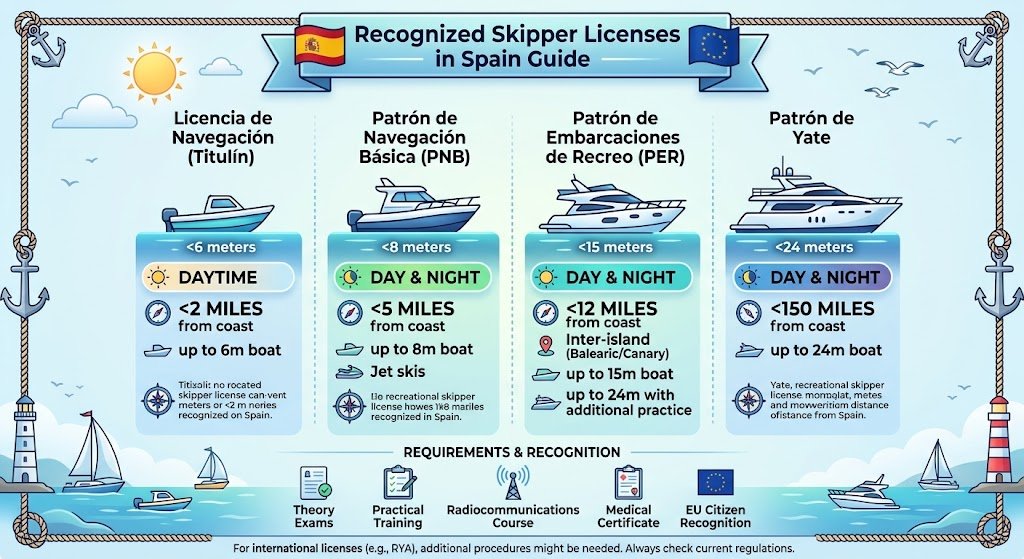
Recreational boating qualifications in Spain are codified under Real Decreto 875/2014, de 10 de octubre. The system comprises four primary leisure skipper tiers:

1. Licencia de Navegación (Formerly “Titulín”)

The entry-level Spanish nautical license is ideal for day cruisers. It authorizes skippering motorboats and sailboats up to 6 meters in hull length with unlimited engine power (up to manufacturer limit), as well as all jet skis (motos de agua). Limitations: daylight navigation only, up to 2 nautical miles from a port or shelter. The course requires 6 hours of instruction (2 hours theory, 4 hours practice) with no official exam required.

2. Patrón de Navegación Básica (PNB)

The PNB permit authorizes commanding motorboats and sailboats up to 8 meters in hull length. It permits both day and night navigation up to 5 nautical miles from a port or coastal refuge. Earning a PNB requires passing a 27-question theory exam, 8 hours of basic safety practices, and 4 hours of radio training.

3. Patrón de Embarcaciones de Recreo (PER)

The PER is the benchmark recreational qualification in Spain. In standard form, it authorizes skippering vessels up to 15 meters in length up to 12 nautical miles offshore, day and night, including coastal passages between islands in the Balearic and Canary archipelagos.

With an optional 24-hour continuous navigation practice module (habilitación a 24 metros y Baleares), PER authority expands to command vessels up to 24 meters and conduct mainland-to-Balearic open-sea crossings.

4. Patrón de Yate & Capitán de Yate

For offshore skippers, Patrón de Yate covers vessels up to 24 meters navigating up to 150 nautical miles offshore. The highest recreational grade, Capitán de Yate, carries no geographical or boat size limits, permitting worldwide oceanic navigation.

Are Foreign Skipper Licenses Recognized in Spain?

If you hold a nautical qualification issued outside Spain, its validity depends on international treaties, vessel flag, and your residency status:

The International Certificate of Competence (ICC – Resolution 40)

Spain adheres to the United Nations Economic Commission for Europe (UNECE) Resolution 40. The ICC is the most universally accepted foreign boating permit in Spain. If your national maritime authority issues an ICC for coastal motor vessels, it is accepted by charter agencies, port authorities, and maritime insurance companies.

UK RYA Qualifications

British Royal Yachting Association (RYA) certifications are widely respected across Spain. For bareboat charters on Spanish-flagged rental vessels (Lista 6ª):

  • RYA Day Skipper (Practical): Authorizes daytime cruising in coastal waters (typically up to 12 miles offshore). Widely accepted by charter companies, especially when paired with an ICC.
  • RYA Coastal Skipper & Yachtmaster: Accepted for extended offshore passages and night cruising within certified limits.

US, Canadian, and Australian Boat Licenses

Certifications from US Sailing, the American Sailing Association (ASA 104 Bareboat Cruising), or Australian State Authorities are recognized for non-resident tourists chartering boats, provided the charter company verifies equivalency under Annex IX of Real Decreto 875/2014.

Crucial Legal Distinction: Tourists vs. Spanish Residents: Foreign certifications are recognized for visiting tourists. However, if you become a registered resident of Spain (empadronado), Spanish law requires you to obtain a Spanish certificate (PNB, PER) or formally homologate your foreign license through the DGMM.

Mandatory Documentation Required on Board

When cruising Spanish waters, the Guardia Civil del Mar or maritime customs can conduct inspections. You must have original documents aboard:

  • Original Skipper License: Valid Spanish certificate, ICC, or approved national license matching vessel size and cruising zone.
  • Identification: Valid passports, national IDs, or NIE certificates for everyone aboard.
  • Boat Registration & Inspection: For Spanish vessels, the Hoja de Asiento, Permiso de Navegación, and valid Certificado de Navegabilidad (ITB).
  • Marine Liability Insurance: Proof of mandatory third-party insurance complying with Real Decreto 607/1999, along with current payment receipt.
  • Charter Agreement: If renting, a signed charter contract and passenger crew list.

Professional Skipper Training and Maritime Services in Spain

Navigating maritime regulations, preparing for PER exams, or homologating foreign skipper titles in Spain can be intricate. For accredited nautical courses, English-language skipper training, boat registration, and legal consulting, partner with the experts at SEAMEN.es. To explore top cruising routes and community boat trips, browse our FreeWIND Motor Boats guides.

Frequently Asked Questions (FAQ)

Can I charter a motorboat in Spain with an RYA Day Skipper certificate?

Yes. The vast majority of professional charter companies across Spain accept the RYA Day Skipper (Practical) certificate for bareboat motorboat charters. Having your RYA certificate endorsed with an ICC provides extra assurance.

Can a foreign boat license be converted into a Spanish PER?

Direct license conversion (convalidación) is possible primarily for qualifications issued by EU member states with bilateral agreements with Spain, processed through the DGMM with certified translations and medical fitness proof.

What are the fines for skippering without a recognized license?

Operating a boat that requires a license without a legally recognized qualification is a serious maritime offense under the Ley de Puertos del Estado. Fines range from €3,000 to €10,000, and the boat will be immobilized by maritime police.

Do I need a separate marine radio license in Spain?

The entry-level Licencia de Navegación does not require radio certification. However, both PNB and PER qualifications include mandatory Short Range Radio Operator modules (Operador de Corto Alcance – ROC) covering VHF DSC radio.

Is a medical exam required for a Spanish boat license?

Yes. Obtaining or renewing a Spanish nautical qualification requires a specialized psychophysical medical certificate (Certificado Médico de Aptitud Psicofísica) issued by an authorized driver/nautical medical clinic assessing vision, hearing, and coordination.

Squid Fishing (Eging) in Spain: Pro Tips

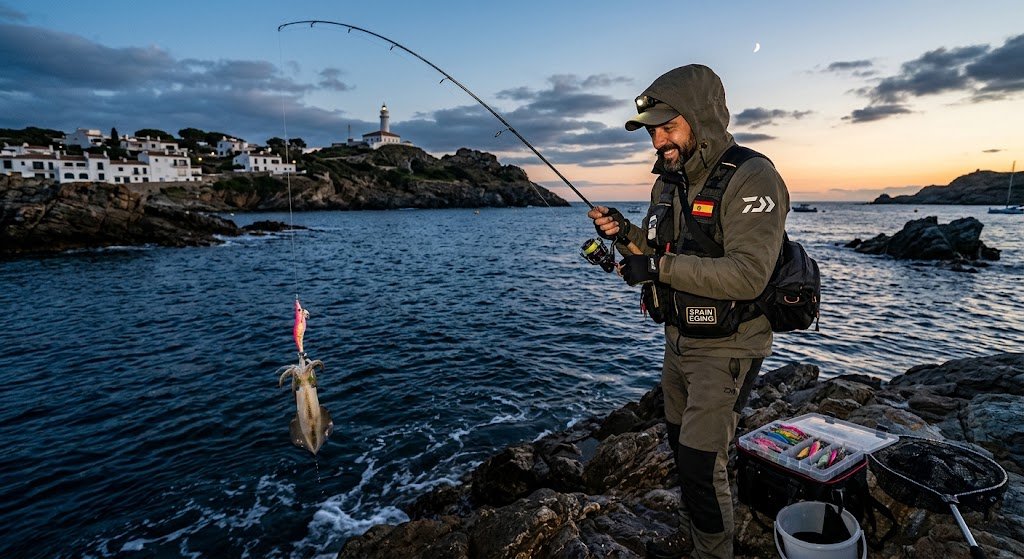
Originating in Japan and embraced across the Mediterranean, the art of eging—lure angling for cephalopods with specialized prawn jigs (egis)—has transformed coastal fishing. When targeting squid fishing in Spain along Costa Blanca (Torrevieja, Santa Pola, Alicante, Calpe), anglers discover an exciting discipline combining light tackle, subtle bite detection, and exquisite culinary rewards.

As Mediterranean waters cool from late October through February, European Common Squid (calamar) migrate from offshore depths into coastal shallows and breakwaters under cover of dusk. Adapting Japanese eging methods to Spanish conditions produces consistent action. This guide covers jig sizes, sink rates, UV glow technology, darting retrieves, and caring for your fresh catch.

Japanese Eging Adapted to Mediterranean Waters

Unlike tidal ocean shores, the Mediterranean features exceptional water clarity and subtle currents. Squid in Spanish waters are cautious, making finesse gear essential:

  • Eging Rods: Sensitive 8’0″ to 8’6″ rods rated for PE 0.4 to 0.8 braids and Egi sizes #2.0 to #3.5. A responsive blank absorbs the pulsing runs of hooked squid without tearing delicate tentacles.
  • Micro Braid & Leaders: Spool a 2500 reel with smooth 8-strand PE braided line (PE #0.6 to #0.8). Tie a 1.5-meter leader of 100% fluorocarbon (0.20 mm to 0.24 mm) for invisibility and abrasion resistance.
  • Quick-Snap Clips: Attach jigs with a rounded, ultra-light egi snap (size #0 or #1) to preserve natural side-to-side darting action.

Egi Jig Sizes, Sink Rates, and Color Selection

Selecting the appropriate jig size and sink rate keeps your lure in the strike zone:

  • Size #2.5 (10-12g): Ideal for early autumn (October/November), calm bays, and shallow weed edges. Sinks slowly at 5.0 to 5.5 seconds per meter.
  • Size #3.0 (15-16g): The versatile Mediterranean workhorse for depths of 4 to 10 meters along outer breakwaters. Sinks at 3.5 to 4.0 seconds per meter.
  • Size #3.5 (20-22g): Used for winter trophy squid, deeper reefs (12+ meters), boat drifting, or windy days. Sinks faster at 2.8 to 3.2 seconds per meter.

Color selection depends on lighting conditions and moon phases:

  • Full Moon & Clear Water: Natural patterns (mackerel, sardine, prawn) with silver or transparent bases. Keimura (UV-reactive) bodies excel at twilight.
  • New Moon & Murky Water: High-visibility luminous green or blue glow bases with pink or orange cloth.
  • Dusk & Dawn: Pink, orange, and red-bellied patterns simulate distressed prey.

Rod Action: The “Bichi-Bichi” Jerk and the Critical Drop

The cardinal rule of squid fishing in Spain is that squid attack on the slow, horizontal descent. Master this retrieve rhythm:

  1. Cast & Count Down: Cast your egi and let it sink near the seabed. Count down seconds based on depth and jig sink rate.
  2. The Jerk Sequence: Impart two to four sharp upward rod snaps (“bichi-bichi”). This causes the jig to dart erratically, attracting squid from a distance.
  3. The Controlled Fall: Lower the rod tip with light line tension, letting the egi glide downward at a 45-degree angle.
  4. Detecting the Bite: Cephalopod takes feel like sudden dead weight, a subtle tug, or sudden slack line as tentacles grip the lure.
  5. The Sweep Set: Avoid violent strikes. Lift firmly and reel steadily. The needle crowns (coronas) will penetrate cleanly. Keep steady tension without pumping the rod.

Top Coastal Locations and Boat Drifting Tactics

Costa Blanca offers prime eging environments during cooler months:

  • Breakwaters and Outer Walls: Ports in Torrevieja, Santa Pola, and Alicante provide deep water access. Focus on transition zones where port lights meet dark water. Note: Always fish permitted outer breakwaters; operational dock basins are off-limits.
  • Rocky Capes and Points: Cabo de las Huertas and Cabo Cervera create tidal eddies where squid gather to hunt.
  • Boat Drifting: Over 15 to 30 meter sandy gravel beds, deploy a sea anchor (ancla de capa) to slow drift while working jigs. For private boat charters and skipper support, consult verified experts at SEAMEN maritime services.

Caring for Your Catch: From Dispatch to Plancha

Fresh Mediterranean squid deserves culinary care:

  • Humane Dispatch (Ikejime): Insert a squid spike between the eyes. The squid turns white instantly, preserving natural sweetness and texture.
  • Avoid Fresh Water: Keep squid dry in a cooler with ice packs inside a sealed plastic bag. Washing with chlorinated tap water ruins delicate skin texture.
  • Calamar a la Plancha: Sear briefly on a screaming-hot griddle with extra-virgin olive oil, coarse sea salt, garlic, and parsley for two minutes per side.

For more coastal fishing advice, visit our FreeWIND Sea Fishing section and read our overview on Mediterranean species, techniques, and charter trips.

Frequently Asked Questions About Squid Fishing in Spain

1. When is the peak season for squid fishing (eging) in Spain?

The season runs from late October through February, peaking in November and December when large winter calamari approach coastal breakwaters to hunt and spawn.

2. What is the difference between squid (calamar) and cuttlefish (sepia)?

Squid swim actively in the water column and strike falling lures. Cuttlefish dwell directly on sandy beds and weed edges, requiring jigs dragged or hopped slowly along the bottom.

3. Why do squid jigs use barbless crown needles instead of treble hooks?

Squid have soft, muscular tentacles that tear on barbed hooks. Fine circular crown needles distribute tension evenly, keeping the squid secure under steady reeling without ripping flesh.

4. Is night fishing better than daytime for squid in Spain?

Yes. Shore eging is primarily nocturnal. The two hours after dusk and calm moonlit midnight hours produce the highest activity, as squid move into shallower water to feed.

5. Do I need a fishing license to catch squid in Spain?

Yes. Squid are regulated under regional recreational maritime fishing laws. A standard Class 1 (shore) or Class 2 (boat) license is required across all Spanish autonomous communities.

Marine Weather & Wind Apps for Spain Boating

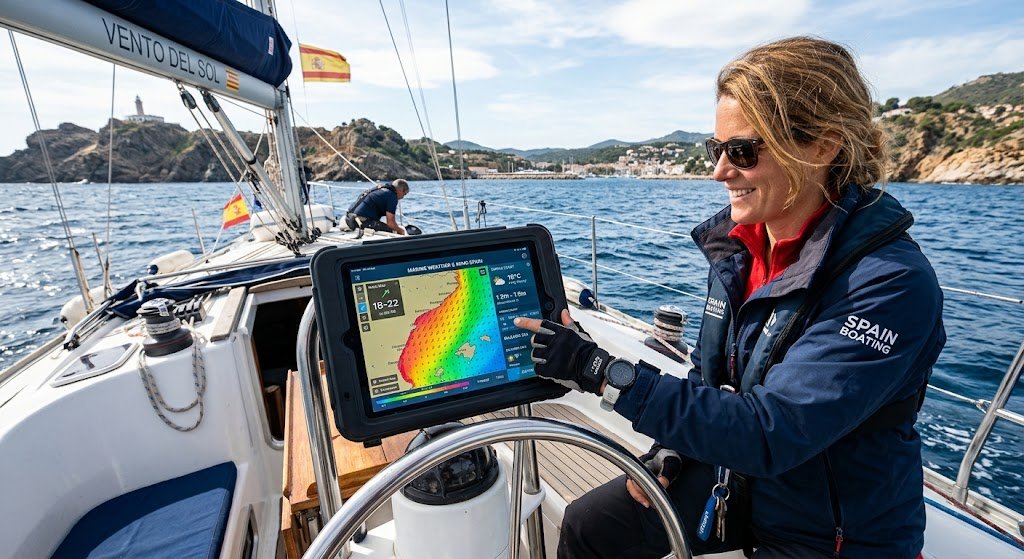
The Mediterranean waters of Spain’s Costa Blanca are famed for sunny cruising, calm anchorages, and turquoise coves. Yet every experienced skipper knows that the sea commands respect. What looks like a calm morning can turn into steep, choppy waves within an hour. Mastering regional weather patterns and choosing the best marine weather apps Spain skippers rely upon is essential for safe motor boating.

From understanding the contrast between humid Levante and scorching Poniente winds to reading wave periods and coastal alerts, here is your essential guide to Mediterranean marine meteorology and navigation apps.

Understanding Costa Blanca Wind Regimes: Levante vs. Poniente

Navigating Spanish coastal waters requires a solid grasp of regional wind systems that govern the Alicante coastline:

The Levante (East / Northeast Wind)

Originating over the central Mediterranean, the Levante gathers moisture across open sea before hitting eastern Spain. It brings humid air, haze, and persistent rolling swells with steep chop. Even a moderate 12-to-15 knot Levante wind can generate 1.0 to 1.5-meter waves along exposed beaches and harbor entrances in Torrevieja and Santa Pola. When Levante blows, seek shelter in west-facing coves or stay moored in the marina.

The Poniente (West / Southwest Wind)

Blowing from continental Spain towards the sea, the Poniente is hot, dry, and gusty during summer. Because it blows offshore, it flattens coastal water near the shore, creating a deceptive mirror-like surface. Warning: Calm nearshore water is deceptive! Poniente winds push drifting vessels, small boats, and paddleboards rapidly away from shore into open waters.

The Thermal Sea Breeze (Virazón)

On sunny summer days without strong regional winds, the land heats up faster than the sea, creating a dependable sea breeze called the Virazón. Starting around 13:00, it blows from the southeast (Garbí), peaks between 15:00 and 17:30 at 12 to 18 knots, and subsides cleanly before sunset. Plan outbound cruising in the morning calm and factor afternoon chop into your return trip.

Swell Height vs. Wave Period: The Critical Safety Factor

Novice boaters frequently check only the forecasted wave height (e.g., “0.8 meters”). However, wave period (the seconds between wave crests) is far more critical for motorboat safety and comfort.

  • Short Period (3 to 5 seconds): Classic Mediterranean wind chop (mar de viento). A 1.0m wave with a 4-second period produces violent, jarring motion that slams against motorboat hulls, causing heavy spray and seasickness.
  • Long Period (8 to 12 seconds): Groundswell (mar de fondo). A 1.0m swell with a 9-second period feels like a smooth, gentle roller that modern motorboats glide over with ease.
Pro-Boater Rule: Prioritize high wave periods over low wave heights. If the wave period in seconds is shorter than wave height in feet multiplied by two, conditions will be steep, close together, and bumpy.

Top Marine Weather Apps Spain Boaters Depend On

Modern mobile tools deliver accurate supercomputer forecasting to your helm console. Here are the top apps for cruising Spanish waters:

1. Windy.com

The definitive multi-model forecasting app for coastal skippers. Windy allows toggling between Europe’s benchmark ECMWF model (9km resolution), the American GFS model, and the German ICON-EU model (7km resolution). It displays wind gusts, wave height, swell period, sea surface temperature, and animated wind arrows.

2. PredictWind

Renowned among offshore sailors and cruisers, PredictWind features high-resolution PWG and PWE micro-models (1km and 8km grids). It delivers precise localized thermal wind predictions around headlands like Cabo Cervera and Cabo de Santa Pola.

3. AEMET (Agencia Estatal de Meteorología)

Spain’s official government meteorological agency provides legal maritime forecasts and coastal alerts (Avisos Costeros):

  • Yellow Alert (Aviso Amarillo): Coastal winds force 7 (28–33 knots) or rough seas (waves 2.5–3m). Exercise caution.
  • Orange Alert (Aviso Naranja): Gale-force winds or very rough seas (waves 4m+). Small leisure boats should remain in port.
  • Red Alert (Aviso Rojo): Extreme maritime danger. Total navigation ban for recreational craft.

4. Windfinder Pro

Known for its clear interface and Superforecast model (7km grid updated 4 times daily), Windfinder delivers 3-hour snapshots of wind speed, gusts, air pressure, and wave direction calibrated for marinas like Torrevieja and Alicante.

5. Puertos del Estado

While weather apps predict conditions, the Puertos del Estado marine network reveals real-time measurements from deep-sea buoys (such as Cabo de Palos). It provides actual measured wave height, water temperature, wind speed, and tidal curves.

VHF Radio Coastal Broadcasts from Salvamento Marítimo

Mobile phone reception can fade offshore or beneath steep cliffs. Spain’s maritime rescue agency, Salvamento Marítimo, broadcasts routine weather bulletins over VHF Channel 16, transferring to working channels (Ch 27 or 74) at scheduled times (typically 09:30, 15:30, and 21:30 UTC).

Pre-Departure Weather Checklist

  • Compare wind forecasts across two independent models (ECMWF vs. ICON on Windy).
  • Confirm the wave period exceeds 6 seconds if wave heights are above 0.7 meters.
  • Check that there are no active AEMET yellow or orange coastal alerts.
  • Plan arrival before afternoon thermal winds reach their peak.

For more boating safety guides and charter tips, visit FreeWIND Motor Boats. For professional skipper training, weather routing, and vessel management in Spain, consult the team at SEAMEN.es.

Frequently Asked Questions (FAQ)

Which forecast model is most accurate for the Spanish Mediterranean?

The European ECMWF model and German ICON-EU model prove most accurate for Mediterranean coastal waters, handling local sea breezes and thermal gradients far better than standard global GFS models.

What wind speed is too high for a small motorboat?

For small motorboats under 6 meters, sustained winds above 12 to 14 knots with short chop make cruising uncomfortable. For craft between 7 and 10 meters, winds up to 18 knots are manageable for experienced skippers in long-period swell.

Why does Poniente make nearshore waters look flat?

Poniente blows offshore from land out to sea. Near the beach, the wind has no distance (fetch) to generate waves, creating deceptive calm. However, offshore currents and waves build rapidly further out.

How can I check actual sea conditions before leaving port?

Check live harbor webcams at Marina Salinas Torrevieja or Santa Pola, and view real-time buoy telemetry on the Puertos del Estado app to see measured wave heights and periods.

What should I do if caught in an unexpected squall?

Put on life jackets, secure loose gear, throttle down to maintain steerage into waves at a 45-degree angle (bow-quartering), and motor towards nearest sheltered harbor. Broadcast a Pan-Pan call on VHF Channel 16 if vessel safety is threatened.

Navigating to Tabarca Island: Boating Guide

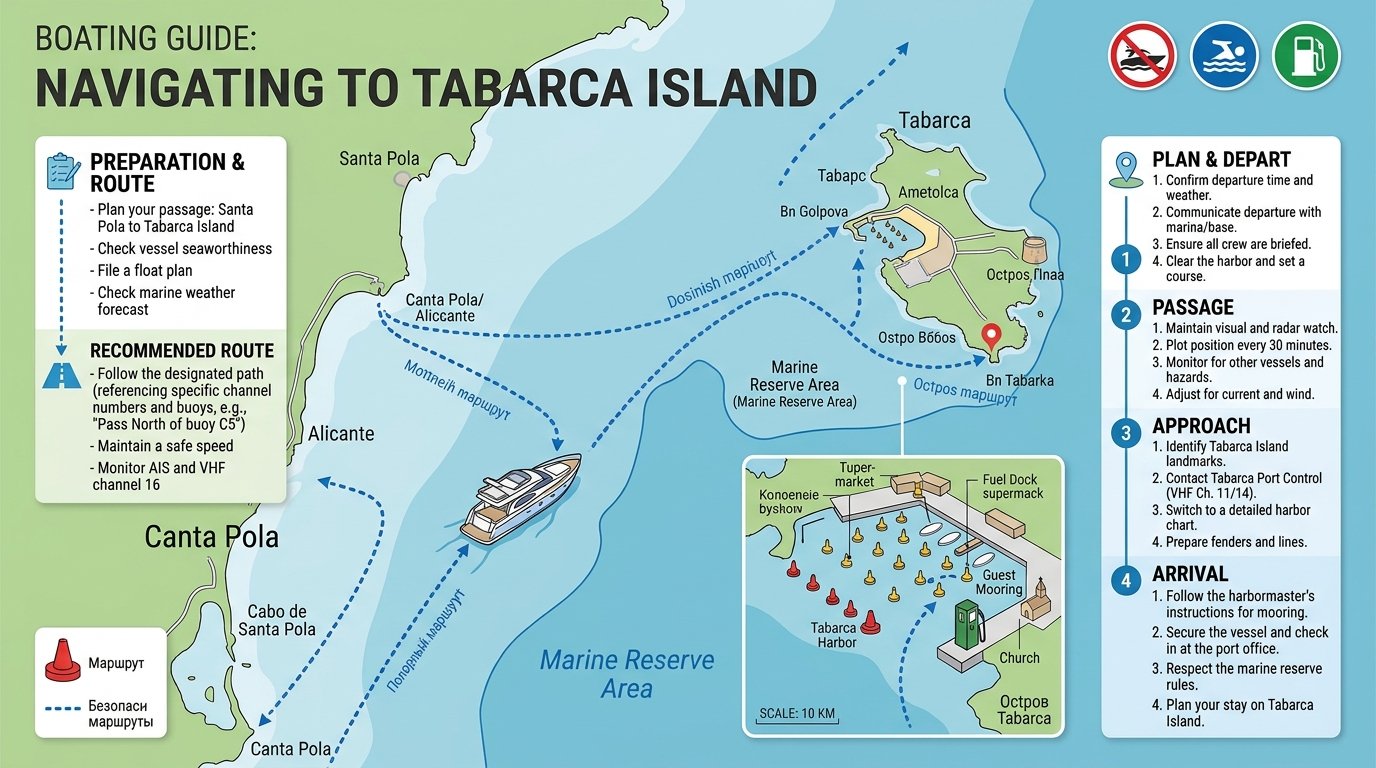
Rising like a jewel from the sapphire Mediterranean, the historic islet of Tabarca (Isla de Tabarca or Nueva Tabarca) is the quintessential offshore voyage for motorboaters along the Costa Blanca. Measuring 1,800 meters long and 400 meters wide, this fortified maritime sanctuary was designated Spain’s very first marine reserve in 1986. If you plan to navigate to Tabarca Island on your own vessel or a charter, thorough planning is essential to respect protected ecosystems and ensure a safe passage.

From navigating around shallow reefs and securing ecological mooring buoys to landing tenders and savoring authentic island gastronomy, here is your essential guide to navigating Tabarca safely from Torrevieja, Santa Pola, or Alicante.

Sea Routes and Distances to Navigate to Tabarca Island Safely

Depending on your departure marina on the Costa Blanca, passages offer distinct conditions and navigation considerations:

Route from Santa Pola Marina (Shortest Crossing)

Santa Pola is the closest port to Tabarca. The passage spans just 4.5 nautical miles on a heading of 135° Southeast. At a cruising speed of 15 to 20 knots, the trip takes only 15 to 20 minutes. It is the smoothest route for small day cruisers, as Santa Pola Bay provides initial shelter before reaching the open passage.

Route from Torrevieja (Marina Salinas & RCNT)

Departing Torrevieja requires a northbound coastal run of approximately 14.0 nautical miles on a heading of 025° North-Northeast. You motor past Cabo Cervera, the sand dunes of Guardamar del Segura, and Santa Pola’s coastline before turning east towards the island. Cruising at 18 to 22 knots covers this distance in 45 to 55 minutes.

Route from Alicante Marina

Leaving Puerto de Alicante entails heading 165° South-Southeast across Alicante Bay for 11.5 nautical miles. The crossing takes approximately 35 to 45 minutes, with panoramic views of Santa Bárbara Castle.

Key Navigational Coordinates & Hazards

  • Tabarca Island Center / Village: 38°09’55” N, 00°28’30” W
  • Tabarca Lighthouse (Faro de Tabarca): 38°09’50” N, 00°28’10” W (Fl(2+1) W 12s, range 14 nautical miles).
  • The Llosa Shoal (Bajo de la Llosa): Located 0.6 miles south-southwest of Tabarca. This dangerous rocky pinnacle rises within 3.5 meters of the surface. Always give La Llosa a wide berth when approaching from Torrevieja.

Marine Reserve Rules & Posidonia Oceanica Protection

The waters surrounding Tabarca belong to the Reserva Marina de la Isla de Tabarca, managed under strict environmental regulations by Spain’s Ministry of Agriculture and Fisheries and the Generalitat Valenciana.

The fundamental rule: anchoring on Posidonia oceanica seagrass is strictly prohibited. Posidonia is a protected endemic marine plant that oxygenates Mediterranean waters and shelters aquatic life. Dropping an anchor into Posidonia rips up fragile roots that take decades to regenerate.

Under Valencian Decree 64/2022, marine surveillance boats (Vigilancia Marina) actively inspect anchorages using underwater cameras. Unlawful anchoring over Posidonia carries fines from €3,000 to over €30,000. Always anchor exclusively in clear white sandy patches or use authorized mooring buoys.

The Ecological Mooring Buoy System (Campos de Boyas)

To preserve the seabed, authorities maintain an ecological mooring buoy field during the summer boating season (June to September). Buoys are color-coded by boat size:

  • White Buoys: For craft up to 8 meters in length.
  • Yellow / Orange Buoys: For vessels between 8 and 12 meters.
  • Red Buoys: Reserved for larger motor yachts up to 15+ meters.

Approach buoys slowly heading into the wind, thread your forward bow line through the buoy ring, and cleat off with sufficient slack to absorb swell.

Dinghy Landing and Ashore Protocol

Tabarca’s small inner harbor is strictly reserved for official passenger catamarans (tabarqueras), local fishermen, and rescue vessels. Private recreational boats cannot dock inside the harbor basin.

To go ashore, anchor in the designated anchorage and launch your dinghy. Motor into the harbor at dead-slow speed (under 3 knots) and secure your dinghy at the public tender pontoon. Ensure your kill switch is attached and oars are aboard. Local water taxis are also available to ferry crew ashore for a small fee.

Snorkeling, History, and Island Gastronomy

Once settled, Tabarca offers extraordinary activities:

  • Marine Life Snorkeling: Marine reserve protections ensure fearless marine fauna. Snorkelers routinely encounter large groupers (meros), gilt-head sea bream (doradas), and schools of obladas in 15-meter visibility.
  • Cueva del Llop Marí: A dramatic sea cave beneath the cliffs, once home to Mediterranean monk seals, perfect for paddleboard exploration.
  • The Fortified Village: Walk through stone gates commissioned by King Carlos III in 1768 to house rescued Genoese fishermen.
  • Caldero Tabarquino: Taste Tabarca’s signature culinary dish: fresh local rockfish served in rich broth with alioli, followed by rice cooked in fish stock.
Pro-Skipper Weather Tip: In easterly Levante winds, anchor in the northern bay (El Portet). In westerly Poniente breezes, anchor south of the isthmus. Depart before afternoon thermal winds peak.

Plan Your Tabarca Cruise with Professional Support

Crossing open water to an offshore island requires confidence, reliable equipment, and sound seamanship. If you are chartering a boat, seeking skipper training, or need vessel management in Spain, contact the maritime specialists at SEAMEN.es. For local routes and boat rental guides, explore our FreeWIND Motor Boats hub.

Frequently Asked Questions (FAQ)

Can I drive a license-free 15 HP boat to Tabarca Island?

No. Under Spanish maritime law (Real Decreto 875/2014), license-free 15 HP boats are strictly limited to 2 nautical miles from shelter. Tabarca is 4.5 miles from Santa Pola and 14 miles from Torrevieja. Attempting this crossing without a license is illegal and dangerous.

Can I anchor anywhere around Tabarca Island?

No. Anchoring is strictly banned on Posidonia seagrass across the marine reserve. You may only anchor in white sand patches outside swimming zones or tie up to designated ecological buoys.

What should I do if all mooring buoys are occupied?

Find an open patch of white sand in 4 to 8 meters of depth on the sheltered side of the island. Drop anchor with 4:1 chain scope and check with a mask that your anchor is firmly set in pure sand.

Are jet skis allowed inside the Tabarca Marine Reserve?

Recreational jet skis are heavily restricted in the reserve. Free-riding, racing, or wave jumping is strictly forbidden, and transit speeds are capped at 3 knots.

What is the best departure time from Torrevieja?

Leave between 08:30 and 10:00 AM when the sea is calmest. Plan your return voyage by 16:30 or 17:00 PM before afternoon sea breezes generate choppy waves.

Driving a Boat in Spain Without a License

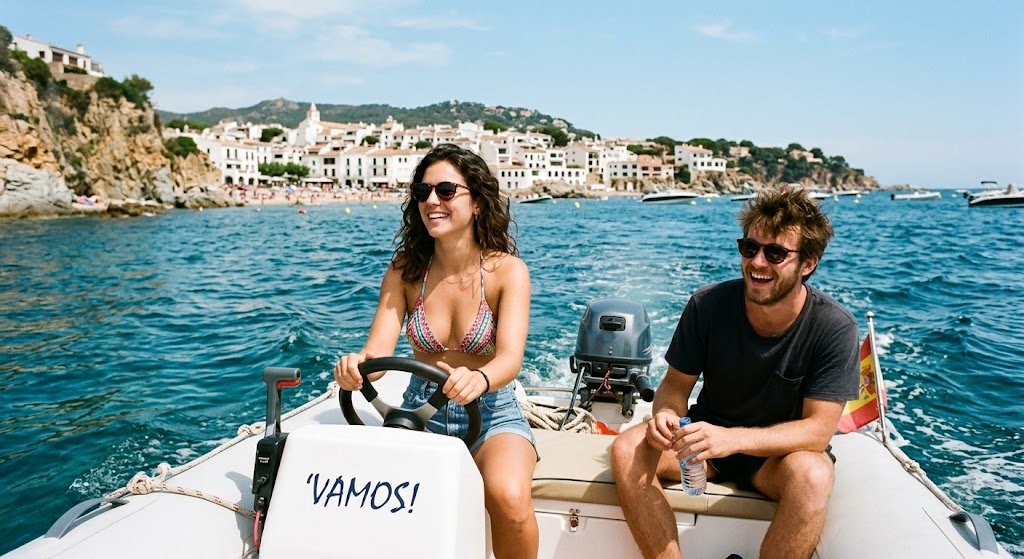
Dreaming of cruising the Mediterranean, feeling the sea breeze, and anchoring in secluded coves along the Costa Blanca? You might think skippering a vessel requires formal nautical academy courses and captain licenses. Fortunately, Spanish maritime regulations make sea life accessible: you can legally drive a boat in Spain without a license under specific statutory conditions.

Whether holidaying in Torrevieja, Santa Pola, or Alicante, license-free boats (barcos sin titulación) offer true maritime freedom. However, commanding any motorboat involves safety obligations and legal boundaries enforced by the Coast Guard (Guardia Civil del Mar) and Capitanía Marítima. Here is your complete guide to regulations, safety gear, and top routes.

Legal Rules to Drive a Boat in Spain Without a License

Recreational boating in Spain is governed by national maritime law under Real Decreto 875/2014, de 10 de octubre. Article 10 defines the exact vessel parameters exempt from licensing:

  • Maximum Length: Motorboats must not exceed 5.0 meters in hull length (6.0 meters for sailboats).
  • Maximum Engine Power: Engine output cannot exceed 11.2 kW (15 HP / CV). Any motor above 15 HP requires a certified license, regardless of boat size.
  • Daylight Hours Only: Navigation is permitted strictly from sunrise to sunset (orto a ocaso). Night sailing without a license and navigation lights is illegal.
  • 2 Nautical Mile Boundary: Vessels must remain within 2 nautical miles of a marina, port, or accessible coastal shelter (lugar de abrigo). Open sea crossings are prohibited.
  • Minimum Age: The skipper must be at least 18 years old (or 16 with written parental authorization).

Types of License-Free Boats Available

Modern license-exempt rental fleets on the Costa Blanca offer reliable, modern hulls designed for stability and fuel efficiency:

Rigid Inflatable Boats (RIBs / Semirrígidas)

Measuring 4.2 to 4.8 meters, RIBs feature tough inflatable tubes and deep-V fiberglass hulls. They provide unsinkable buoyancy and absorb wave chop smoothly. Powered by 15 HP four-stroke outboards, they cruise comfortably at 8 to 12 knots with 4 to 5 passengers.

Fiberglass Center-Console Boats

Open fiberglass runabouts feature bow solariums, bimini sunshades, swim ladders, and dry lockers. With higher freeboards, they keep spray out and offer ideal setups for sunbathing, swimming, and family coastal outings.

Mandatory Safety Equipment Required by Capitanía Marítima

As skipper, you are legally responsible for safety on board. Always verify that your boat carries required gear before untying lines:

  • Life Jackets (Chalecos Salvavidas): CE/SOLAS-approved (100N minimum) for 100% of passengers, with proper sizes for children.
  • Kill-Switch Lanyard (Hombre al Agua): Red spiral cord connected to the engine kill switch. Wear it around your wrist or life vest whenever the engine runs.
  • Bailing System: Manual bailer (achicador) or operational electric bilge pump.
  • Oars or Paddle: Auxiliary propulsion in case of mechanical breakdown.
  • Sound Signal: Marine foghorn or whistle to signal in reduced visibility.
  • Ground Tackle: Anchor with chain lead and rope line (minimum 3 times water depth).
  • Fire Extinguisher: Portable 21B extinguisher if the boat has an enclosed tank or engine compartment.
Pro-Skipper Tip: Keep your phone in a waterproof pouch and save Spain’s maritime search and rescue line: Salvamento Marítimo (+34 900 202 202) or call 112 in any emergency.

Essential Navigation Rules & Maritime Etiquette

Navigating safely requires following international collision regulations (COLREGs) and coastal environmental laws:

  • Bathing Zones: Keep at least 200m away from sandy beaches and 50m from rocky shorelines. Never enter yellow buoy swim zones. Only use designated boat channels (canales de varada) at under 3 knots.
  • Harbor Limits: Speed inside ports and marinas like Torrevieja or Santa Pola is restricted to 3 knots. Wake creation is strictly penalized.
  • Right of Way: Motorboats yield to sailboats and non-motorized paddle craft. When meeting head-on, both boats alter course to starboard (right). In crossing paths, give way to vessels on your starboard side.

Top Costa Blanca Routes for License-Free Boats

The protected coastline around Alicante and Torrevieja features idyllic cruising grounds within the 2-mile limit:

  • Torrevieja to Cala Ferris: Head south past the harbor to reach the palm-fringed sands of Cala Ferris. Anchor on sandy patches in 3m depth for superb snorkeling.
  • Santa Pola to Cabo Headland: Cruise east beneath towering cliffs towards the Santa Pola lighthouse for calm, clear swimming waters sheltered from westerly breezes.
  • Torrevieja North to Cabo Cervera: A scenic northbound route past historical coastal watchtowers, offering rocky reefs teeming with Mediterranean marine life.

Upgrading Your Boating License in Spain

A 15 HP boat is the ultimate introduction to seamanship. When you are ready to pilot larger boats, cruise offshore, navigate at night, or cross to Tabarca Island, consider getting an official nautical license like the Licencia de Navegación (Titulín—6-hour course with no exam) or the comprehensive PER (Patrón de Embarcaciones de Recreo).

For accredited skipper licensing, boat documentation, and maritime management, consult our partners at SEAMEN.es. Explore more coastal guides and community trips on our FreeWIND Motor Boats hub.

Frequently Asked Questions (FAQ)

Can foreign tourists drive a boat in Spain without a license?

Yes. The exemption under Real Decreto 875/2014 applies to all nationalities. Presenting a valid passport or national ID and being at least 18 years old is sufficient to charter and operate an eligible craft.

How fast can a 15 HP license-free boat cruise?

With 2 to 4 adults aboard, a 15 HP motorboat typically cruises between 8 and 12 knots (15 to 22 km/h). This speed provides comfortable, scenic cruising with minimal fuel consumption.

What are the fines for sailing beyond 2 miles or after sunset?

Navigating further than 2 nautical miles from shelter or operating after dark without a license constitutes a serious maritime violation. Fines from Capitanía Marítima start at €1,500 and increase depending on conditions and safety infractions.

Are alcohol limits enforced on license-free boats in Spain?

Yes. The Guardia Civil del Mar enforces identical limits to road traffic: 0.5 g/l blood alcohol or 0.25 mg/l breath alcohol. Operating while impaired triggers severe fines and vessel impoundment.

Where am I allowed to anchor safely?

You can anchor outside marked bathing areas (200m from beaches). Always drop anchor in clear sand, never on protected Posidonia oceanica seagrass beds, which is strictly prohibited and heavily fined across the Valencian Community.

Catching Dorada & Seabass in Spain Guide

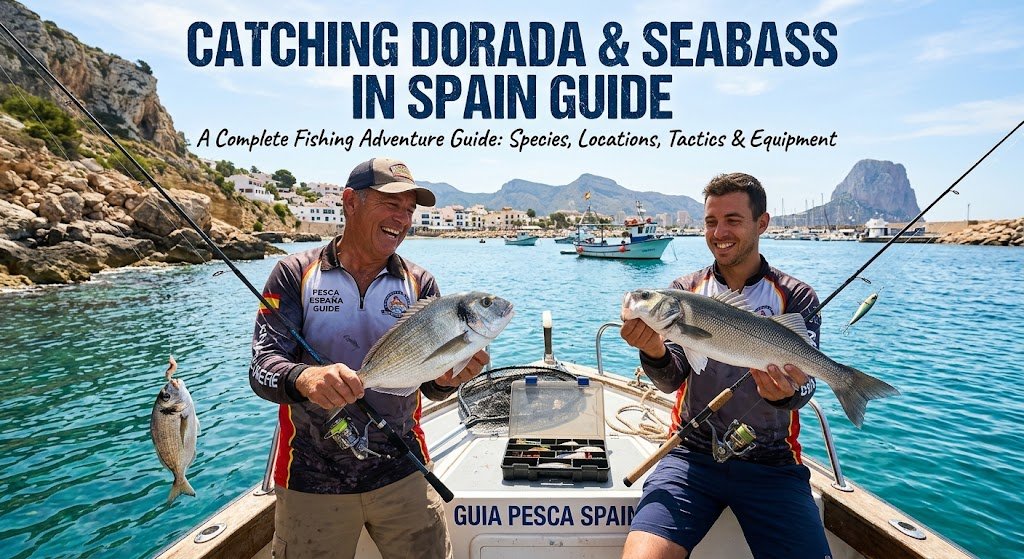
Among Mediterranean coastal sportfish, two species capture the imagination of shore anglers above all others: the wary Gilthead Seabream (Sparus aurata, or dorada) and the predatory European Sea Bass (Dicentrarchus labrax, or lubina). When it comes to catching dorada in Spain and pursuing sea bass along Costa Blanca (Alicante, Guardamar, Torrevieja), success requires specialized baits, refined terminal tackle, and the skill to read subtle underwater topography.

Both species thrive in Spanish waters, yet they display contrasting feeding habits. While dorada use powerful crushing molars to break open hard-shelled mollusks and crabs in sandy troughs, predatory sea bass hunt in foamy surf washes, stalking baitfish and swimming crabs. This guide details premier Mediterranean natural baits, tournament-tested rigs, seabed interpretation, and bite detection techniques.

Top Mediterranean Natural Baits: Analysis & Presentation

Local bait shops (tiendas de pesca) across the Spanish Mediterranean offer an impressive array of live saltwater baits. Choosing the right bait for target species and conditions is essential:

  • Lombriz de Arena (Catalana / Beach Worm): The classic Mediterranean surfcasting bait for calm summer waters. Delicate and blood-rich, it is threaded onto fine long-shank hooks using a hollow baiting needle. Exceptional for dorada and mormo (herrera) at long casting distances.
  • Tita (Sipunculid Bibi Worm): The premier big-dorada bait. Tough, leathery, and full of scented fluids. Small titas are hooked whole, while giant titas are cut into strips, turned inside-out, and wrapped tightly with lycra elastic thread to resist small bait-stealers.
  • Americano (Bloodworm): A thick, tough worm filled with vibrant red hemoglobin fluids. Highly attractive to night-hunting sea bass and specimen dorada. Puncturing the head cleanly ensures fluids are retained.
  • Coreano (Ragworm): An affordable, lively green worm with active swimming motion. Highly effective for sea bass and white bream around rocky breakwaters during daytime or murky sea conditions.
  • Navajas (Fresh Razor Clams): Natural coastal delicacy for dorada. Threaded whole (with or without shell) using two hooks and bound securely with elastic thread. The scent trail in mild surf proves irresistible.
  • Cangrejo (Shore Crabs / Calavereta): The ultimate selective bait for trophy dorada. Small shore crabs or sand crabs (calavereta) are hooked through the rear shell. Nuisance fish cannot damage it, keeping your bait intact for big fish.

Terminal Rigs for Dorada & Seabass: Plomo Corrido and URFE Systems

Dorada are famously suspicious. The moment they feel unusual resistance from a heavy lead sinker, they instantly drop the bait. Spanish surfcasters rely on two primary setups:

1. Running Ledger Rig (Plomo Corrido)

The running ledger features a hydrodynamic casting sinker running freely on the main line or tapered shock leader. A rubber bead protects a micro swivel, to which a fluorocarbon hooklength (bajo de línea) measuring 1.8 to 2.5 meters is tied. With a diameter of 0.20 mm to 0.26 mm, it remains invisible in crystal Mediterranean waters while allowing feeding fish to run without resistance.

2. URFE Clip System

The URFE system utilizes a short, rigid stainless-steel wire shaft (6 to 10 cm) with a quick-release lead clip and an upper rolling swivel. It prevents line tangles during aerodynamic pendulum casts and permits rapid sinker changes as currents shift.

  • Hooks: For dorada, forged wide-gape hooks with curved points (Chinu style, sizes 1 to 4) penetrate tough crushing jaw plates without bending. For sea bass, long-shank Aberdeen or curved octopus hooks (sizes 1/0 to 2/0) accommodate bulky worm and fish baits.

Reading the Seabed: Sandbars, Posidonia Edges, and Surf Washes

Blind casting into flat water rarely yields trophy fish. Reading seabed features makes the difference:

  • Sandbars and Troughs: Observe breaking wave patterns. Waves break over shallow sandbars and reform in deeper troughs (fondales). Dorada cruise these depressions to scavenge exposed worms and crabs.
  • Posidonia Weed Edges: Extensive meadows of Posidonia seagrass line the coast. Dorada and sea bass patrol the transition border where sand meets weed. Casting within two meters of this edge is highly productive.
  • Surf Wash & Foam Lines: European sea bass are opportunistic ambush hunters. They feed in churning white water, rip channels, and river mouths where disoriented baitfish struggle against currents.

If you prefer targeting coastal reefs and offshore underwater canyons by boat rather than casting from shore, consulting experienced skippers via SEAMEN maritime services provides access to calibrated fish-finder electronics and vessel charters.

Bite Detection and Hook Setting: Double-Tap vs Aggressive Strike

Dorada and sea bass register distinct bites on the rod tip:

  • The Dorada Bite: Starts with several sharp taps as the bream crushes bait with its back molars. Do not strike immediately! Wait for the rod tip to steadily pull down and drag begins slipping. Set the hook with a smooth, firm sweep.
  • The Seabass Strike: Sea bass feed by flaring gills to inhale prey whole. The strike is aggressive, often creating slack line or a sharp rod bend. Strike firmly to drive the hook home.

To master more Mediterranean angling tactics, explore our FreeWIND Sea Fishing section and check out our foundational overview on Mediterranean species, techniques, and charter trips.

Frequently Asked Questions About Catching Dorada & Seabass in Spain

1. What is the single best bait for catching dorada in Spain?

For trophy specimens, live shore crabs (cangrejo calavereta) and strips of giant tita worm bound with elastic thread are unbeatable. For numbers on calm summer nights, lombriz de arena (catalana worm) produces the highest bite rates.

2. What time of day is best for catching dorada from Spanish beaches?

During warm summer months (June to September), night fishing between 22:00 and 04:00 is prime. In spring and autumn, daytime angling during mild southeasterly breezes (levante) often triggers feeding.

3. Why is fluorocarbon necessary for Mediterranean surfcasting?

The Mediterranean is exceptionally clear compared to ocean waters. Standard nylon monofilament casts visible shadows, causing wary dorada to shy away. Fluorocarbon has a refractive index close to water, making your leader virtually invisible.

4. What is the minimum legal size for dorada and sea bass in Spain?

Under Valencian regulations, the minimum legal size for Gilthead Seabream (dorada) is 20 cm, while European Seabass (lubina) has a minimum size of 25 cm. Anglers are encouraged to release bass under 36 cm to support breeding stocks.

5. Should I leave the reel drag loose when fishing for dorada?

Yes. Set your front drag light or engage a baitrunner spool so running dorada feel minimal resistance. Once the initial run begins, cup the spool or engage fighting drag before setting the hook.

Mediterranean Sea Fishing Calendar Spain

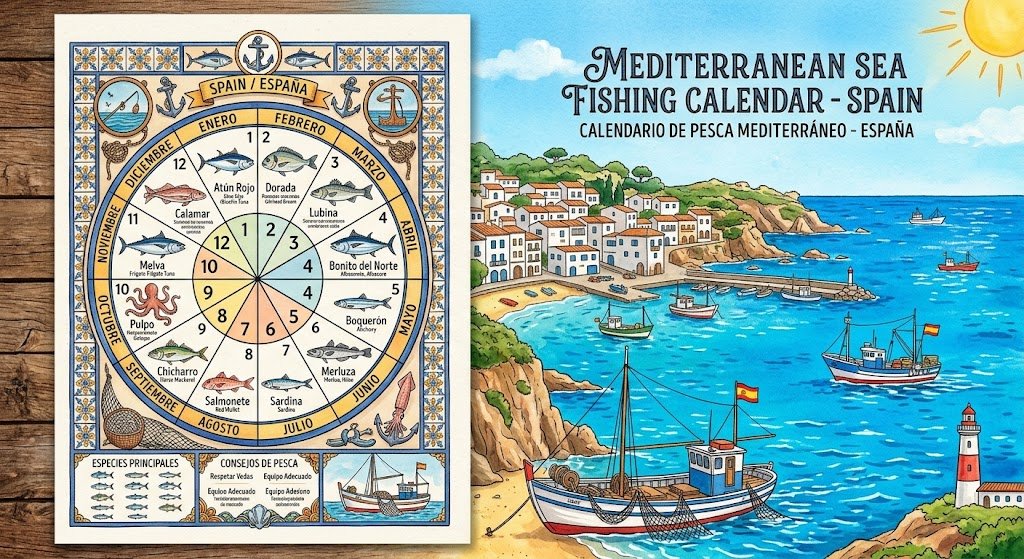
Understanding seasonal migrations, feeding habits, and thermal cycles is the secret to successful angling along the Spanish coast. A comprehensive Mediterranean fishing calendar Spain empowers surfcasters, lure anglers, and boat skippers to target the right species at the right time. Unlike the Atlantic ocean with its massive tides, the western Mediterranean—particularly Costa Blanca (Alicante, Torrevieja, Santa Pola)—is governed by subtle water temperature shifts, micro-tides, barometric pressure, and seasonal pelagic runs.

Whether you are casting worms under summer moons, trolling for pelagics in autumn, or jigging for trophy squid in winter, timing dictates results. In this seasonal guide, we break down month-by-month angling conditions across Spain’s Mediterranean coast, detailing target species, productive tactics, and key environmental factors.

Spring (March to May): Cuttlefish, Seabass, and Early Dorada

As Mediterranean surface temperatures climb from winter lows of 14°C toward 18°C, coastal ecosystems awaken. Spring runoffs carry nutrients into coastal bays and estuaries, sparking marine activity:

  • March: Prime window for cuttlefish (sepia) over sandy weedbeds and shallows using slow-sinking squid jigs. European seabass (lubina) hunt along surf breaks and rocky points after spring storms.
  • April: The first large gilthead seabream (dorada) migrate inshore from deep winter waters to feed on shellfish. Shore anglers see early catches on beach worms (lombriz de arena) and razor clams.
  • May: White seabream (sargo) feed aggressively in the white wash of rocky breakwaters. Shore spinning with soft plastics targets active seabass and barracuda (espetón) at dawn and dusk.

Summer (June to August): Night Surfcasting, Llampuga, and Trolling

Surface waters warm to 25°C-28°C by August, creating a thermocline around 15 to 25 meters. Inshore species seek shade under posidonia weedbeds during the heat, shifting prime shore angling into the night:

  • June: Night surfcasting begins. Anglers hit Costa Blanca beaches after bathers leave (from 21:00 onwards), targeting trophy dorada and mormo (herrera) with tita worms and crabs.
  • July: Pompano (palometa) and leerfish hunt shallows, attacking surface poppers and live needlefish. Offshore, light trolling (curricán) produces mackerel (caballa) and horse mackerel (jurel).
  • August: Dolphin fish (llampuga / mahi-mahi) arrive, gathering beneath floating buoys and flotsam. Anglers target them with small surface lures. Offshore charters also pursue pelagics.

When arranging private boat charters or deep-sea excursions during summer, working with verified maritime specialists like SEAMEN nautical services provides licensed skippers, electronics, and offshore logistics.

Autumn (September to November): Pelagic Blitzes and Squid Season

Autumn is considered the premier season on the Mediterranean fishing calendar Spain. As tourist crowds depart and coastal waters cool to 20°C-22°C, predatory fish feed aggressively before winter:

  • September: Offshore feeding blitzes. Flocks of diving seabirds indicate surface-feeding schools of Atlantic bonito, little tunny (bacoreta), and frigate tuna (melva). Fast trolling and casting metal jigs into boils delivers exciting action.
  • October: Trophy dentex (dentón) and amberjack hunt drop-offs and reefs at 25 to 60 meters. Slow jigging, inchiku, and live squid trolling produce ferocious strikes.
  • November: The squid fishing (eging) season opens. European squid (Loligo vulgaris) move inshore toward breakwaters and reefs at twilight. Anglers cast Japanese jigs with darting retrieves.

Winter (December to February): Deep Bottom Fishing and Big Squid

While winter brings cooler air and northwesterly winds, water temperatures stabilize around 14°C to 15°C. Winter angling focuses on specialized shore and deep-water tactics:

  • December: Trophy squid month. Large calamari over 1 kg hunt breakwaters and rocky coves on calm, moonlit evenings.
  • January: Deep bottom fishing (pesca a fondo) from boats at 50 to 120 meters. Anglers catch blackspot seabream (besugo), pandora (pagel), and grouper using sardine baits and heavy sinkers.
  • February: Rough winter swells churn sandy shallows, dislodging crabs and clams. Surfcasters brave the surf wash after storms to land massive winter sea bass and solitary dorada.

Environmental Factors: Water Temperature, Moon Phases, and Micro-Tides

Maximizing catch rates along the Mediterranean coast requires understanding key environmental factors:

  • Water Temperature: Shifting from 14°C in February to 27°C in August. Thermocline depth dictates whether fish feed on the seabed or near the surface.
  • Micro-Tides: Mediterranean tides measure only 20 to 40 cm. Anglers watch for wind currents, groundswells (mar de fondo), and falling barometer readings that trigger feeding windows.
  • Moon Cycles: Full moon nights are prime for summer surfcasting and squid eging, while dark moon nights trigger morning feeding blitzes among pelagics.

For more tackle tactics and coastal locations, explore our FreeWIND Sea Fishing articles and read our guide to Mediterranean species, fishing techniques, and local charters.

Frequently Asked Questions About Mediterranean Sea Fishing in Spain

1. What is the best month for sea fishing in Spain?

October is widely considered the best month. Water temperatures remain warm, tourist crowds are gone, pelagics (bonito, melva, llampuga) feed near shore, dentex are active, and inshore squid season begins.

2. When can I catch Gilthead Seabream (Dorada) along Costa Blanca?

Dorada are caught from April through November, with peak trophy specimens landed during warm summer nights (June to September) using surfcasting rigs baited with crabs or tita worms.

3. What is the legal season for Bluefin Tuna in Spain?

Atlantic Bluefin Tuna is strictly regulated under catch-and-release quotas managed by the fisheries ministry. The recreational season opens in mid-June and closes once regional quotas are exhausted. Retaining tuna without special permits is illegal.

4. When is the best time for squid fishing (eging) in the Mediterranean?

Squid move into coastal waters as temperatures drop in late autumn. The peak eging season runs from November through February, especially during the two hours surrounding dusk on calm evenings.

5. Does barometric pressure affect Mediterranean fish feeding?

Yes. In micro-tidal Mediterranean waters, sudden pressure drops before weather fronts trigger strong feeding activity. Conversely, high pressure requires lighter leaders and refined bait presentation.

Sea Fishing License in Spain: Expat Guide

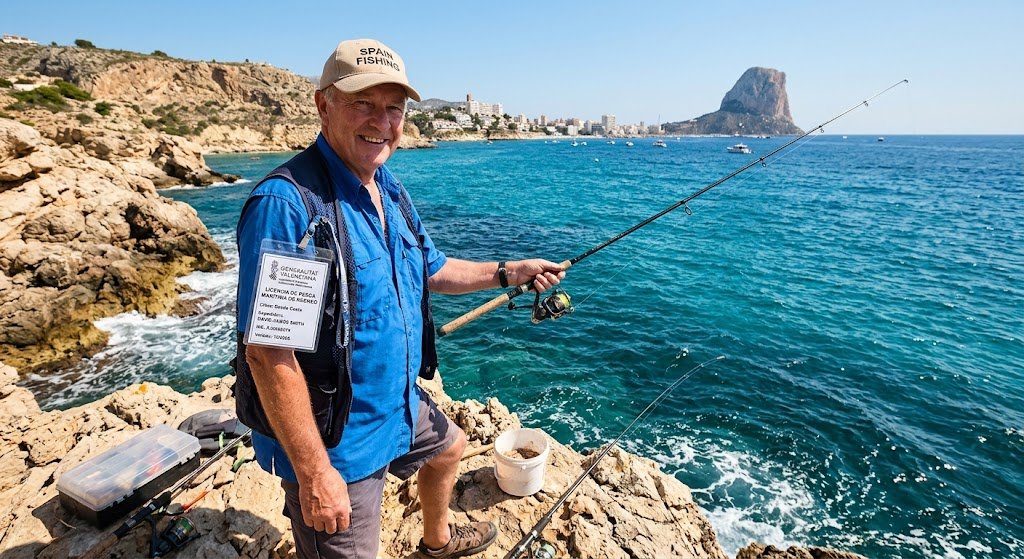
Planning to cast a line into the Mediterranean? Obtaining a legal sea fishing license in Spain is mandatory for every coastal angler, visiting tourist, and resident expat. Spain’s southeastern coastline, especially along Costa Blanca (Alicante, Torrevieja, Santa Pola), offers rich waters teeming with gilthead seabream (dorada), seabass (lubina), dentex, and bonito. However, Spanish maritime enforcement is strict. Fishing without a permit can result in heavy fines, gear confiscation, and legal sanctions from the Guardia Civil and SEPRONA.

While navigating foreign administration may seem daunting, securing your recreational maritime fishing permit (Licencia de Pesca Marítima de Recreo) is straightforward once you know the classifications, portals, and fees. This guide explains license classes, application steps in the Valencian Community, catch limits, protected zones, and conservation rules.

Types of Spanish Sea Fishing Licenses: Understanding the Classes

In the Valencian Community, recreational maritime fishing falls into three core classes, plus collective charter options:

  • Clase 1: Recreativa desde Tierra (Shore Fishing): Covers angling from beaches, rocky shores, cliffs, and permitted breakwaters using up to two rods with maximum three hooks each.
  • Clase 2: Recreativa desde Embarcación (Boat Fishing): Required when fishing from private motor boats, sailboats, or kayaks, covering trolling (curricán) and bottom angling.
  • Clase 3: Recreativa Submarina (Spearfishing): Allows breath-hold apnea spearfishing only (scuba is strictly banned). Requires a medical certificate and federation civil insurance.
  • Commercial Charter Exemption: Certified charter boats operate under a collective license covering all clients on board. When arranging deep-sea fishing trips or vessel charters, booking with trusted specialists like SEAMEN maritime services guarantees full compliance without needing an individual boat permit.

Requirements and Documents for Expats & Non-Residents

Any foreign citizen can apply for a sea fishing license in Spain without permanent residency. You simply require:

  • Passport or NIE: Both Spanish NIE and foreign passports are fully accepted on official application portals.
  • Contact Address: A local holiday home, rental, or hotel address suffices for the application form.
  • Age Verification: Minimum age is 16 years (or 14 with signed parental authorization).
  • Medical Certificate (Spearfishing only): Official doctor’s certificate issued within 90 days by an authorized medical center (check the guide to maritime and sports medical examination centers in Alicante & Torrevieja).

Step-by-Step: Applying for Your Sea Fishing License Online

The regional authority (Generalitat Valenciana) manages applications through the PROP citizen platform:

Option 1: Online with Digital Certificate or Cl@ve

If you possess a Spanish digital certificate or Cl@ve PIN, log into the Generalitat portal, choose Licencia de Pesca Marítima de Recreo, complete personal details, pay the administrative fee by card, and immediately download your official PDF license.

Option 2: Without Digital Certificate via Form 046

For visiting tourists and expats without digital ID:

  1. Access the Generalitat tax portal (Tributos Modelo 046).
  2. Select Fee Code 9838 (Tasas por servicios de pesca marítima de recreo).
  3. Choose license modality (Clase 1 shore or Clase 2 boat) and validity period.
  4. Enter passport details and generate the 3-part Form 046.
  5. Pay the fee at any local bank (CaixaBank, BBVA, Santander) or local ATM.
  6. Submit the stamped receipt and passport at a local PROP or agricultural office (OCA) in Alicante or Torrevieja to collect your card.

Fees, Validity, and Regional Recognition

Recreational fishing permits along Costa Blanca are very affordable:

  • Shore License (Clase 1): Costs €12 to €28 depending on duration (1 to 5 years). Retirees over 65 often qualify for fee exemptions.
  • Boat License (Clase 2): Approximately €25 to €45 for up to 3 years.
  • Inter-Autonomous Reciprocity: A shore license issued in Valencia is recognized across Murcia, Andalucia, Catalonia, and the Balearic Islands, subject to local reserve rules.

Mediterranean Rules, Bag Limits, and Marine Reserves

Holding a license requires strict adherence to environmental protections:

  • Daily Bag Limit: 5 kg of fish plus one single larger fish per angler per day. Catch and release is strongly encouraged once personal food limits are reached.
  • Non-Commercial Only: Selling recreational catches to individuals, markets, or restaurants is illegal and heavily fined.
  • Minimum Sizes (Tallas Mínimas): Undersized fish must be released unharmed immediately: Dorada (20 cm), Lubina (25 cm), Sargo (15 cm), Salmonete (11 cm).
  • Prohibited Zones: Angling is strictly forbidden inside commercial ports, marinas, and marine reserves (e.g., Isla de Tabarca). During summer, beach fishing is allowed only outside bathing hours (typically 21:00 to 09:00).

Guardia Civil & SEPRONA Enforcement: Penalties and Fines

The maritime Guardia Civil and SEPRONA actively patrol shorelines and waters:

  • Minor Infractions: Not carrying your license card or exceeding rod counts (€60 to €300).
  • Serious Infractions: Fishing without a valid license, keeping undersized fish, or fishing in marine sanctuaries (€301 to €3,000, plus confiscation of rods and tackle).
  • Very Serious Infractions: Commercial sale of catches or landing protected bluefin tuna without state authorization (up to €60,000).

For more coastal advice and regional tackle guides, visit our FreeWIND Sea Fishing guides and explore our primer on Mediterranean species, techniques, and local charters.

Frequently Asked Questions About Sea Fishing Licenses in Spain

1. Do tourists need a sea fishing license in Spain for a short vacation?

Yes. All anglers casting from beaches, breakwaters, or private boats must hold a valid license regardless of holiday duration. There are no temporary tourist exemptions.

2. Does a Valencian fishing license work in Murcia or Andalucia?

Yes. Spain maintains mutual recognition across autonomous communities for shore fishing (Clase 1), provided you obey each region’s local reserve boundaries and minimum sizes.

3. Do I need an individual license on a private fishing charter?

No. Authorized charter boats carry a collective commercial license that covers all passengers on board. For verified boat charters and marine logistics, consult professional teams like SEAMEN.

4. Do children need a fishing license in Spain?

In the Valencian Community, children under 14 do not need their own permit when fishing alongside a licensed adult who assumes supervision and counts the catch within the daily bag limit.

5. Can I harvest octopus (pulpo) from coastal rocks?

In Valencia, recreational capture of octopus is strictly controlled and prohibited during specific seasonal closures. Taking octopus out of season incurs substantial fines from SEPRONA.

Paddleboarding with Dolphins in Costa Blanca

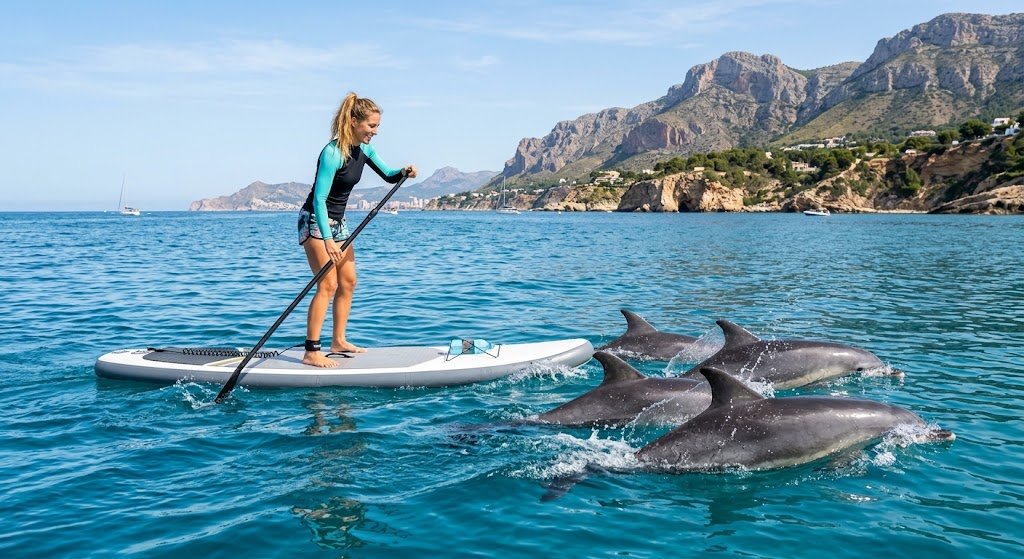
Few experiences in coastal paddling match the unexpected thrill of a dolphin surfacing 10 metres from your board. For paddleboarders on the Costa Blanca, this is not a rare fantasy — it is something that happens regularly, particularly in the early morning hours when the sea is calm and human boat traffic is minimal. This guide covers everything you need to know about paddleboarding with dolphins in Costa Blanca: the species you might encounter, the hotspot locations, the best seasons, and the ethical code that ensures these encounters remain positive for both humans and cetaceans.

Which Dolphin Species Live Near Torrevieja and Costa Blanca?

The western Mediterranean supports a surprisingly diverse cetacean community. Within paddleboard range of the Costa Blanca coast, two species are most regularly encountered by paddlers:

Bottlenose Dolphin (Tursiops truncatus)

The classic, charismatic bottlenose is the species most likely to approach and interact with a SUP board. Adults reach 2–3.8 metres in length and travel in social pods of 5–20 individuals. Bottlenose dolphins in the Mediterranean are highly intelligent and have learned that paddleboards, moving slowly through the water without engine noise, are non-threatening. They will sometimes bow-ride the very subtle pressure wave created by a touring paddleboard, surfing alongside the board within touching distance (though touching is both legally prohibited and ethically wrong).

Bottlenose dolphins are resident year-round in the Mediterranean and are not strictly migratory — the same family groups can inhabit a coastal area for years. Local fishermen and longstanding sea users in Torrevieja frequently recognise individual animals by their dorsal fin markings.

Striped Dolphin (Stenella coeruleoalba)

The striped dolphin is the most abundant cetacean in the Mediterranean, with population estimates of several hundred thousand individuals. Smaller and faster than bottlenose (reaching 1.8–2.5 metres), striped dolphins are characterised by their bold blue-white lateral stripes and hyperactive surface behaviour: acrobatic leaps, spins, and breaches that make them spectacular to observe. They tend to form larger groups (20–200+ animals) that move through coastal waters on feeding migrations following anchovy and sardine shoals.

A striped dolphin pod passing through your paddling route is an extraordinary event — the water erupts with leaping animals in every direction. Unlike bottlenose dolphins, striped dolphins are less likely to approach stationary paddleboards, but a moving, slowly paddling board in their path will sometimes attract curious individuals from the pod.

Where to Find Dolphins from a Paddleboard on Costa Blanca

The Torrevieja Submarine Canyon Zone

Approximately 3–5 km offshore from Torrevieja, the Mediterranean seafloor drops off the continental shelf into deeper water. These underwater topographic features concentrate fish life: upwelling nutrients, dense baitfish schools, and consequently, the dolphins that follow them. While this zone is beyond practical SUP range for most paddlers, large dolphin pods from this feeding area regularly move into the shallower coastal waters, particularly during the early morning feeding chase when baitfish schools are driven toward the surface.

Around Fish Farms

The Mediterranean coast around Torrevieja and Santa Pola has several offshore aquaculture installations. These fish farms attract wild fish (and therefore dolphins) because excess feed particles and small fish that escape the pens create reliable food sources. Bottlenose dolphins are particularly opportunistic around fish farm areas. While paddling within the immediate perimeter of fish farm installations is restricted (they are marked exclusion zones), paddling in the general coastal zone 1–2 km from these areas frequently produces dolphin sightings.

Cabo Santa Pola and the Tabarca Approach Channel

The waters between Cape Santa Pola and Tabarca Island — specifically the 8 km channel separating them — is productive dolphin habitat. This is a known dolphin movement corridor used by both bottlenose and striped dolphin groups moving between coastal feeding areas and deeper offshore waters. Boat trips to Tabarca regularly report dolphin sightings in this channel, and paddleboarders launching from Santa Pola’s Playa Lisa in the early morning have multiple documented encounters in this zone.

When: Seasonal and Daily Timing for Dolphin Encounters

Best months: June through October. Summer and early autumn see dolphins most active in nearshore waters following the seasonal peak of baitfish (sardines, anchovies, and young mackerel). Water temperatures above 22°C correlate with higher coastal dolphin activity on Costa Blanca.

Best time of day: Dawn to 09:30 AM without question. The glassy water of the early morning allows you to see dolphins from much further away (dorsal fins are easily visible in flat conditions), the absence of motorboat noise means dolphins vocalise and move more freely in coastal areas, and the low human presence reduces dolphin wariness. Afternoon encounters are possible but less frequent as boat traffic increases and animals often move to deeper water to escape heat and noise.

The Legal Framework: Spanish Dolphin Protection Regulations

Spain takes cetacean protection very seriously. Royal Decree 1727/2007 on the protection of cetaceans in Spanish waters establishes strict rules for any vessel or watercraft approaching marine mammals:

  • Minimum approach distance: 60 metres for any swimming, paddling, or motoring activity. You must not deliberately approach a cetacean within 60 metres.
  • Surrounding or encircling a group of dolphins is prohibited.
  • Cutting across the path of a dolphin group or positioning yourself in their direction of travel is prohibited.
  • Sound emission (music, engines, underwater speakers) within 500 metres of cetaceans is restricted.
  • Penalties for deliberate violation range from fines of €6,000 to €600,000 for serious infractions causing harm to protected species.

The important practical note for paddleboarders: if dolphins choose to approach you, remain stationary and allow them to do so. The legal restriction applies to your deliberate approach toward dolphins, not to dolphins voluntarily approaching your stationary or slow-moving board. Many of the most memorable dolphin encounters from paddleboards happen when you stop paddling, sit quietly, and let curious animals investigate on their own terms.

Ethical Paddling: The Code of Conduct with Marine Mammals

Beyond legal requirements, the FreeWIND community adheres to a personal code of conduct around marine wildlife that reflects our broader values as sea stewards:

  • Never pursue or chase: If a dolphin swims away, it has expressed its preference. Do not follow.
  • Never touch: Even apparently friendly and approachable dolphins carry diseases transmissible to humans, and human contact can disrupt their social behaviour and natural wariness of boats (creating danger for them).
  • Minimise noise: Talking loudly, splashing aggressively, or making sudden movements disrupts dolphin sonar and social communication. Remain calm and quiet.
  • Never feed: Feeding wild dolphins habituates them to human proximity and boat engines, increasing their risk of propeller injuries.
  • Document responsibly: Photograph and film freely but without flash (which can startle animals) and without manoeuvring aggressively for the perfect angle.

🧭 GUIDE & FAQ: Dolphins and Paddleboarding on Costa Blanca

Q1: How often can I realistically expect to see dolphins from a SUP on Costa Blanca?

In peak season (June–September), regular early morning paddlers in the Santa Pola–Torrevieja zone report dolphin encounters on roughly 1 in 4 to 1 in 3 sessions. This is a remarkable frequency compared to most European paddling locations. September and October seem particularly productive as striped dolphin pods follow anchovy migration. Winter sightings are less frequent but not uncommon during calm settled periods.

Q2: Are there whale species that can be seen from Costa Blanca?

Yes. Fin Whales (Balaenoptera physalus) — the second-largest animal on Earth — pass through the western Mediterranean seasonally. They are occasionally sighted from the coast or from boats in the Alicante region, though encounters from SUP range are very rare. Sperm Whales occur in deeper offshore Mediterranean waters. For paddleboarders, dolphins are the primary and realistic cetacean encounter.

Q3: What should I do if I encounter a stranded or distressed dolphin near the coast?

Call 112 immediately and describe the animal’s location and condition. Do not attempt to push the animal back into deeper water without guidance — stranded cetaceans can panic and injure both themselves and rescuers. Keep other boats and swimmers at a distance and monitor the animal until the marine rescue team arrives. In the Alicante region, the ANSE (Asociación de Naturalistas del Sureste) coordinates cetacean strandings.

Q4: Can I participate in citizen science dolphin monitoring from my paddleboard?

Yes, and it’s actively encouraged. The Spanish citizen science platform Observadores del Mar (observadoresdelmar.es) invites anyone to submit geotagged sightings of cetaceans, sea turtles, and jellyfish. Paddleboarders are ideally positioned for this as regular, quiet coastal observers. Recording the species (if identifiable), number of animals, direction of travel, and any distinctive markings (dorsal fin notches, body scars) contributes to long-term population monitoring. High-quality photographs of dorsal fins allow researchers to identify individual animals through photo-ID catalogues.

Q5: Is it safe to be in the water near dolphins on a paddleboard?

Wild Mediterranean dolphins present no danger to paddleboarders. Unlike orca (Orcinus orca) incidents that have occurred off the Atlantic coast of Portugal and Spain (involving a specific small group of animals interacting with sailing vessels), Mediterranean bottlenose and striped dolphins do not exhibit boat-approach or interaction behaviour that poses safety risk to paddlers. If a dolphin does approach your board closely, remain calm, do not paddle aggressively, and enjoy the extraordinary experience. Maintain your stability on the board and be aware that a dolphin surfacing unexpectedly directly beneath your board could cause a startled fall.

Share your dolphin sighting stories with the FreeWIND community and browse our Costa Blanca SUP guides. For nautical excursions and maritime services in Spain, explore seamen.es.