
Paddleboarding with Dolphins in Costa Blanca
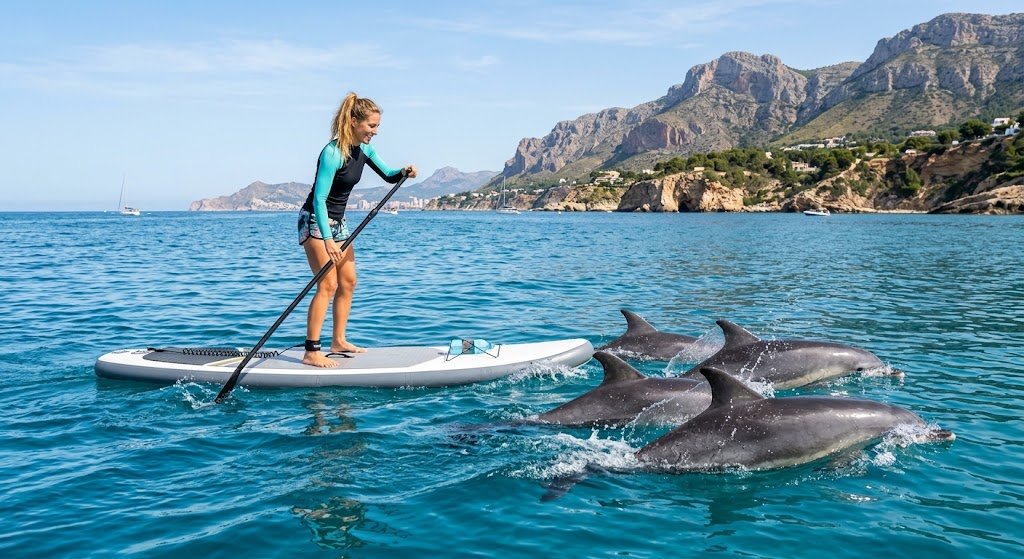
Few experiences in coastal paddling match the unexpected thrill of a dolphin surfacing 10 metres from your board. For paddleboarders on the Costa Blanca, this is not a rare fantasy — it is something that happens regularly, particularly in the early morning hours when the sea is calm and human boat traffic is minimal. This guide covers everything you need to know about paddleboarding with dolphins in Costa Blanca: the species you might encounter, the hotspot locations, the best seasons, and the ethical code that ensures these encounters remain positive for both humans and cetaceans.
Which Dolphin Species Live Near Torrevieja and Costa Blanca?
The western Mediterranean supports a surprisingly diverse cetacean community. Within paddleboard range of the Costa Blanca coast, two species are most regularly encountered by paddlers:
Bottlenose Dolphin (Tursiops truncatus)
The classic, charismatic bottlenose is the species most likely to approach and interact with a SUP board. Adults reach 2–3.8 metres in length and travel in social pods of 5–20 individuals. Bottlenose dolphins in the Mediterranean are highly intelligent and have learned that paddleboards, moving slowly through the water without engine noise, are non-threatening. They will sometimes bow-ride the very subtle pressure wave created by a touring paddleboard, surfing alongside the board within touching distance (though touching is both legally prohibited and ethically wrong).
Bottlenose dolphins are resident year-round in the Mediterranean and are not strictly migratory — the same family groups can inhabit a coastal area for years. Local fishermen and longstanding sea users in Torrevieja frequently recognise individual animals by their dorsal fin markings.
Striped Dolphin (Stenella coeruleoalba)
The striped dolphin is the most abundant cetacean in the Mediterranean, with population estimates of several hundred thousand individuals. Smaller and faster than bottlenose (reaching 1.8–2.5 metres), striped dolphins are characterised by their bold blue-white lateral stripes and hyperactive surface behaviour: acrobatic leaps, spins, and breaches that make them spectacular to observe. They tend to form larger groups (20–200+ animals) that move through coastal waters on feeding migrations following anchovy and sardine shoals.
A striped dolphin pod passing through your paddling route is an extraordinary event — the water erupts with leaping animals in every direction. Unlike bottlenose dolphins, striped dolphins are less likely to approach stationary paddleboards, but a moving, slowly paddling board in their path will sometimes attract curious individuals from the pod.
Where to Find Dolphins from a Paddleboard on Costa Blanca
The Torrevieja Submarine Canyon Zone
Approximately 3–5 km offshore from Torrevieja, the Mediterranean seafloor drops off the continental shelf into deeper water. These underwater topographic features concentrate fish life: upwelling nutrients, dense baitfish schools, and consequently, the dolphins that follow them. While this zone is beyond practical SUP range for most paddlers, large dolphin pods from this feeding area regularly move into the shallower coastal waters, particularly during the early morning feeding chase when baitfish schools are driven toward the surface.
Around Fish Farms
The Mediterranean coast around Torrevieja and Santa Pola has several offshore aquaculture installations. These fish farms attract wild fish (and therefore dolphins) because excess feed particles and small fish that escape the pens create reliable food sources. Bottlenose dolphins are particularly opportunistic around fish farm areas. While paddling within the immediate perimeter of fish farm installations is restricted (they are marked exclusion zones), paddling in the general coastal zone 1–2 km from these areas frequently produces dolphin sightings.
Cabo Santa Pola and the Tabarca Approach Channel
The waters between Cape Santa Pola and Tabarca Island — specifically the 8 km channel separating them — is productive dolphin habitat. This is a known dolphin movement corridor used by both bottlenose and striped dolphin groups moving between coastal feeding areas and deeper offshore waters. Boat trips to Tabarca regularly report dolphin sightings in this channel, and paddleboarders launching from Santa Pola’s Playa Lisa in the early morning have multiple documented encounters in this zone.
When: Seasonal and Daily Timing for Dolphin Encounters
Best months: June through October. Summer and early autumn see dolphins most active in nearshore waters following the seasonal peak of baitfish (sardines, anchovies, and young mackerel). Water temperatures above 22°C correlate with higher coastal dolphin activity on Costa Blanca.
Best time of day: Dawn to 09:30 AM without question. The glassy water of the early morning allows you to see dolphins from much further away (dorsal fins are easily visible in flat conditions), the absence of motorboat noise means dolphins vocalise and move more freely in coastal areas, and the low human presence reduces dolphin wariness. Afternoon encounters are possible but less frequent as boat traffic increases and animals often move to deeper water to escape heat and noise.
The Legal Framework: Spanish Dolphin Protection Regulations
Spain takes cetacean protection very seriously. Royal Decree 1727/2007 on the protection of cetaceans in Spanish waters establishes strict rules for any vessel or watercraft approaching marine mammals:
- Minimum approach distance: 60 metres for any swimming, paddling, or motoring activity. You must not deliberately approach a cetacean within 60 metres.
- Surrounding or encircling a group of dolphins is prohibited.
- Cutting across the path of a dolphin group or positioning yourself in their direction of travel is prohibited.
- Sound emission (music, engines, underwater speakers) within 500 metres of cetaceans is restricted.
- Penalties for deliberate violation range from fines of €6,000 to €600,000 for serious infractions causing harm to protected species.
The important practical note for paddleboarders: if dolphins choose to approach you, remain stationary and allow them to do so. The legal restriction applies to your deliberate approach toward dolphins, not to dolphins voluntarily approaching your stationary or slow-moving board. Many of the most memorable dolphin encounters from paddleboards happen when you stop paddling, sit quietly, and let curious animals investigate on their own terms.
Ethical Paddling: The Code of Conduct with Marine Mammals
Beyond legal requirements, the FreeWIND community adheres to a personal code of conduct around marine wildlife that reflects our broader values as sea stewards:
- Never pursue or chase: If a dolphin swims away, it has expressed its preference. Do not follow.
- Never touch: Even apparently friendly and approachable dolphins carry diseases transmissible to humans, and human contact can disrupt their social behaviour and natural wariness of boats (creating danger for them).
- Minimise noise: Talking loudly, splashing aggressively, or making sudden movements disrupts dolphin sonar and social communication. Remain calm and quiet.
- Never feed: Feeding wild dolphins habituates them to human proximity and boat engines, increasing their risk of propeller injuries.
- Document responsibly: Photograph and film freely but without flash (which can startle animals) and without manoeuvring aggressively for the perfect angle.
🧭 GUIDE & FAQ: Dolphins and Paddleboarding on Costa Blanca
Q1: How often can I realistically expect to see dolphins from a SUP on Costa Blanca?
In peak season (June–September), regular early morning paddlers in the Santa Pola–Torrevieja zone report dolphin encounters on roughly 1 in 4 to 1 in 3 sessions. This is a remarkable frequency compared to most European paddling locations. September and October seem particularly productive as striped dolphin pods follow anchovy migration. Winter sightings are less frequent but not uncommon during calm settled periods.
Q2: Are there whale species that can be seen from Costa Blanca?
Yes. Fin Whales (Balaenoptera physalus) — the second-largest animal on Earth — pass through the western Mediterranean seasonally. They are occasionally sighted from the coast or from boats in the Alicante region, though encounters from SUP range are very rare. Sperm Whales occur in deeper offshore Mediterranean waters. For paddleboarders, dolphins are the primary and realistic cetacean encounter.
Q3: What should I do if I encounter a stranded or distressed dolphin near the coast?
Call 112 immediately and describe the animal’s location and condition. Do not attempt to push the animal back into deeper water without guidance — stranded cetaceans can panic and injure both themselves and rescuers. Keep other boats and swimmers at a distance and monitor the animal until the marine rescue team arrives. In the Alicante region, the ANSE (Asociación de Naturalistas del Sureste) coordinates cetacean strandings.
Q4: Can I participate in citizen science dolphin monitoring from my paddleboard?
Yes, and it’s actively encouraged. The Spanish citizen science platform Observadores del Mar (observadoresdelmar.es) invites anyone to submit geotagged sightings of cetaceans, sea turtles, and jellyfish. Paddleboarders are ideally positioned for this as regular, quiet coastal observers. Recording the species (if identifiable), number of animals, direction of travel, and any distinctive markings (dorsal fin notches, body scars) contributes to long-term population monitoring. High-quality photographs of dorsal fins allow researchers to identify individual animals through photo-ID catalogues.
Q5: Is it safe to be in the water near dolphins on a paddleboard?
Wild Mediterranean dolphins present no danger to paddleboarders. Unlike orca (Orcinus orca) incidents that have occurred off the Atlantic coast of Portugal and Spain (involving a specific small group of animals interacting with sailing vessels), Mediterranean bottlenose and striped dolphins do not exhibit boat-approach or interaction behaviour that poses safety risk to paddlers. If a dolphin does approach your board closely, remain calm, do not paddle aggressively, and enjoy the extraordinary experience. Maintain your stability on the board and be aware that a dolphin surfacing unexpectedly directly beneath your board could cause a startled fall.
Share your dolphin sighting stories with the FreeWIND community and browse our Costa Blanca SUP guides. For nautical excursions and maritime services in Spain, explore seamen.es.