
SUP Safety & Coastal Laws in Spain: Full Guide
If you paddle a Stand Up Paddleboard beyond the swimming zone on Spain’s Mediterranean coast, you are operating a watercraft subject to Spanish maritime law. Understanding the legal framework is not bureaucratic box-ticking — it determines whether you can be rescued effectively, whether your travel insurance covers you if you’re injured, and whether you face fines in the increasingly common maritime police checks that take place on busy summer days. This guide covers SUP laws in Spain comprehensively, from the legal classification of your board to the precise safety equipment required and the geographic zones where different rules apply.
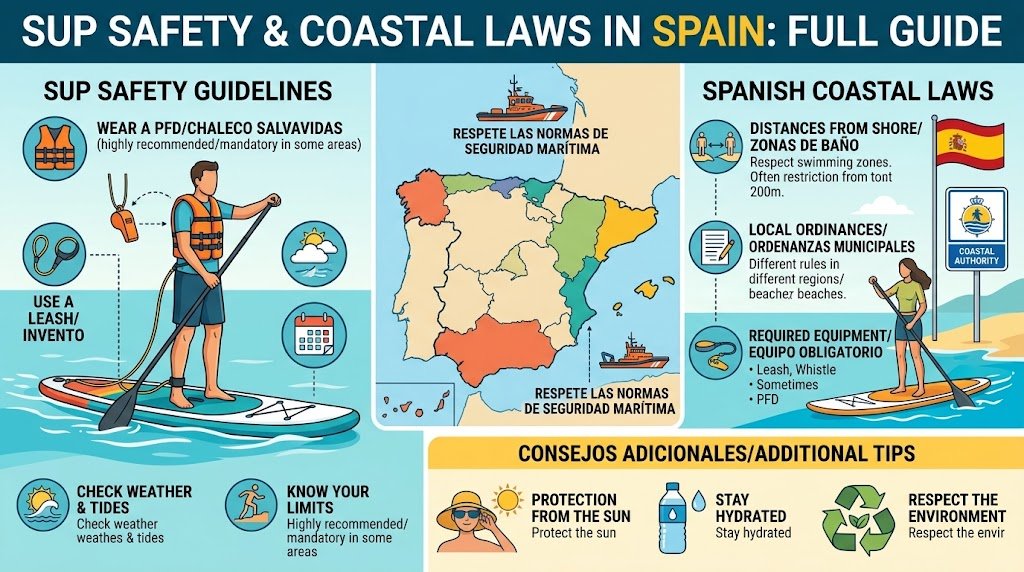
The Legal Status of SUP Boards in Spain
Spanish maritime law has historically been ambiguous about paddleboards, and this ambiguity has caused considerable confusion. The legal situation as of 2024 is as follows:
Within the 200-metre coastal swimming zone: SUP boards are treated as swimming/bathing aids (artefactos flotantes de uso recreativo). No maritime regulations apply beyond basic swimming rules. Lifeguards supervise this zone and may ask you to leave if you are creating a hazard for swimmers.
Beyond the 200-metre swimming zone: SUP boards are increasingly classified under the category of embarcación de recreo (recreational vessel) — specifically within the subcategory of non-motorised craft. Under this classification, the General Regulation on Recreational Boating (Real Decreto 875/2014) applies, though its application to human-powered craft is not fully codified in all autonomous communities.
What this means practically: Maritime police (Guardia Civil Mar, Carabinieri Marítima) in Alicante and Murcia regions do conduct checks on paddleboarders beyond the swimming zone, and fines have been issued for absence of required safety equipment.
The 200-Metre Beach Zone: Rules and Consequences
Spain’s coastal safety regulations establish a 200-metre exclusion zone from bathing beaches for motorised craft. This zone is marked by yellow buoys arranged in a cordon extending from beach ends and around the swimming area. Within this zone:
- Motorised vessels are prohibited (with narrow exceptions for emergency services and authorised operations).
- Non-motorised craft including SUP boards, kayaks, and windsurfers may navigate, but must give way to swimmers at all times and maintain a safe distance.
- A separate 50-metre zone from rocky shorelines (not beaches) is also defined — motorised craft must stay 50 metres clear of rocky coastal sections, but again, SUP and human-powered craft are not restricted by this.
The practical implication for paddleboarders launching from a beach: you must paddle through the swimming zone carefully, giving absolute right of way to all swimmers, before reaching open water. Do not paddle at speed through crowded bathing areas. Beach wardens and lifeguards have authority to stop and redirect paddleboarders who are creating hazards within the swimming zone.
Mandatory Safety Equipment for SUP Beyond the Swim Zone
Based on the current interpretation and enforcement patterns in the Alicante and Murcia regions (where FreeWIND community members have direct experience with maritime police checks), the following safety equipment is expected for paddleboarders operating beyond the 200-metre zone:
1. Personal Flotation Device (PFD) / Life Jacket
A certified buoyancy aid or life jacket must be carried aboard (i.e., on your board, on your person, or in a deck bag). The requirement is to have it available, not necessarily to wear it at all times, though wearing it is strongly recommended. The CE-certified minimum is 50N buoyancy for recreational use in sheltered coastal waters, though 100N life jackets providing greater protection are recommended for open water and offshore conditions. SUP-specific inflatable PFDs (worn as a belt or in a minimal vest) are widely used by experienced paddlers and satisfy the legal requirement.
2. Ankle Leash
While not specified in national legislation, the maritime police in several regions treat a leash as a fundamental safety requirement for SUP. The leash serves as your connection to your board — your largest buoyancy aid. In offshore wind, a paddler separated from their board by even 10 metres cannot swim back against the breeze before exhausting themselves. A coiled leash for sea paddling (to prevent tangling with seaweed and rocks) or a straight leash attached to your ankle or calf is essential.
Important coiled vs. straight leash guidance: Coiled leashes are recommended for SUP on the Mediterranean as they keep the cord out of the water and away from propellers, rocks, and kelp. Use the same length as your board (10′ board = 10′ leash maximum). For big surf or areas with underwater obstacles, a quick-release waist leash allows you to detach from a sinking board in an emergency.
3. Sound Signalling Device
Under maritime collision regulations (COLREGS), any vessel — including non-motorised craft — operating in restricted visibility must be capable of making sound signals. A simple sports whistle attached to your PFD satisfies this requirement. An aerosol horn (available for under €5 at chandleries) carries much further in an emergency.
4. Visual Distress Signal (Recommended)
For coastal paddling beyond 500 metres from shore, a waterproof mobile phone in a float-equipped case serves as your primary emergency communication device. The Salvamento Marítimo maritime rescue service (reachable on VHF Channel 16 or via phone 900 202 202) is active 24/7 on Spain’s coasts. A small mirror for daytime signalling is an inexpensive backup. Proper maritime flares require licences in Spain and are impractical for SUP — a waterproof high-lumen flashlight or LED signal device is the practical alternative.
Night Paddling Rules in Spain
Night paddling — or twilight/dawn paddling before full nautical daylight — is subject to additional requirements. Any vessel (including SUP) operating between sunset and sunrise must display navigation lights: a white all-round light visible for 2 nautical miles is the minimum requirement for non-motorised craft under 7 metres. Practically, a high-lumen headlamp worn on your head satisfies this requirement, making you visible to approaching motorboats while allowing you to see ahead.
Many Costa Blanca paddlers do early dawn paddles starting before full daylight. In these conditions, a chest-mounted flashing red or white LED combined with reflective strips on your board and paddle provides excellent visibility to other water users.
🧭 GUIDE & FAQ: SUP Laws in Spain
Q1: Do I need a license to use a paddleboard in Spain?
No license or skipper qualification is required to operate a non-motorised SUP board in Spanish waters. This applies to all nationalities, ages (for adults — minors under 14 should be supervised in open water), and all types of SUP boards. The legal framework requires safety equipment beyond the swimming zone, but no formal training certificate or license. See also our article on boat licenses in Spain for comparison with motorised vessel rules.
Q2: Can I be fined for paddleboarding without a life jacket in Spain?
Yes, fines have been documented for paddleboarders stopped by maritime police (Guardia Civil Servicio Marítimo) operating beyond the 200-metre zone without a personal flotation device. Fines under Spanish maritime law for failure to carry mandatory safety equipment start at €300 for minor infractions. While enforcement specifically targeting SUP paddlers is not yet systematic, inspections are becoming more common in summer on the Costa Blanca and Costa del Sol. Carrying a PFD costs under €40 and eliminates this risk entirely.
Q3: Can I paddleboard anywhere on the Spanish coast, or are some areas restricted?
Most of Spain’s coastline is freely accessible to SUP paddlers, but several specific zones have restrictions: Marine reserves like the Reserva Marina de Tabarca have strict circulation restrictions for all watercraft (including SUP) within certain zones — check the reserve regulations before entering. Military exclusion zones (marked on nautical charts) prohibit entry by all vessels. Certain port and harbour approaches have designated shipping channels that small craft including SUP should avoid.
Q4: Does my travel insurance cover SUP activities in Spain?
Most travel insurance policies covering ‘watersports’ include non-motorised SUP. However, policies vary significantly — check whether your policy specifically excludes ‘extreme watersports’ (some define this loosely) and whether coverage requires you to be operating within the swimming zone or extends to open coastal waters. If you are paddling regularly or on longer coastal routes, a specialist watersports insurance policy or nautical club membership with third-party liability coverage is recommended. Seamen.es can advise on appropriate maritime activity insurance options in Spain.
Q5: Are electric SUP motors (eSUP) subject to different laws?
Yes, significantly. An electric-assist SUP (eSUP with a motor) is classified as a moto náutica or motorised recreational vessel in Spanish law, regardless of engine power. This brings the craft within the full scope of the Spanish recreational boating regulation (Real Decreto 875/2014), requiring a skipper’s license (minimum Licencià de Navegación / Titulín) for operation beyond the 200m zone, vessel registration, and third-party insurance. Using an electric SUP motor without complying with these requirements constitutes an offense. This is a rapidly evolving area of maritime law — check current guidance with the Dirección General de la Marina Mercante before purchasing or operating an eSUP in Spain.
For more practical guidance on water activities in Spain, explore the FreeWIND SUP section. For maritime legal and licensing questions, the team at seamen.es can provide expert nautical advice.