
Sunrise SUP in Spain: Mediterranean Morning Magic
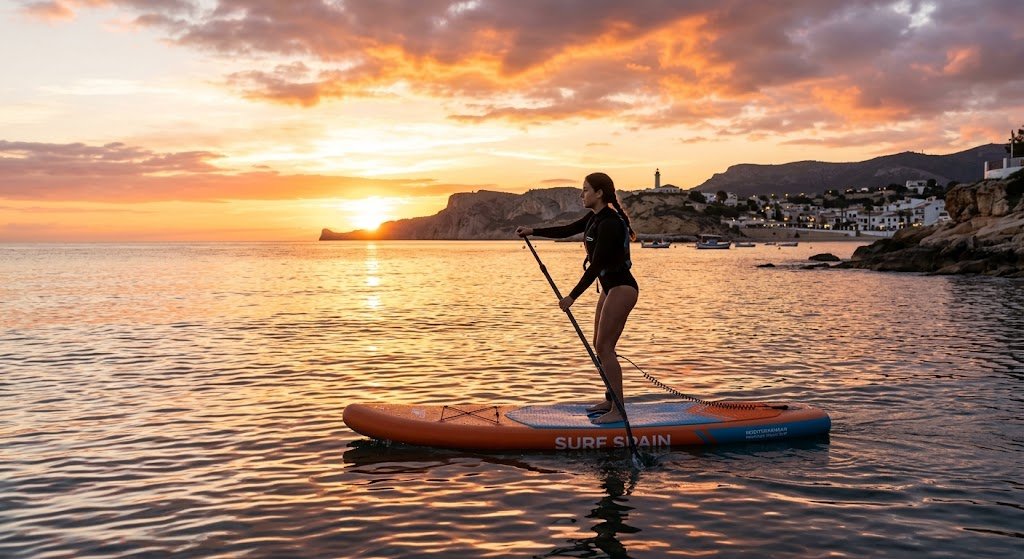
There is a moment on the Mediterranean that no photograph truly captures — the precise instant when the first orange light breaks over the Sierra del Cid mountains and sets the flat, glassy sea ablaze with amber and gold. For members of the FreeWIND community, this is the reason to set an alarm at 06:00 AM and drive to the coast before the rest of the world wakes up. Sunrise SUP in Spain is not just a paddleboarding session — it is a moving meditation, a social ritual, and one of the most genuinely peaceful experiences the Mediterranean offers.
Why Morning is the Magic Hour on the Mediterranean
The answer lies in Mediterranean sea-breeze physics. During the night, land cools faster than the sea, meaning by pre-dawn the air over the land is cold and dense, and the air over the warmer sea is slightly warmer. These temperature gradients are small — negligible — and there is simply no thermal engine to drive wind. The sea surface sits undisturbed, built up by whatever offshore breeze (usually calm) moved across it during the dark hours.
As the sun rises, it heats the land mass rapidly. By 09:00–10:00 AM, the land temperature exceeds the sea temperature, warm air rises off the heated earth, and cool sea air rushes in to replace it. This is the virazón — the classic Mediterranean thermal sea breeze. On Costa Blanca in summer, it builds reliably from 10:00–11:30 AM, reaching 10–18 knots by midday, and often strengthening to 20–25 knots by 2–3 PM on hot days.
The window before the virazón — roughly 06:30 AM to 09:30 AM in summer — is a meteorological gift. The sea is glass. Currents are minimal. There are no powerboats, jet skis, or beach crowds. Just you, the warm pastel light, and the sound of your paddle dipping cleanly into perfectly flat water.
The Best Sunrise SUP Spots on Costa Blanca
Cala Ferris, Torrevieja
Cala Ferris (37.9421° N, 0.6924° W) faces due east and catches the first light of dawn directly on its amber sandstone cliffs and wild palm grove. Park on the road above and carry your board down the short path. The sheltered cove protects you from the light northerly that sometimes drifts along the coast at night. Once on the water, the palm trees are silhouetted against the rising sun, the sea glows in shades from deep violet through pink to gold, and every stroke of your paddle creates a V-shaped wake that ripples outward in perfect symmetry. This is the most photographed sunrise spot among FreeWIND community members.
Playa de los Locos, Torrevieja
The longest sandy beach in Torrevieja offers easy board entry and a long, flat-water corridor perfect for fitness paddles and distance sessions. Arriving before 07:00 AM, you will share the sea only with local swimmers doing their morning laps and possibly a small fishing boat heading out. The distinctive pink water of the nearby salt lake (Laguna Rosa) is visible from the sea, creating an extraordinary colour contrast. An easy 3 km out-and-back paddle makes this ideal for early-morning cardio sessions.
Cabo Cervera Headland
Launching from the small rocky inlet at Cabo Cervera and paddling the sea caves and arches to the north at dawn is an otherworldly experience. The low angled light cuts into the sea cave mouths, illuminating the underwater rocks in electric turquoise. Schools of striped sea bream are visible in the shallows. The watchtower silhouette against the brightening sky makes for outstanding photographs. This route requires slightly more experience due to the rocky entry point, but rewards with scenery unavailable at any other time of day.
Safety During Low-Light Morning Paddles
Paddling at dawn introduces specific safety considerations that mid-morning sessions do not. The most important is visibility. You are on dark water, in reduced light, and you may encounter early-morning fishing vessels and small motorboats that are looking ahead into the rising sun — not behind them at dark water. Make yourself visible:
- LED headlamp or chest light: A red or white flashing LED worn on your body or attached to your leash makes you visible from 200+ metres.
- Reflective accents on your board: Many boards and paddles have reflective strips. Supplement with reflective tape if yours does not.
- Bright board or clothing colours: Yellow, orange, and lime green boards are far more visible than navy, grey, or clear inflatable boards in low light.
- Sound signal: Carry a whistle or aerosol horn. Under Colregs (maritime collision regulations), any vessel in reduced visibility must signal with sound.
- Paddle with a partner: Solo dawn paddling carries additional risk. The FreeWIND community organises group sunrise sessions for this reason — there is genuine safety in numbers, and they are incomparably more fun.
Morning SUP Nutrition and Hydration
Early starts mean your last meal was many hours ago. Paddling on a completely empty stomach leads to early fatigue and poor concentration. A light, easily digestible pre-paddle snack 30–45 minutes before launch makes a meaningful difference: a banana, a handful of dates, or a small bowl of porridge provides quick energy without the discomfort of paddling on a full stomach.
Hydration is critical even before the heat of the day arrives. You are working muscles, breathing hard, and sweating (even in the cool morning air at exertion levels). Carry at least 750ml of water in a bungee-secured bottle or hydration bladder. Electrolyte tablets dissolved in water are particularly valuable for longer morning sessions exceeding 90 minutes.
Photography: Capturing the Golden Hour from a Paddleboard
The golden hour — the 30–60 minutes after sunrise — produces the most extraordinary natural light available to photographers. On a paddleboard, you have a unique low-water-level perspective unavailable to drone operators or beach photographers: the cliffs appear towering, reflections are immaculate on flat water, and the horizon seems impossibly wide.
Most waterproof action cameras (GoPro, Insta360) and smartphone waterproof cases work perfectly for SUP photography. Mount your camera on your paddle shaft for dynamic forward-looking shots, attach a selfie mount to your board nose for wide-angle seascapes, or simply hold your waterproof phone to capture the moment. RAW format captures maximum dynamic range in the challenging high-contrast conditions of sunrise over water.
The Social Dimension: Morning Paddle Clubs on Costa Blanca
Some of the strongest friendships in the FreeWIND community have formed at 07:00 AM on a flat sea at Cala Ferris. There is a special camaraderie among people who voluntarily rise before the rest of the world to do something they love. Morning paddle groups on Costa Blanca are informal, welcoming, and diverse — you will meet retired expats with decades of sea experience, young families fitting in a session before children wake, competitive distance paddlers training for crossing events, and beginners taking their first trembling strokes on a board.
After the paddle, the group reconvenes at a nearby beach bar for coffee, fresh orange juice, and toast with olive oil and tomáte — the essential Spanish breakfast. This post-paddle social element is, for many regulars, equally important as the paddling itself.
🧭 GUIDE & FAQ: Sunrise SUP in Spain
Q1: What time exactly should I launch for the best sunrise conditions?
In summer (June–August), sunrise on Costa Blanca occurs approximately 06:30–06:45 AM. Aim to be on the water by 06:45–07:00 AM to catch the full golden hour. In spring and autumn, sunrise times shift (05:45 AM in June, 07:30 AM in October), so adjust accordingly. The virazón sea breeze typically builds by 10:00–10:30 AM — giving you a comfortable 3–3.5 hour morning window of flat water.
Q2: Is it legal to paddleboard before official beach opening hours?
Yes. Paddling in the sea outside the designated swim zone (beyond the 200-metre buoy line) is not restricted by beach opening hours. Beach safety regulations govern swimming within the cordoned area and lifeguard operating hours — they do not restrict sea access for paddle craft. You can legally enter the water at any time of day or night, though safety considerations around visibility make solo night paddling inadvisable.
Q3: What if the sea is calm when I check the forecast but picks up while I am out?
Sea breezes on Costa Blanca can occasionally build earlier or stronger than forecast. If conditions deteriorate while you are on the water, head immediately toward the nearest land (not your starting point if it is far away). Lie down on your board to reduce wind resistance, paddle with long efficient strokes, and angle 45 degrees into the wind rather than directly against it. If genuinely unable to make progress, call 112 or use VHF Channel 16 to request maritime assistance. The Salvamento Marítimo rescue service monitors Channel 16 continuously.
Q4: Do I need a wetsuit for early morning paddling in summer?
In July and August, water temperatures reach 25–27°C and a wetsuit is unnecessary. A rash vest or long-sleeve UV shirt provides sun protection without warmth. In May, June, September, and October, water temperatures drop to 18–23°C — comfortable for active paddling but cold for extended floating. A 2mm summer wetsuit provides warmth without restricting movement. In November–April, a 3mm full wetsuit is recommended for comfortable extended morning sessions.
Q5: How do I find other paddlers to join for morning sessions?
Follow the FreeWIND blog and social channels where we share planned morning session meetups at Cala Ferris and other spots. The FreeWIND WhatsApp community group is the most immediate way to connect with local paddlers — details on the contact page. The broader maritime community on Costa Blanca can be found through seamen.es, who also facilitate connections with watersports clubs across the region.
Join the FreeWIND community at freewind.es and explore more SUP guides for Costa Blanca. For maritime services and boat support on the Spanish Mediterranean, visit seamen.es.